







Commentary: Why firms are pivoting from 'China shedding' to 'Chinamaxxing'
Some of China’s most successful global companies have spent years masking their origins to sidestep Western scrutiny. That has changed, says Juliana Liu for Bloomberg Opinion.
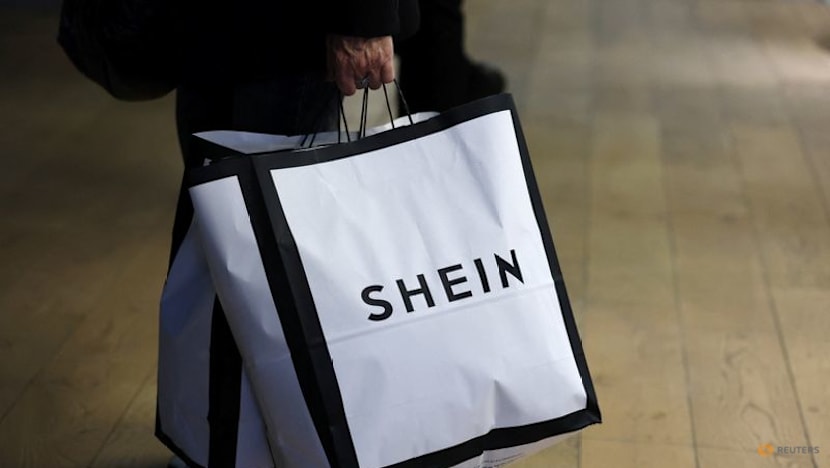
A customer holds shopping bags with a Shein logo in the first physical space of Chinese online fast-fashion retailer Shein on the day of its opening inside the Le BHV Marais department store, the Bazar de l'Hotel de Ville, in Paris, France, Nov 5, 2025. REUTERS/Sarah Meyssonnier
HONG KONG: Some of China’s most successful global companies have spent years masking their origins to sidestep Western scrutiny. But that approach, called “China shedding”, has run its course - at least for the bigger players.
The surprise homecoming of online retailer Shein’s founder should be the final nail in the coffin for the strategy. Last month, Xu Yangtian, who has been rarely photographed, took to the stage in the southern Chinese province of Guangdong to thank the local government and suppliers for helping the company to become a retail juggernaut.
Shein is now the biggest player in the global market for bargain-priced apparel, according to GlobalData, ahead of the likes of Primark and Target. Private market research firm Sacra estimates its 2025 sales at US$60 billion, which would be more than Hennes & Mauritz and Inditex’s Zara combined.
CHANGING APPROACH
Blurring ties to Beijing to minimise regulatory or reputational risk overseas was a defensive manoeuvre five years ago. At the time, telecoms equipment maker Huawei Technologies was still making headlines after being banned by Washington over spying concerns. Following that episode, Chinese firms aiming for international prominence wanted to avoid a similar fate.





Three of the most successful - social media platform TikTok and budget online retailers Temu and Shein - have all tried to distance themselves from their roots. None have succeeded. Increasing opposition from Beijing, combined with a recent vibe shift that has elevated perceptions of Chinese products suggest it would be smart for homegrown companies to be more upfront about where they’re from.
What was unusual about Xu’s first-ever public appearance is that Shein had been presenting itself as a Singapore-based fast-fashion giant, with only perfunctory mentions on its website of the region that powers its ability to churn out designs in as little as three weeks. It’s a positioning that reportedly upset the Chinese regulators who must approve its long-delayed IPO.
Another reason companies should be more honest is that China shedding was always a hard sell. Just look at TikTok, owned by Beijing-based ByteDance. No matter what it tried, the short-form video platform was unable to convince the public it wasn’t Chinese, even though it doesn’t exist in China.


Fearing a Huawei-like ban following a 2019 national security probe, TikTok hired Kevin Mayer, a former Walt Disney executive, as CEO in an effort to improve its standing in the US. The platform even left Hong Kong in 2020 to signal independence from China. To no avail. President Joe Biden’s efforts to investigate it culminated in a congressional grilling of the next chief executive, Chew Shou Zi, in March 2023.
Pressed on whether TikTok was Chinese, Chew sidestepped the question, saying only that the app was unavailable in China and based in Los Angeles and Singapore. Though Chew comported himself well, his argument was unconvincing.
The lesson? Simply downplaying Chinese ties was not enough to avoid political scrutiny. Eventually, the Trump White House brokered a deal to create a US-controlled TikTok to which ByteDance licenses its algorithm.
“CHINAMAXXING” TAKES OFF
Concern over TikTok’s future drove many young Americans to check out RedNote and contributed to a tonal shift over the past few months in how some, especially Gen Z, view China.
A trend called “Chinamaxxing” has taken over social media feeds with influencers drinking hot water, using chopsticks, or engaging in other ways of “becoming Chinese.” An association with Made in China hasn’t alienated the wider US public, despite tough talk.


Last year, during the height of the US-China tensions, President Donald Trump ended a long-standing tariff exemption on goods under US$800 that had propelled the fortunes of Temu, owned by PDD Holdings, and Shein. But while the active users of both online shopping sites fell, they eventually recovered, with Shein bouncing back especially quickly, according to market intelligence firm Sensor Tower.
In fact, trade volatility hasn’t hurt the seller of US$1 eyebrow shapers and US$4 wax strips at all.
Shein raised its US prices before tariffs on small packages were imposed, which is expected to have helped its net income hit US$2 billion in 2025, nearly double the year before, Bloomberg News reported.
Smaller companies may still be able to fly under the radar with China shedding. Not so for the global heavyweights for which honesty would be the best policy.






