







Commentary: Tiger Beer does not need to be brewed locally to be a Singapore icon
Local brand Tiger Beer is marketed as an international one and run like the global business it has become, says SUSS marketing professor Lau Kong Cheen.

Tiger beer advertisement posted outside a coffee shop in Singapore on Sep 28, 2012. (File photo: AFP/Roslan Rahman)

This audio is generated by an AI tool.


SINGAPORE: For many in Singapore, Asia Pacific Breweries Singapore’s (APBS) announcement on Mar 24 that it will cut about 130 jobs and relocate all of Tiger Beer’s production to Malaysia and Vietnam might have hit harder than a typical business restructuring.
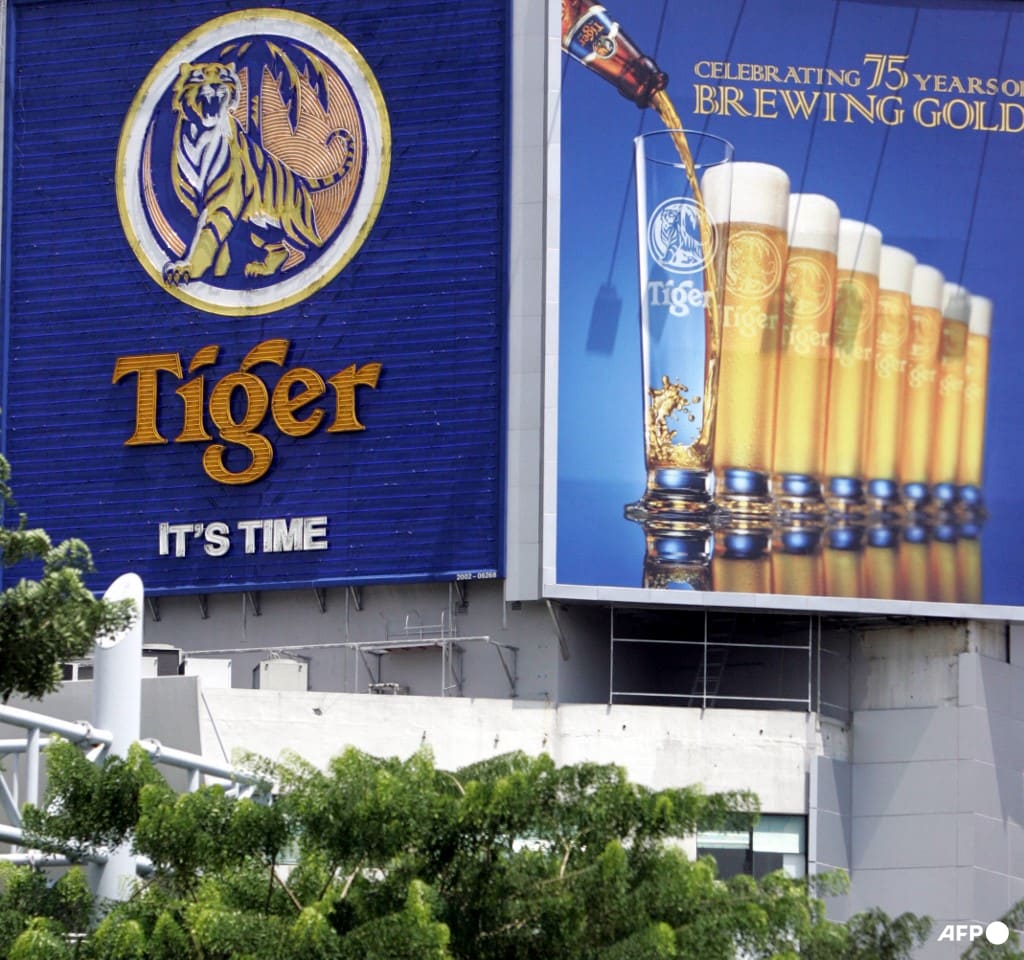
Early millennials and those before them will fondly recall the brand’s iconic advertisements, from the classic “Give the man a Tiger” to the catchy “It’s Tiger Time”. Older generations who grew up near Alexandra Road may still recall the distinctive aroma of barley and hops from the local brewery, before it relocated to Tuas in 1990.
Conceived in 1932, Tiger Beer has woven itself into Singapore’s historical narrative and national identity. Its presence across hawker centres, coffee shops, local restaurants and international bars is unmistakable.
Rising costs of energy, water and manpower have long challenged large-scale brewing in Singapore, despite heavy investments in automation. APBS owner Heineken’s regional expansion has created lower-cost production alternatives and a more efficient supply chain, rendering this relocation a strategic necessity to remain competitive.





So as production moves abroad, it raises a question that extends far beyond economics: Can Tiger Beer remain authentically Singaporean if it is no longer brewed here?

A SYMBOL OF NATIONAL PRIDE
As much as Tiger Beer is undeniably a local brand, it has long been marketed as an international one.
Tiger Beer is one of Singapore’s earliest global consumer brands, now exported to more than 60 markets worldwide. Over the decades it has earned numerous international accolades and forged a reputation for quality, positioning itself as a cosmopolitan Asian beer rather than a purely local one.
The spread of its paw prints across the globe has distinguished it as a symbol of modernity and national pride. Whether in a London pub or a New York bar, Singaporeans travelling overseas often take pride in identifying the brand as a homegrown icon.
Tiger Beer has also not been Singapore-owned for more than a decade. The brand has been under Dutch ownership since 2012, when local conglomerate Fraser and Neave (F&N) sold its stake to Heineken.
Moving production could be seen through the lens of Tiger Beer being run like the global business it has become.

REALITY OF A GLOBAL MARKET
Some critics worry that shifting production from Singapore will dilute Tiger Beer’s identity and dampen its appeal. Yet global precedents suggest otherwise.
Foster’s remains seen as Australian despite no longer being brewed in its country of origin. Guinness consumed in this region is brewed in Malaysia and yet continues to be regarded as quintessentially Irish. Manufacturing location only becomes central when geographical origins are legally protected or deliberately woven into the brand narrative. Take Moet & Chandon and other brands of champagne, which cannot be made anywhere other than France’s Champagne region.
That is not the case for Tiger Beer. Its reputation rests on its exotic yet cosmopolitan charm, brand positioning and accolades rather than its Singaporean brewing base.
For many Singaporeans, their perception of Tiger Beer is unlikely to change much. If they already embrace it as an international brand with foreign ownership, where it is brewed will probably not matter so long as Tiger Beer tastes the same, maintains its quality and still feels like part of local life.
For tourists seeking the novelty of a local beer, the Singapore heritage should continue to pique curiosity, even if brewed elsewhere. Globally, consumers care less about production location and more about the lifestyle associations and image that shape consumption.
This reflects the reality of a globalised market: Nike shoes are rarely made in the United States, Toblerone chocolate is produced outside Switzerland and Coca-Cola outsources bottling worldwide but remains a symbol of American identity. Tiger Beer fits this pattern.
ENSURING AN ENDURING ASSOCIATION WITH SINGAPORE
APB has emphasised that Singapore remains the home of Tiger Beer. To ensure this association endures, several strategies are key.
The company will retain its headquarters here and invest in innovation and pilot brewing facilities. This should continue to generate high‑value jobs, keep core brand-related decision‑making rooted locally, and reinforce the brand’s heritage in the country.
The company should continue to highlight Tiger Beer’s Singapore roots in its brand narrative. But “Born in Singapore, enjoyed worldwide” could remain hollow words unless it continues investing in its local cultural presence.
Guinness offers another comparison point: Though it is brewed in over 50 countries, the brand has invested heavily in Irish cultural associations – the pint, the pub, the mythology.
For example, heritage storytelling can be deepened through local campaigns, a Tiger Beer museum, maintaining the iconic Tiger Tavern in the Tuas brewery or perhaps even recreating it elsewhere on the island. Collaborations with local F&B, involvement in local festivals and events and other community engagement would anchor its identity in local life.


It will also have to continue adapting to shifting lifestyles, including younger Singaporeans with different consumption habits and less attachment to Tiger Beer's legacy given their access to global beer choices.
Tiger Beer’s journey reflects the realities of globalisation: Production may shift, but identity endures. Business has gone from selling a beer to selling a brand experience.
In this context, the physical relocation of a brewery is far less critical than the endurance of the brand’s story – a symbol of national pride for Singapore; an icon of Asian cosmopolitanism for global consumers. Singapore can proudly say: Give the world a Tiger!
Associate Professor Lau Kong Cheen is head of the marketing programme at the Singapore University of Social Sciences’ (SUSS) School of Business.





