Commentary: How Southeast Asia might change the way it engages an increasingly disruptive America
The impetus for engaging Washington in Southeast Asian affairs may be shifting from pragmatism to prevention, says Kevin Chen from the S Rajaratnam School of International Studies.
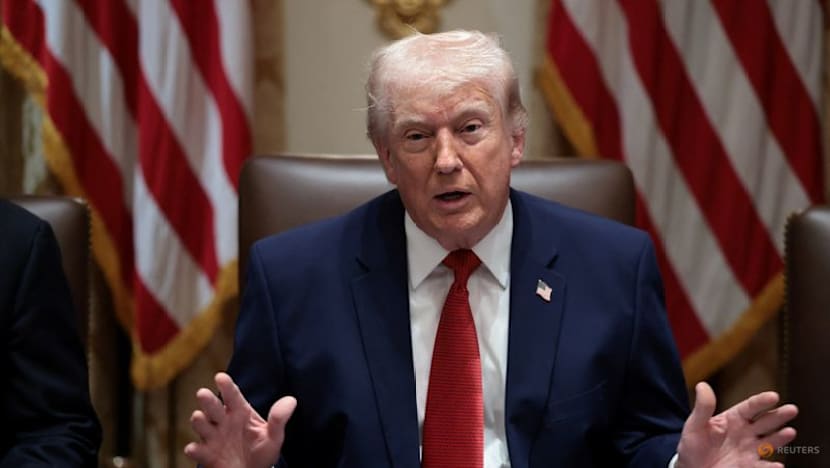
US President Donald Trump holds a cabinet meeting at the White House in Washington, DC, US, Mar 26, 2026. REUTERS/Evelyn Hockstein

This audio is generated by an AI tool.


SINGAPORE: For years, the United States’ relationship with Southeast Asia was anchored on the belief that the US helped to maintain a stable environment in which regional economies could prosper. Engaging Washington ensured its continued participation in this region.
Therefore, it came as a shock when Singapore Foreign Minister Dr Vivian Balakrishnan called the US a “revisionist power” in a Reuters interview in March. This term is used to describe an actor that seeks to fundamentally disrupt the status quo – and one that US President Donald Trump himself has called China and Russia.
Given events that have unfolded relentlessly in Mr Trump’s second term – from tariffs, threats over Greenland, to war in Iran – other political leaders seem to have made similar diagnoses. French President Emmanuel Macron evoked “de-risking” from all big powers at the Munich Security Conference in February, using language previously reserved for China.
Yet, a revisionist power is still a power in its own right, and it is not feasible to entirely shun them. A key question, therefore, is how governments in Southeast Asia are engaging an increasingly disruptive America.





The short answer? Engagement is becoming less about pragmatism and increasingly about preventing a worst-case scenario.
PRAGMATIC COOPERATION WANING
Countries still have something to gain from engaging with Washington – but they are becoming more selective in how they engage.
Initiatives that ostensibly validate Mr Trump’s foreign policy actions, especially militaristic overtures in Iran and Venezuela, are beyond the pale for many governments.
While most Southeast Asian countries were invited to join the Board of Peace, for example, only three – Indonesia, Cambodia and Vietnam – agreed. Even then, Indonesia’s government has had to clarify their involvement with the Board amid domestic opposition.
On the other hand, governments seem to have fewer qualms about joining initiatives that revolve around securing supply chains.
Days before Dr Balakrishnan’s interview, 16 countries, including Singapore, participated in the annual meeting for the Partnership for Indo-Pacific Industrial Resilience. This US-led grouping may have a clear goal of helping the US prepare for a regional conflict, including by establishing radar repair facilities in Australia. However, it also promises to build defence industrial capacity, including drone technologies and diversified supply chains for missile components.
The same can be said for initiatives such as the Forum on Resource Geostrategic Engagement (FORGE), which aims to counter China’s control of critical mineral supply chains. Representatives from over 54 countries gathered in Washington DC, in February to discuss initiatives such as a preferential trading zone for critical minerals. These included parties that have rocky ties with Washington, such as the European Union.


Yet, an undeniable caveat concerns the initiatives that the US has abandoned in recent years. Notably, the US has pulled out of over US$3 billion in commitments for the Just Energy Transition Partnerships with Indonesia and Vietnam, failed to live up to infrastructure initiatives such as the US$600 billion Partnership for Global Infrastructure and Investment, and withdrawn from the Trans-Pacific Partnership. The Biden-era Indo-Pacific Economic Framework (IPEF) is all but defunct as well.
Simply put, the US track record for following through on its own initiatives leaves much to be desired. Countries may be willing to cooperate with the US, but they are likely clear-eyed about the possibility of the initiatives failing to deliver.
PREVENTIVE COOPERATION RISING
As US credibility wanes, an interesting counterpoint is that concerns about Washington’s disruptive instincts have risen. Cooperation is not only about deriving benefits, but preventing worse consequences that emerge from letting Washington’s unilateral actions play out.
This is especially so under the second Trump administration and its penchant for tariffs. The US has not had a positive trade agenda for the region since it withdrew from the Trans-Pacific Partnership in 2017. Even so, countries cannot afford to ignore Mr Trump’s disruptive trade agenda, given the size of the US market and his threats to weaponise it with tariffs.
Initially, Southeast Asian governments responded to his tariffs with offers of investments and purchase deals. Malaysia, for example, agreed to spend over US$240 billion in purchases and investments. Indonesia pledged to buy US$33 billion worth of American goods. These were seen as the price of doing business with Mr Trump’s America.


Now, however, this approach appears to be in limbo. The Supreme Court’s overturning of the Liberation Day tariffs raised questions about the sanctity of the trade deals that the US made with Cambodia, Malaysia and Indonesia. In fact, there is ongoing confusion in Malaysia about the status of their deal with the US. The announcement of the Section 301 investigations into excess capacity and forced labour raised further questions about the value of entering deals with the US when they can be broken so easily.
Public hearings for the Section 301 cases will occur in late April and early May. Accused Southeast Asian countries are expected to attend the hearings to plead their cases, though it is unclear what they will offer or promise to earn Washington’s favour.
A NEW ANCHOR FOR US-SOUTHEAST ASIA TIES?
Overall, countries are choosing to continue engaging a “revisionist” Washington, whether in pursuit of potential benefits through pragmatic arrangements or to mitigate disruptive outcomes from tariffs.
Pointing out that countries are embarking on diversification efforts to reduce their vulnerabilities in response to these challenges has almost become a cliche.
A question for the future, however, is what happens if engagement with Washington becomes largely aimed at preventing negative outcomes instead of encouraging positive results.
Such an arrangement could create a new impetus for Southeast Asian engagement with Washington. Yet, it could also make the relationship between this region and Washington exceedingly fragile. Governments would be far less patient with a disruptive and belligerent actor, especially if there are few upsides to persevering in that relationship.
Kevin Chen is an Associate Research Fellow with the US Programme at the S Rajaratnam School of International Studies (RSIS), Nanyang Technological University (NTU), Singapore. He writes a monthly column for CNA, published every first Friday.