Commentary: Middle power pragmatism underpins Canada’s outreach to India and China
US President Donald Trump’s upending of long-held alliances has made Canada realise that it must engineer new frameworks to survive the disintegration of the world order, says former foreign correspondent Nirmal Ghosh.
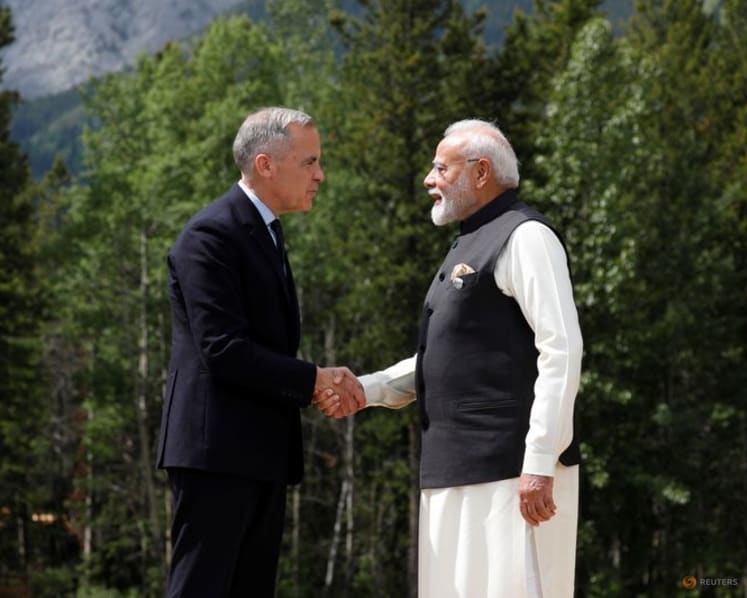
Canadian Prime Minister Mark Carney and Indian Prime Minister Narendra Modi shake hands during the G7 Leaders' Summit in Kananaskis, Alberta, Canada, Jun 17, 2025. (Photo: REUTERS/Amber Bracken)

This audio is generated by an AI tool.


SINGAPORE: Canadian Prime Minister Mark Carney’s recent visits to China and India yielded a flurry of agreements, with some reports describing the trips as a “reset” in bilateral relations.
But these were more than routine diplomatic engagements. Beyond efforts to repair troubled relationships, they signalled a broader intent – to step out of the shadow of Canada’s giant southern neighbour, the United States.
US President Donald Trump’s upending of long-held assumptions of alliances, as well as claims to Canada and Greenland, has made Ottawa realise that it must engineer pragmatic new frameworks if it is to survive the disintegration of the world order.
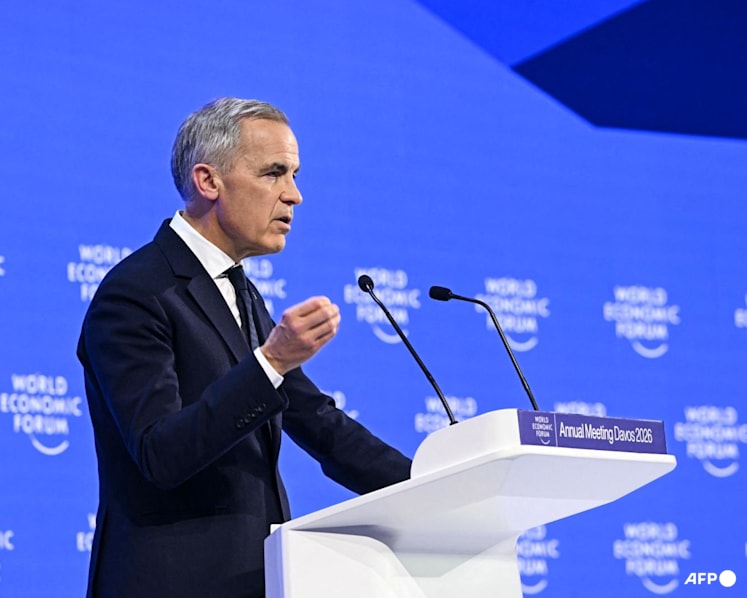
In a now widely referenced speech delivered at the World Economic Forum in Davos in January, Mr Carney said the old world order was not coming back and urged middle powers to “act together because if we're not at the table, we're on the menu”.





LINGERING SUSPICIONS
The outcomes of Mr Carney’s trips to China and India reflected that urgency.
His visit to China in January concluded with 21 agreements in fields from clean energy to agriculture, alongside all the right noises about expanded people-to-people connections.
In India, the Canadian prime minister's visit earlier this month produced agreements on supply chains for clean energy, electric vehicles and advanced manufacturing. Both sides also agreed to accelerate progress on a Comprehensive Economic Partnership Agreement to double bilateral trade.
But calling Canada’s new frameworks with China and India “resets” may somewhat overstate the case, because underlying tensions have not gone away.
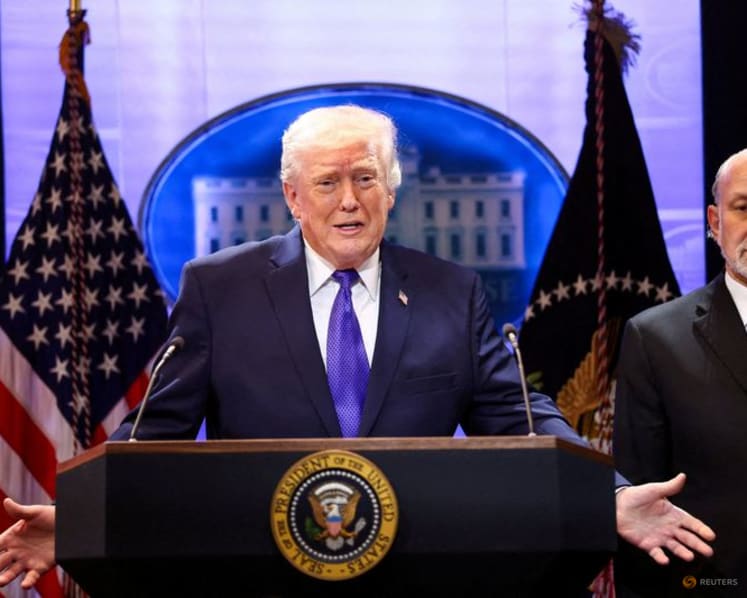
In India’s case, vocal Khalistan separatist voices – which seek the creation of an independent Sikh homeland in northern India - in Canada remain an annoyance for New Delhi.
In Canada’s domestic political landscape, the Sikh vote is important, while advocating the Khalistan cause falls under protected speech in Canada. But Ottawa will need to ensure that this does not rise to the level of jeopardising a relationship which has assumed more importance in the larger context of Canadian foreign policy.
India must also not overreact to Khalistan separatist advocacy in Canada, although this will be difficult as the scar of the Khalistan insurgency in the 1980s – which spawned terrorism, bloody battles and the killing of Prime Minister Indira Gandhi – runs deep and suspicion remains.
Diplomatic relations plunged in 2023 after then-Canadian Prime Minister Justin Trudeau accused Indian government agents of playing a role in the killing of Canadian Sikh activist Hardeep Singh Nijjar in British Columbia. This was strongly denied by India.
The issue remains unresolved, but both governments have decided to let it be, according to veteran Canadian journalist Terry Milewski who wrote the 2021 book “Blood for Blood: Fifty Years of the Global Khalistan Project”.
“They’re just going to have to go with the undecided… dispute in the background,” he told Indian news channel ANI in January.
In China’s case, the two countries will also need to put some issues behind them.
The 2018 detention of Huawei chief financial officer Meng Wanzhou in Canada, on a US request, infuriated Beijing. In what was widely seen as a tit-for-tat action, two Canadians were subsequently arrested in China under state secret laws. All three individuals returned to their home countries, but the episode strained the bilateral relationship.
Ties were further tested in 2024, when trade disputes saw both sides imposing tariffs on one another.
In the backdrop of a changing world, Mr Carney’s trip to China was not simply about stabilising relations, according to Ms Vina Nadjibulla, vice-president of research and strategy at the Asia Pacific Foundation of Canada.
“It was about signalling, and beginning to implement, a more independent Canadian foreign policy in response to fundamental shifts in the global economic and security order - and a growing recognition that Canada can no longer rely on old assumptions about alliances, global rules, predictability, or insulation from geopolitical shock, including in its relationship with the United States,” she wrote in late January.
NO PLACE FOR NOSTALGIA
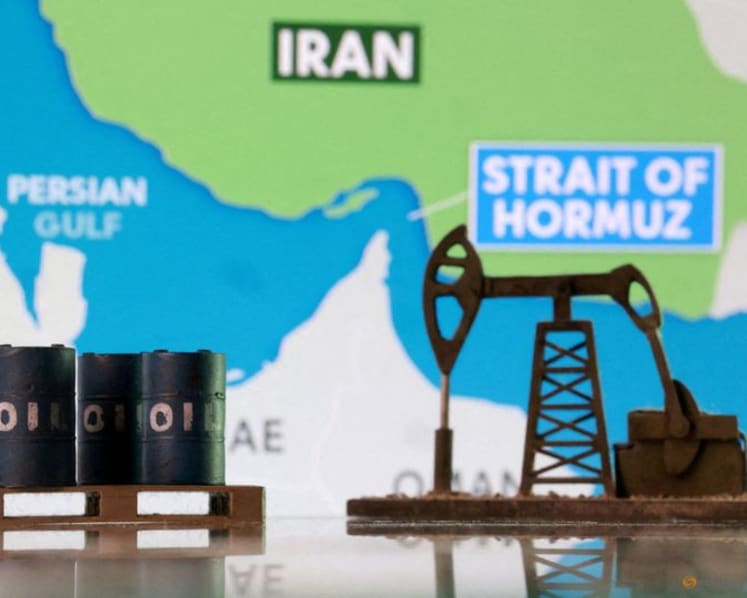
Since then, the fraying of the world order has only deepened, in the form of a war in Iran which has entered its third week and shows no clear end in sight. Amid that, Mr Trump continues to pursue his tariff policy with new trade probes targeting key trading partners – increasingly leaving middle powers like Canada to fend for themselves.
This kind of “middle power pragmatism” also applies to Southeast Asian countries, which know this game well, especially since the end of the Cold War.
India, which has been actively diversifying its trade partners, most notably by finalising what has been dubbed the “mother of all deals” with the European Union, is also learning that despite being a nuclear power, it is not – or at least not yet – the great power it aspires to be.
Veteran former Singapore diplomat Bilahari Kausikan sees Canada’s foreign policy shift as trying to put into practice Mr Carney’s Davos speech.
“But in reality, this is what India, Australia, Japan, South Korea had already been doing with each other and other powers, big, middle and small, for quite some time,” Mr Kausikan told me.
As Mr Carney said at Davos, there is no place for nostalgia. Canada now finds itself in the same boat as other middle powers, sailing rough seas. It is also in the interest of other middle powers, like India, to navigate underlying tensions diplomatically.
Nirmal Ghosh, a former foreign correspondent, is an author and independent writer based in Singapore. He writes a monthly column for CNA, published every third Friday.