Commentary: Trump’s tariff war enters a riskier phase with implications for the world
The latest US trade probes are designed for a specific political purpose - to reclaim lost leverage following the striking down of the “Liberation Day” tariffs, says Kevin Chen from the S Rajaratnam School of International Studies.
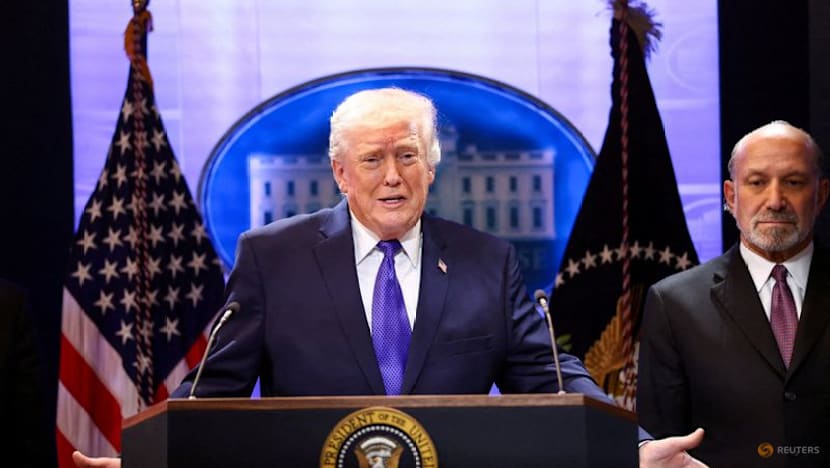
US President Donald Trump, flanked by Secretary of Commerce Howard Lutnick, speaks during a press briefing at the White House, following the Supreme Court's ruling that Trump exceeded his authority when he imposed tariffs, Washington, DC, US, Feb 20, 2026. REUTERS/Kevin Lamarque/File Photo

This audio is generated by an AI tool.


SINGAPORE: As the war in Iran enters its third week, many economic observers have understandably been focused on the situation surrounding the Strait of Hormuz. However, it is arguable that an equally significant storm is brewing in Washington.
The United States Trade Representative’s (USTR) office on Mar 11 announced that it was launching a new Section 301 trade investigation on excess industrial capacity against 16 trading partners, including China, the European Union, Singapore and five other Southeast Asian countries.
This was followed hours later by the announcement of another probe into 60 economies – including Singapore – over failures to take action on forced labour.
These investigations are clearly a move by US President Donald Trump to restore the “Liberation Day” tariffs that were struck down by the US Supreme Court in February. Mr Trump had moved swiftly to announce a new 10 per cent global import duty under a separate legal justification, but that was an interim measure that will expire in July 2026.





PROBES UNDER SECTION 301
Section 301 of the US Trade Act of 1974 grants the USTR the power to respond to “unjustifiable” and “unreasonable” foreign trade practices in ways such as tariffs.
Recent past administrations have tapped on the legal justification to investigate trade practices. For instance, Mr Trump, during his first term, used a Section 301 probe to back his tariffs on many Chinese imports of about 25 per cent.
However, its current invocation dwarfs earlier investigations in terms of scale.
In the probe into excess capacity, USTR essentially argues that 16 countries are intentionally producing more goods than their domestic economies can consume and placing unfair pressure on US manufacturing. The federal register notice for the investigation specifically accused countries that had “large or persistent trade surpluses, as well as underutilised and unused capacity” in manufacturing.

That said, the allegations appear to be based on questionable grounds.
An earlier version of the USTR notice highlighted Singapore as having a US$27 billion trade surplus in both goods and services with the US in 2024. This was disputed by Singapore’s Ministry of Trade and Industry, which pointed to US government data that showed Singapore had a US$27 billion trade deficit with the US in 2024.
A subsequent version of the USTR notice removed the claim, though it maintained that Singapore has “large or persistent trade surpluses” that contributed to global manufacturing overcapacity.
Questions also surround the forced labour investigation. The USTR asserts that even though countries such as Canada and Mexico have adopted measures to stop the sale of products made using forced labour, such measures are “insufficient” and result in US firms being unfairly exposed to “artificially low-cost imports”.
For one, the fact that the list of 60 countries under investigation is made up of US’ key trading partners and excludes countries that the US government has previously criticised for using forced labour, such as Laos and Myanmar, casts doubt on the allegations.
The timeline appears to be accelerated as well, with public hearings for the excess capacity probe scheduled between May 5 and May 8, and Apr 28 to May 1 for the forced labour investigation. In either case, it would be challenging for all affected countries to plead their cases within four working days.
A POLITICAL PURPOSE AND WHAT IT MEANS FOR SINGAPORE
So far, the signs point to the latest trade investigations being designed and accelerated for a specific political purpose: to reclaim lost leverage following the striking down of the “Liberation Day” tariffs.
Amid confusion over whether the tariffs and previously negotiated trade deals were still valid, Washington is likely seeking to maximise their bargaining leverage. The point is not the strength of the accusations, but the fact that countries would be compelled by the investigations to return to Washington to negotiate for better terms.
This apparent “maximum pressure” approach to the Section 301 investigations could have severe implications for countries, such as Singapore.
When the US previously threatened tariffs on key industries such as semiconductors and pharmaceuticals, Singapore was able to use the rationale that Singapore-based companies were investing or planning to invest in the US to escape the worst of the tariffs. However, it is no longer clear that this shield will hold up against the new Section 301 investigations.
The implications of these investigations would be unlike last year’s “Liberation Day” tariffs.
Under the earlier tariff regime, it was relatively easy for a country to remain competitive if it secured a lower tariff rate than its neighbours. With existing Section 301 tariffs varying from 7.5 per cent to 100 per cent depending on the product, it will be much more difficult to discern what is a relatively competitive rate.
Things are further complicated if one considers the Section 232 investigations into specific sectors, such as steel and aluminum, for national security reasons. Countries would be incentivised to pursue the lowest rates possible – and Washington would be incentivised to demand more in return.
While the growing implications of the blockade in the Strait of Hormuz in fuel, fertilisers and other sectors present a critical economic challenge, it is important not to lose sight of this brewing storm around the corner. Mr Trump’s tariff war is entering a new, riskier phase.
Kevin Chen is an Associate Research Fellow with the US Programme at the S Rajaratnam School of International Studies (RSIS), Nanyang Technological University (NTU), Singapore.