







Commentary: Iran war has shattered the Gulf’s image as an oasis
The image of a safe haven focused on economic growth in a turbulent region had been carefully nurtured over decades, says NUS Middle East Institute’s Carl Skadian.

This audio is generated by an AI tool.


SINGAPORE: Oil prices are rising with the Strait of Hormuz effectively closed. An American submarine sank Iran’s warship off the Sri Lankan coast. NATO defences intercepted an Iranian missile headed towards Türkiye.
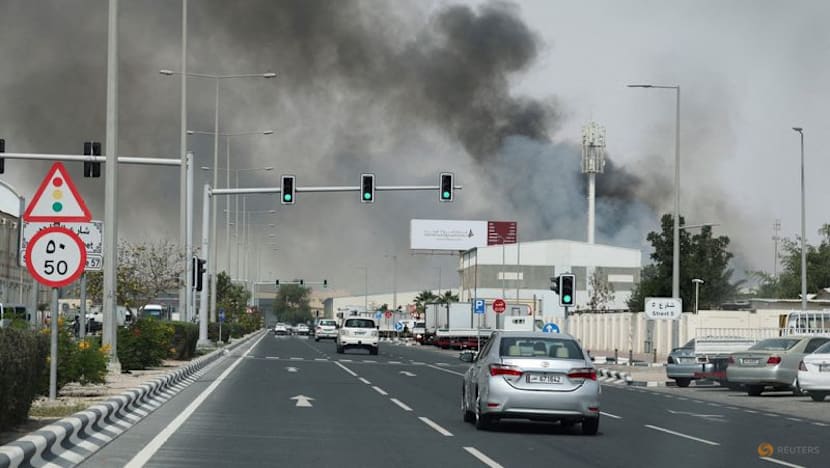
Lost in this avalanche of developments since the United States and Israel began hitting Iran on Feb 28 is another story with far-reaching consequences for the region: one captured by the iconic Burj Al Arab building on fire and a smoke-filled Dubai International Airport.
The videos and images that have emerged from every one of the six Gulf Cooperation Council (GCC) nations – Bahrain, Kuwait, Oman, Qatar, Saudi Arabia and the United Arab Emirates – tell a singular story: The Gulf’s years-long effort to portray itself as an oasis of tranquillity focused on economic growth in a turbulent region is now smouldering, along with its airports, oil facilities and symbols of prosperity.
As importantly, so is its effort to seek an accommodation with Iran as a vital part of its economic transformation programmes.
SPREADING PAIN TO AMERICA’S ALLIES
It was a given that American bases hosted in the GCC countries would be prime targets for retaliation by the Islamic Republic once it was attacked. But the general consensus among analysts and officials was that airports and other civilian areas would be spared.
That has not been the case. What is even more surprising is where some of these civilian targets were: Qatar and Oman.
Qatar – perhaps Iran’s closest friend in the region – was never likely to be spared, as it hosts Al Udeid Air Base, the US’ largest military facility in the Middle East. But Hamad International Airport in Doha, a major hub, would have been thought safe from a direct strike, yet it was targeted by Iranian missiles, which were thwarted.
Oman is an even more baffling target: Muscat was the active go-between between Washington and Tehran in the negotiations that stalled on the eve of the war, and has a reputation as the region’s honest broker. Iran may have considered the sultanate a legitimate target – Duqm Port serves as a logistics node for US forces, while the relatively less relevant Salalah was also hit – but it is hardly the sort of treatment to mete out to a trusted intermediary.
Iran’s strategy appears clear: Spread the pain far and wide in the belief that America’s Gulf allies will make appeals to Washington to dial things down.
THE GULF’S SHATTERED IMAGE AS SAFE HAVEN
The pain has certainly been felt. Whatever illusions businesses and tourists have harboured regarding the GCC as a safe haven have certainly been undermined, at the very least.
The relief expressed by Singaporeans on the first flight out of Dubai to Changi Airport since the war began speaks volumes, as does the fact that most of those interviewed said they had been in the region for business. As more flights are mounted, similar scenes will play out across the world, testimony to the allure of the Gulf as a place to make money.
That image has been carefully nurtured since the various transformation plans were rolled out decades ago, beginning with Oman’s Vision 2020, launched in 1995. Plans launched later, including Saudi Arabia’s Vision 2030, drew much more attention, as much for their boldness as for the opportunities they presented.
Thus far, the results of these transformation drives have been mixed – sparkling in some areas, moribund in others. Tensions within the GCC, including the blockade of Qatar and the rivalry between Saudi Arabia and the UAE, which broke into the open in late 2025, did not help. Despite this, the Gulf has generally developed a reputation as a business-friendly region and is attractive to global talent and the rich and famous cognoscenti alike.
But when the current conflict ends, the visuals of missiles streaking overhead and drones slamming into commercial buildings will provide a major new challenge to the GCC, one arguably more difficult to overcome. “Capital loves stability”, after all, is an old chestnut, perhaps overused, but nonetheless still binding.
WILL THE GULF JOIN THE FIGHT?
The other pile of rubble in the corner is the efforts by the Gulf states to turn away from confrontation with Iran and engage it, a drive sparked by the desire for stability.
The most notable example of this was the 2023 agreement to normalise relations between Riyadh and Tehran, after a particularly fractious period that began in 2016 with the execution of a cleric in Saudi Arabia and eventually led both sides to cut off ties.
These moves were not made because of a newfound affection that developed across the Persian Gulf, but rather from a pragmatic calculation that détente would deliver the stability the Gulf states coveted. The underlying issues that characterised the rivalry between both sides have never gone away.
The attacks on the Gulf states, particularly those on civilian targets, have reignited tensions. In the wake of the Iranian strikes, the GCC collectively issued a statement condemning the strikes, adding that they retained the right to respond.
Several countries, most notably Qatar and Saudi Arabia, did not rule out the use of force, even if they did not explicitly threaten it. Anwar Gargash, the diplomatic adviser to the UAE President, went further, saying military retaliation is “definitely” on the table.
Remarkably, an oft-underreported element was also dragged into the fray. In September last year, Saudi Arabia and Pakistan signed a Strategic Mutual Defence Agreement.
Most paid scant attention to the pact, even though it paired the Saudis with a nuclear-armed state in what was seen as a binding security arrangement. Indeed, when asked if Pakistan’s nuclear capabilities would be extended to Saudi Arabia, Islamabad’s Defence Minister Khawaja Asif said they would, though he later backtracked.
The question of a mutual defence treaty came up again this week, when Pakistan’s Foreign Minister Ishaq Dar said he warned Iran against attacking Saudi Arabia. Referencing the pact, Mr Dar said it helped keep missile or drone attacks against the kingdom “to a minimum”.
WARY OF IRAN AND ISRAEL
The net result of all this is that Iran’s actions have restored it as the GCC’s most immediate, and serious, rival. The anger from the Gulf states over Tehran’s choice of targets is palpable and has left rapprochement in ruins.
Whether there will ever be a level of trust that allows them to restart attempts to find an accommodation with their neighbour across the waterway – or if there will even be an incentive to do so – remains an open question.
That leaves the Gulf nations in a decidedly disadvantageous position: wary of both their neighbour to the east, and the one to the west, Israel.
Ever since the Oct 7, 2023, Hamas terrorist attacks, Israel has adopted an increasingly muscular disposition, attacking its enemies at will, no matter the reputational cost. This was most vividly displayed by its strike on Qatar – a country with which it shares useful working channels, despite the absence of diplomatic ties – in September last year.
This has made other Middle Eastern countries nervous. Into this already choppy harbour now sails Iran, towing more instability in its wake.
Carl Skadian, a former journalist and editor for 30 years, is deputy director at the Middle East Institute, National University of Singapore.




