China's economy grew 5% last year, among slowest in decades
China's fourth quarter GDP grew to 4.5 per cent from a year earlier, marking a three-year low and a slowdown from 4.8 per cent in the third quarter as domestic demand softened.
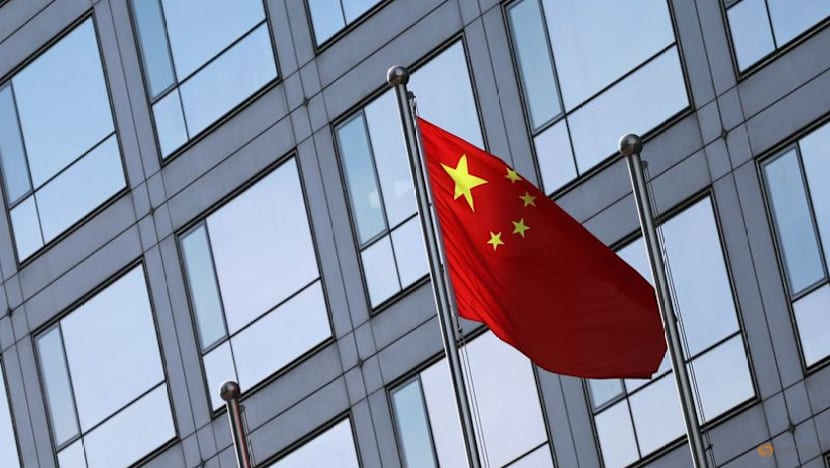
A Chinese flag flutters outside the China Securities Regulatory Commission (CSRC) building on the Financial Street in Beijing, China February 8, 2024. REUTERS/Florence Lo
BEIJING: China's economy grew at one of the slowest rates in decades last year, according to official data released Monday (Jan 19), as officials struggle to overcome persistently low consumer spending and a debt crisis in the country's property sector.
While the 5 per cent expansion was in line with Beijing's annual target - a low-ball figure analysts have likened to a political comfort blanket - observers warned it was driven largely by exports and masked weak sentiment on the ground.
Analysts had forecast 4.9 per cent growth, and the economy grew 5.0 per cent in 2024.
Gross domestic product (GDP) in the fourth quarter slowed to a three-year low as domestic demand softened, and while the full-year pace hit Beijing's target, trade tensions and structural imbalances pose significant risks to the outlook.
China's economy grew 4.5 per cent in the fourth quarter from a year earlier, data from NBS showed on Monday, slowing from the third-quarter's 4.8 per cent pace as consumption and investment dragged.





Analysts polled by Reuters had forecast fourth quarter GDP would expand 4.4 per cent from a year earlier.
The world's second-largest economy showed remarkable resilience in 2025, helped by smaller-than-expected US tariff hikes and exporters' efforts to diversify away from the United States, allowing policymakers to keep stimulus to modest levels. But demand at home further weakened since late last year as confidence has remained low amid a prolonged property crisis.
"The impact of changes in the external environment has deepened," said National Bureau of Statistics (NBS) official Kang Yi.
China's mighty manufacturing machine provided the much-needed economic lift. The nation last week reported a record trade surplus of nearly US$1.2 trillion in 2025, driven by booming exports to non-US markets as producers diversified to offset tariff pressure from Washington.
Last year, China's inroads into global markets went further than ever before, leading to a record trade surplus of US$1.2 trillion, 20 per cent higher than in 2024 and equivalent to the size of a top 20 economy, such as Saudi Arabia.
While shipments to the US fell by a fifth, they rose sharply to the rest of the world as producers conquered new markets to insulate themselves from US President Donald Trump's aggressive tariff policies to counter Beijing's challenge to American hegemony.
"We're doing well in Europe and Latin America and we don't need that market," said Dave Fong, who co-owns three factories in southern China making everything from school bags to climbing gear and industrial machinery. About 15 per cent of his orders used to come from the US, but that's now down to a trickle.
But the reliance on external demand underscores vulnerabilities in China's economy, which is grappling with weak domestic spending amid a prolonged property slump and persistent deflationary strains.
On a quarterly basis, GDP grew 1.2 per cent in October to December, compared with a forecast 1.0 per cent increase and a 1.1 per cent gain in July-September.
Policies and measures to boost consumption would continue into 2026, Kang noted, including a trade-in scheme for old household appliances.
"The gradual implementation of policies to clear unreasonable restrictions in the consumption sector will support consumption growth," he said.
CHINA'S DOMESTIC ECONOMY ENTERS "COLD WINTER"
But the success of China's export-oriented manufacturers contrasts with persistent weakness in the domestic-focused parts of the economy. Monday's data underscored that divergence: industrial output rose 5.9 per cent in 2025, outpacing retail sales' 3.7 per cent growth, while property investment slumped by 17.2 per cent.
And unless Beijing is able to redirect resources towards consumers and lift the sectors depending on Chinese spending at home, future economic growth risks slowing sharply, analysts say. While China is expected to target a roughly 5 per cent pace again this year, a Reuters poll predicted 2026 growth at 4.5 per cent.
Relying on exports for growth in the longer run is hardly an option. If China's trade surplus were to grow every year at the same rate it did in 2025, it would match the size of France's roughly US$3 trillion economy in 2030 and Germany's US$5 trillion output in 2033, Reuters calculations show.
"It’s hard to imagine how the trade surplus could continue to expand at this clip indefinitely into the future, if only because that would incur a wider protectionist backlash abroad," said Christopher Beddor, economist at Gavekal Dragonomics.
China's economic development in 2025 was "hard-won", said Kang Yi, the NBS head on Monday.
"The domestic contradiction of strong supply and weak demand is prominent, and there are still many old problems and new challenges in economic development," he told a news briefing.
Fixed-asset investment shrank 3.8 per cent in 2025, the first annual drop since data became available in 1996 - a sign that local governments are under pressure to reduce debt rather than build new roads and bridges, their usual growth playbook.
Private investment also fell 6.4 per cent as businesses see little reason to expand in an economy marred by overcapacity, where households prefer to save rather than spend.
Scott Yang, who owns a factory making pipe-fitting valves used in real estate and infrastructure projects in eastern China, feels the domestic strains first-hand.
"If real estate is doing poorly, the impact on our whole industry is very large. Same for infrastructure," Yang said.
"It's hard to quantify, but qualitatively this winter feels piercingly cold."
Yang said he felt he had no solutions, especially without funds to upgrade the factory's products: "If our profits in the past few years weren't very good, where would the investment come from?"

BEIJING FACES PRESSURE TO STIMULATE DEMAND
To help small businesses like Yang and ease credit access across the economy, the central bank announced on Thursday a targeted monetary policy easing package, including a new 1 trillion yuan (US$144 billion) programme for private enterprises.
But analysts say credit supply has been ample for years and demand is the missing piece.
Beijing's demand-side policies so far include incremental annual increases on minimum pensions and other welfare items, such as childcare or tuition support - which are also aimed at arresting a demographic decline. Data on Monday showed China's population fell for a fourth straight year.
A consumer goods subsidy scheme from last year was extended into 2026.
These policies provide insufficient support, analysts say.
"Unless policy pivots more decisively towards households and consumption, growth is likely in the low-4s to mid-4s" in 2026, said Charu Chanana, chief investment strategist at Saxo in Singapore.
Carol Zhang, 36, lost a lucrative job at a tech company a few years ago and only recently found stable employment in e-commerce.
Zhang says the way China pushed back against Trump last year made her "reasonably optimistic" as the economy will cope if trade tensions flared up again. But she remains cautious when it comes to her own outlook.
"When I had more money working in tech I would buy something that was 2,000 yuan, no problem," she said. "Now I still buy things, but they're 20 yuan."
EXPORTS, PRODUCTIVITY TO UNDERPIN 2026 GROWTH: ANALYST
Dan Wang, China director at political risk consultancy Eurasia Group, said the latest GDP figures underscore Beijing’s ability to maintain growth despite internal and external pressures, with exports continuing to play a key role in supporting the economy into 2026.
“Throughout the last four years, there was this structural underestimation of China’s strength in both exports and supply chain,” Wang told CNA’s Asia First.
“So I think in 2026, exports will once again be the growth engine for China, not (the) domestic economy,” she said, pointing to “a fundamental weakness in domestic consumption (and) investment”.
She added that continued export dependence would require Chinese manufacturers to deepen access to overseas markets, particularly in developed economies such as Europe and the US.
Wang noted that 2026 will be a politically and economically significant year, marking the start of the 15th Five-Year Plan and coming a year ahead of the Chinese Communist Party’s 21st National Congress, meaning growth targets will be closely watched.
While growth could slow in the second half of the year, Wang said policymakers are likely to act if conditions deteriorate.
“The fiscal response will be quite substantial if there is a major slowdown,” she said.
Wang added that the property sector remains a drag on growth but is no longer being treated as an economic growth engine, with policymakers instead shifting their focus to productivity gains.
Looking ahead, she said Beijing is expected to “double down” on high-tech investment under the 15th Five-Year Plan, signalling that future growth will hinge on efficiency gains.