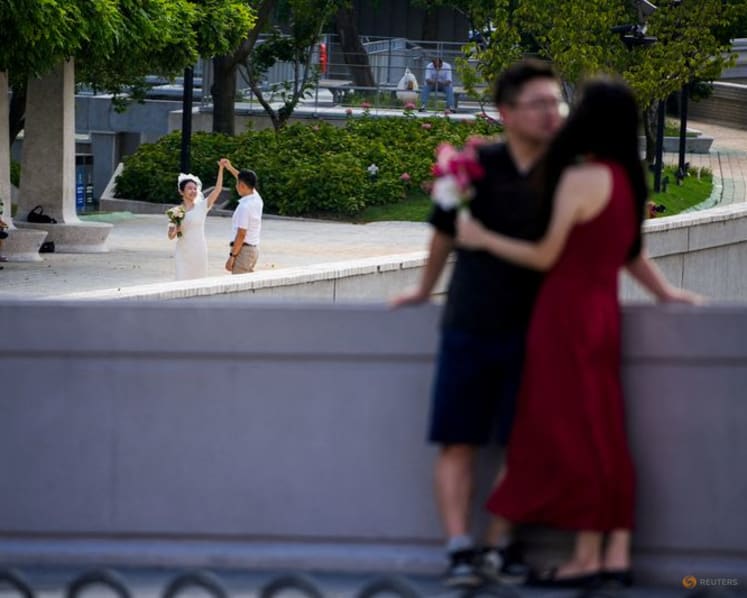
China’s marriage numbers edge higher in 2025, but demographic worries remain
6.76 million couples tied the knot in China last year – a 10.8 per cent rebound from 2024’s record low – but falling birth rates continue to cast a shadow on the world’s second-most populous nation.

China recorded 6.76 million marriages in 2025, a 10.8 per cent increase from 2024’s record low.

This audio is generated by an AI tool.




SHANGHAI: Every weekend, a corner of Shanghai’s People’s Park fills with anxious parents on a mission.
Sheets of paper are pinned along the pathways, taped to bags or umbrellas, or laid out on the ground. They list their children’s age, job, details about their appearance and financial assets – often without the children’s knowledge.
Parents hope this will help secure a match.
The so-called “marriage market”, which reportedly first started about 20 years ago, draws not only parents, but also matchmaking agencies and singles of all ages.
Their urgency reflects broader national concerns about marriage and birth rates.





MODEST REBOUND IN MARRIAGES
China recorded 6.76 million marriages in 2025, according to newly released data last Thursday (Feb 12).
That marks a 10.8 per cent increase from 2024, which itself was a record low.
However, the uptick comes after a decade-long decline, and the number of registrations last year was still only about half of the 12.25 million recorded in 2015.
With marriage and childbearing still largely intertwined in Chinese culture, these figures come at a key time for China's rapidly-aging population.
Births fell to a record low of 7.92 million last year.
LEGACY OF ONE-CHILD POLICY
In People’s Park, one elderly man has become a familiar face.
He first came to help his daughter find a partner. Now, he visits almost every weekend and even guides others through different sections – younger singles, older singles and those who have studied overseas.
He believes the younger generation sees marriage differently, especially in the wake of the country’s one-child policy, introduced in 1979 to curb population growth and formally ended in 2015.

"Unlike us, who grew up with brothers and sisters – we deeply value family bonds from childhood till today," he said.
"But the post-80s generation doesn’t have this kind of ‘asset’, which is the bond between siblings. Young men and women of this generation are fiercely independent, and perhaps that’s why marriages today have become complex."

SINGLES STILL FACE PERSISTENT PRESSURES
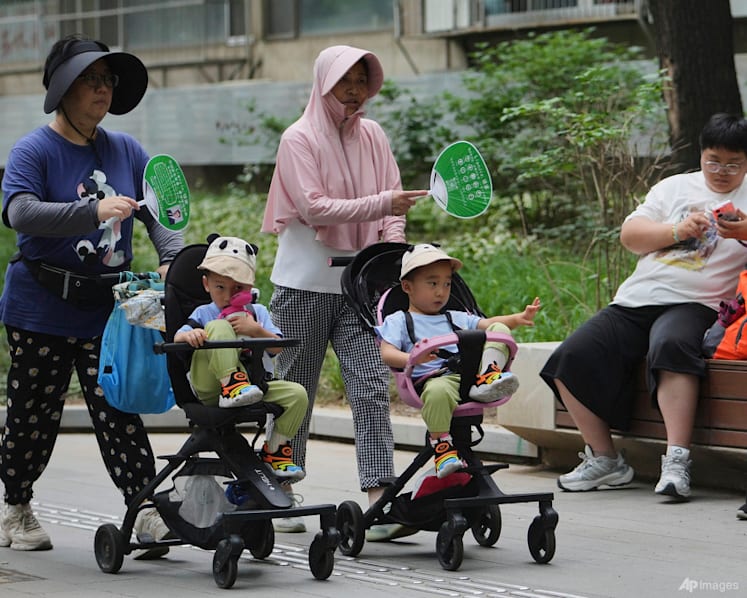
The uptick in figures comes as authorities introduce a slew of marriage incentives.
From May 2025, couples have been allowed to register their marriages anywhere in the country, ending a decades-long restriction that required couples to be married in one of their hometowns.
Some provinces also offer up to a month of marriage leave and cash benefits.
However, experts said more time and data are needed to determine whether the rebound can be sustained.
The uptick in figures could be due to a postponement of marriages during COVID-19, or from 2024 – an inauspicious year in the Chinese calendar, they said.
"We've got to be very careful to see this (uptick) as some major shift, or these (marriage) policies as a panacea," said Stuart Gietel-Basten, professor of social science and public policy at the Hong Kong University of Science and Technology.
Underlying pressures discouraging singles from getting married, such as unemployment and long working hours, have changed little in recent years.
"What will change the number of people getting married, is everything in society," said Gietel-Basten.
"It is about how you get started in life, about jobs, about housing, about cost of living, about expectations about childbearing and your career progression and looking after your parents. It's a much, much, much bigger system that we need to look at."