Harsher rhetoric by PLA mouthpiece ties Zhang Youxia, Liu Zhenli probes more to politics than graft: Observers
A stinging editorial published by the People’s Liberation Army Daily on Sunday (Jan 25) against Zhang Youxia and Liu Zhenli used wording that goes beyond how previous senior military purges have been framed, say analysts.

This audio is generated by an AI tool.


BEIJING: A stinging editorial published by the People’s Liberation Army (PLA) Daily on Sunday (Jan 25) has cast fresh light on the political gravity of the investigation into China’s top generals Zhang Youxia and Liu Zhenli, with particularly harsh wording that analysts say goes beyond how previous senior military purges have been framed.
Published on the front page of its physical edition, the official mouthpiece of the Chinese armed forces accused Zhang and Liu of having “seriously trampled on and undermined the system of ultimate responsibility resting with the Central Military Commission (CMC) chairman” - a post held by President Xi Jinping, who sits at the apex of China’s military command structure.
It came a day after Beijing announced that both men were being probed for “serious violations of discipline and law”, a common euphemism for corruption, in what has become one of the most consequential cases to engulf the PLA’s senior leadership in years.
“You can feel the bitterness in the paragraph,” Yang Zi, a research fellow at Singapore’s S Rajaratnam School of International Studies, told CNA.





He highlighted that only a small portion of the editorial focused on corruption, while most of it read like “a list of grievances” centred on Zhang and Liu allegedly chipping away at the authority of the CMC chairman.
“It’s definitely … much stronger,” Yang said, referring to the use of the phrase “seriously trampled on”. “It reflects a very severe breakdown in the relationship.”
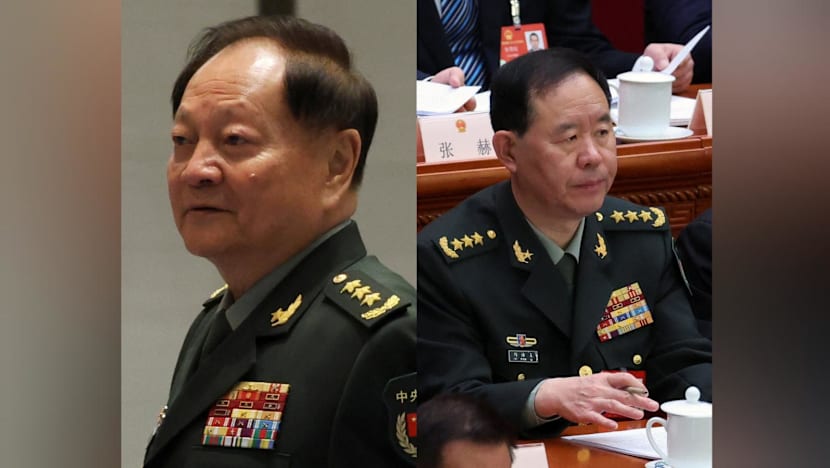
Zhang, 75, is the first-ranking vice chair of the CMC, China’s top military decision-making body, and one of Xi's longest-serving allies in the armed forces.
Liu, 61, is a fellow CMC member and its Joint Staff Department chief, responsible for overseeing PLA joint operations, training and combat readiness.
STINGING CRITICISM AGAINST ZHANG, LIU
The editorial framed the case as a vindication of Xi’s long-running anti-corruption campaign within the armed forces, calling the investigation a “major achievement” and urging officers and soldiers to maintain absolute obedience to the party centre, the CMC and Xi.
Beyond the headline charge of corruption, the PLA Daily editorial levelled a sweeping set of political accusations against Zhang and Liu, portraying their alleged misconduct as a fundamental threat to the party’s control of the military.
The editorial said the two men had “gravely betrayed the trust and expectations” of the party leadership, accusing them of “seriously fostering and exacerbating political and corruption-related problems” that weaken the Communist Party’s absolute leadership over the armed forces and endanger the party’s governing foundations.
It further blamed Zhang and Liu for damaging the authority and image of the CMC leadership, undermining the political and ideological foundations of unity within the ranks, and inflicting “immense damage” on the PLA’s political ecology and combat effectiveness.
Their actions, the editorial claimed, had caused “extremely negative consequences” for the party, the state and the military.
Zhang and Liu were said to have “seriously trampled on and undermined the system of ultimate responsibility resting with the Central Military Commission chairman”.
Checks by CNA found that in the PLA Daily editorials published in the immediate aftermath of the fall from grace of former CMC vice-chairs - Xu Caihou and Guo Boxiong, and He Weidong more recently - these individuals were accused of “undermining” the chairman responsibility system, without invoking the far stronger charge of having “trampled on” it.
The shift in wording points to a sharper political judgement, one focused less on graft alone and more on authority, loyalty and control at the very top of the military, analysts said.
“The wording seems severe and suggests insubordination,” said Chong Ja Ian, a non-resident scholar at Carnegie China and an associate professor of political science at the National University of Singapore (NUS).
At the same time, he cautioned that the language sheds little light on the specific conduct involved.
“The public-facing elements are deliberately vague, even though they suggest great seriousness,” Chong said, adding that the messaging serves to reinforce three core points: that Zhang and Liu committed serious wrongdoing, that no one is beyond party discipline, and that Xi’s authority at the top is unassailable.
EMERGING ALLEGATIONS
Adding another layer of complexity, a Wall Street Journal report published on Sunday cited unidentified sources familiar with a high-level briefing as alleging that Zhang is suspected of passing secret information about China’s nuclear weapons programme to the United States, as well as forming political cliques and abusing his authority in military decision-making.
Chinese authorities have not commented on the report.
Yang from RSIS urged caution, saying that in elite political struggles, severe accusations can sometimes serve to discredit targets and legitimise their removal, even when independent verification is impossible.
“(An) attacker will always try to use smears to sort of discredit the one that’s being attacked. So maybe it’s just a form of character assassination to justify the attack,” he said, adding that such patterns have appeared repeatedly in past political purges.
Zhang’s background adds to the questions surrounding the allegation.
A longstanding Communist Party insider and career military officer, he rose through the PLA over decades and is the son of a revolutionary general tied to the party’s founding generation, a profile that has long marked him as deeply embedded within the system.
“There’s an accusation about him leaking nuclear weapons secrets to the US, but what exactly is the motivation for leaking this information? What is he getting in return?” Yang said.
NUS’ Chong similarly urged caution against coming to conclusions prematurely, noting that speculation has flourished amid Beijing’s lack of transparency.
“Rather than get caught up in breathless claims, a more even-handed approach is to wait for corroborating evidence,” he said, adding that this could take time.
MILITARY LEADERSHIP VACUUM
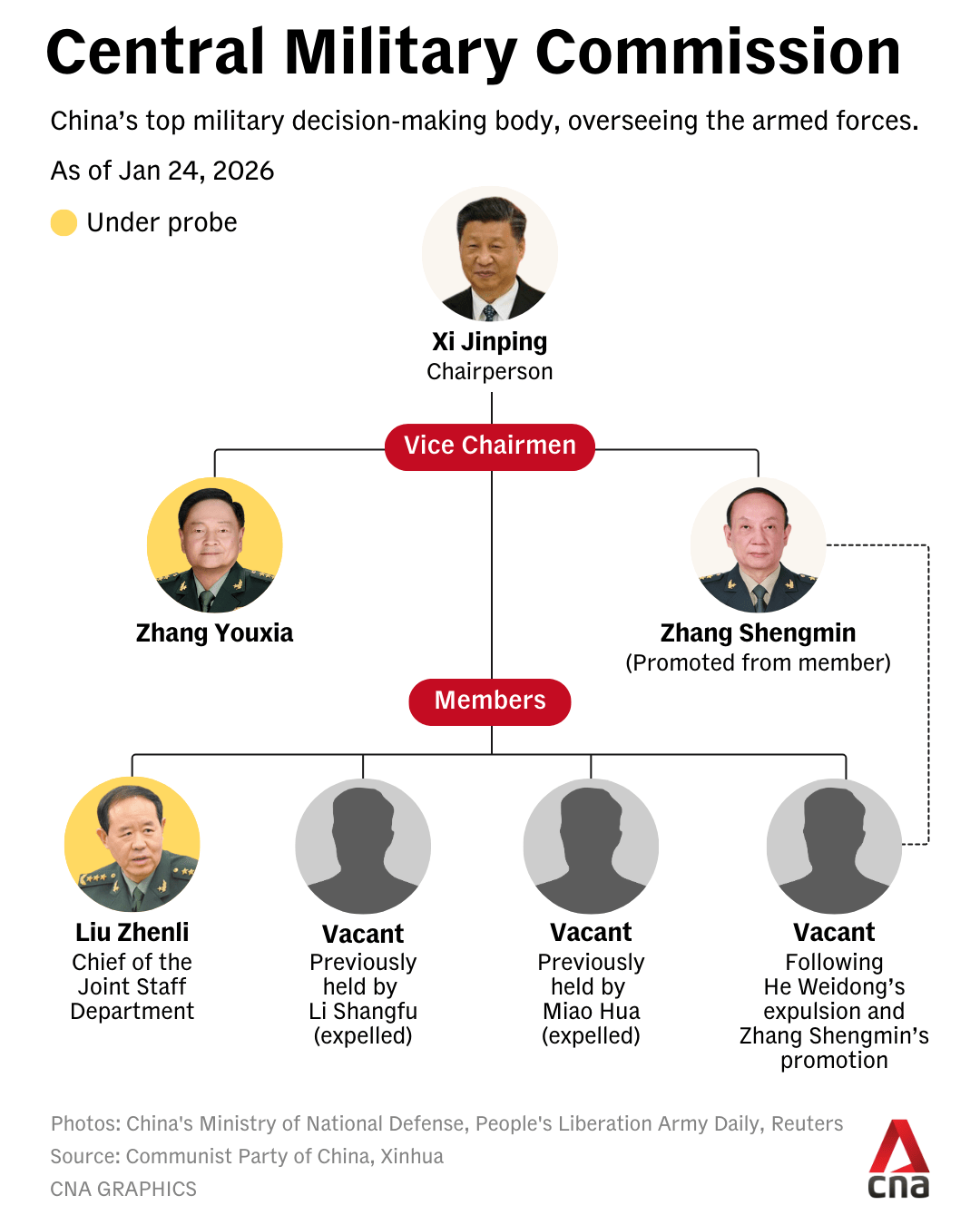
The investigation into Zhang and Liu has also exposed growing gaps at the very top of China’s military command, raising questions about continuity, confidence and succession within the PLA.
The latest development further pares down an already diminished CMC, which began its current term after the 20th Party Congress in 2022 with seven members.
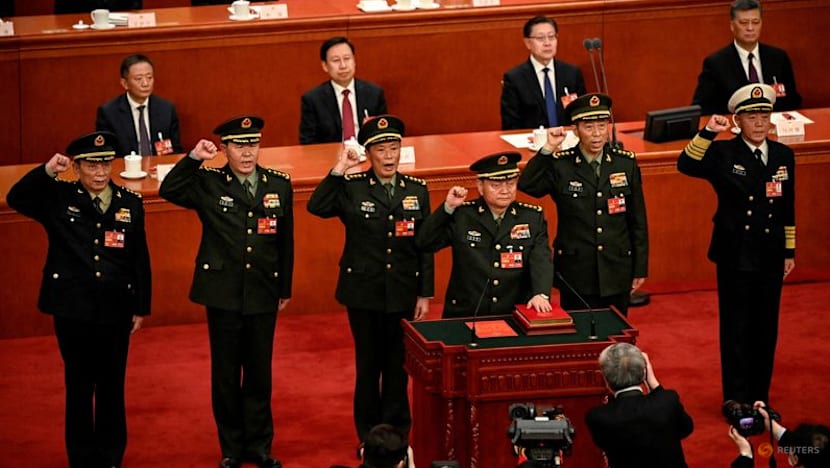
Since then, several senior figures have been removed amid an intensified anti-corruption campaign within the PLA, including former defence minister Li Shangfu, who was expelled from the Communist Party in June 2024, as well as former CMC vice-chair He and ex-Political Work Department chief Miao Hua, who were expelled just months ago.
With Zhang and Liu under investigation, their roles at the apex of the military command are now effectively in question, creating uncertainty around key nodes in the PLA’s command structure.
Analysts noted that the Joint Staff chief, Liu’s role, is central to coordinating operations, planning and combat readiness, making the absence particularly consequential even if day-to-day functions continue.
The prolonged lack of replacements points to deeper issues of trust between Xi and the military elite, said Yang from RSIS. He noted that no new members have been brought into the CMC for months, even after earlier removals, suggesting hesitation at the very top.
He added that repeated purges may have left Xi increasingly reliant on loyalty over professional competence.
“I feel like he doesn’t have a lot of trust and confidence in military officers, especially those more professional ones who might be more adamant in their professional opinions, rather than being just a die-hard loyalist,” he said.
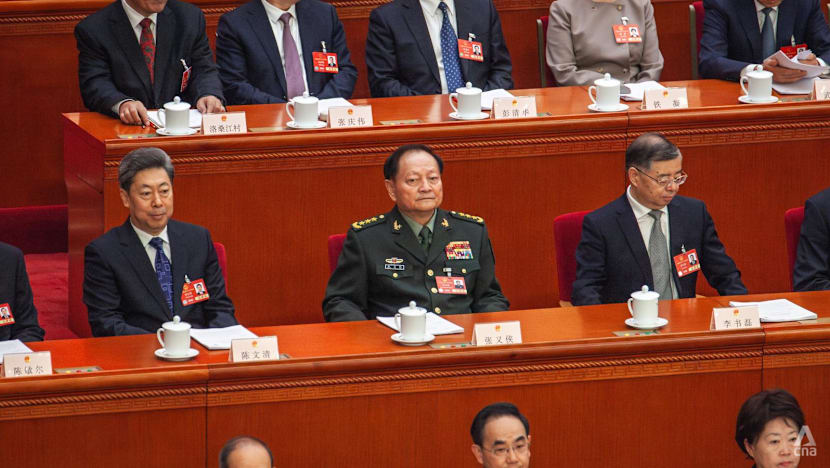
The uncertainty is also likely to weigh on morale within the upper ranks, analysts said.
With Zhang having spent decades in the system and promoted many officers along the way, his investigation has cast a shadow over associates and subordinates, a dynamic that Yang said could encourage caution and risk aversion at a time when the leadership is already inward-looking.
Looking ahead, analysts said the most telling signals will come from who is promoted next - and how quickly.
Appointments of younger officers with long career runways could indicate an effort to lock in control beyond the current political cycle, while continued delays may reinforce perceptions of mistrust and paralysis at the top.
Chong said the concentration of authority around Xi also carries longer-term risks, including reinforcing concerns about leadership transition.
“When Xi is unable to manage the politics of the CCP (China’s Communist Party) and there is no clear successor who can replicate Xi’s authority, more severe internal cleavages could appear,” he said.
“That may reverberate through the PRC (People’s Republic of China) and have economic, political, and foreign policy ramifications.”