







analysis East Asia
Why overtures by President Xi, KMT chair to other Taiwanese parties are unlikely to see breakthrough
In his meeting with visiting Kuomintang (KMT) leader Cheng Li-wun on Friday (Apr 10), Chinese President Xi Jinping said he was willing to work with all political parties in Taiwan to advance cross-strait ties.
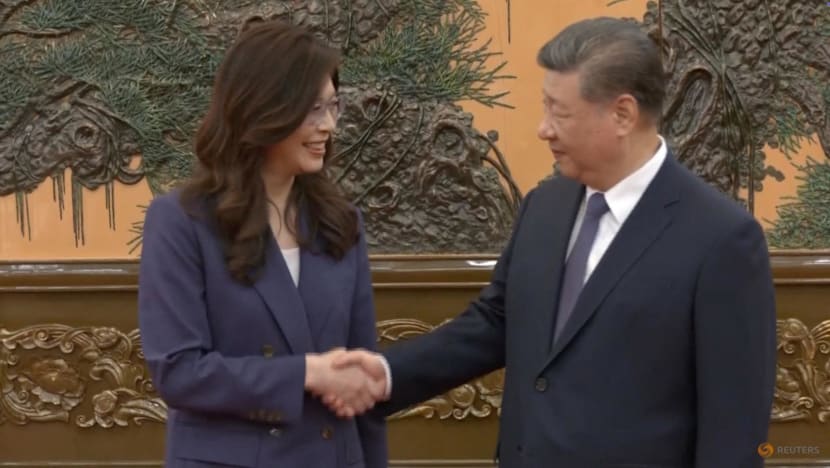
Cheng Li-wun, chairperson of the Kuomintang (KMT), Taiwan's largest opposition party, shakes hands with Chinese President Xi Jinping at the Great Hall of the People in Beijing, China on Apr 10, 2026, in this screengrab from a video provided by CTI. (Image: CTI via Reuters)

This audio is generated by an AI tool.


BEIJING: Remarks by Chinese President Xi Jinping in his meeting with Kuomintang (KMT) leader Cheng Li-wun on his willingness in working with all political parties in Taiwan to advance cross-strait ties reflect an attempt to widen Beijing’s outreach, say analysts, though they also point out the hurdles.
Observers say the overture remains bound by longstanding red lines including the rejection of Taiwanese independence and adherence to the “1992 Consensus”, an understanding that both sides acknowledge there is “one China” while leaving room for different interpretations of what that means. The ruling Democratic Progressive Party (DPP) has long rejected this framework.
Analysts also say the outreach comes alongside continued military pressure by China over Taiwan, limiting prospects for a breakthrough.
Cheng is the party's first leader to visit China in a decade, but her trip, which began on Tuesday (Apr 7) and culminated with the meeting with Xi on Friday morning, has sparked debate in Taiwan with critics accusing her of being too pro-Beijing.





The last sitting KMT chair to visit the mainland was Hung Hsiu-chu in 2016. Beijing severed high-level contact with Taipei in 2016 after Tsai Ing-wen of the DPP won the presidency.

In his meeting with Cheng, Xi said he is willing to work with all political parties, and people from all sectors in Taiwan “on the common political foundation of the 1992 Consensus and opposition to Taiwan independence” - to promote peace and exchanges across the Strait.
Xi also told the visiting delegation he had "full confidence" that Taiwanese and Chinese people would be united, saying both sides of the strait belong to “one China”, according to a separate state media read out.
“When the family is harmonious, all things will prosper,” he said, adding that “Taiwan independence is the chief culprit in undermining peace in the Taiwan Strait”.
“We will absolutely not tolerate or condone it.”
Taiwan opposition leader Cheng Li-wun pledged to channel the spirit of her party's founder Sun Yat-sen and seek reconciliation with China, offering praise at his tomb for the country's achievements following the communist revolution.
Cheng also framed cross-strait engagement as a broader responsibility beyond party lines, during the meeting as well as in her comments to the media afterwards.
The issue should not be treated as “a tool for partisan competition or electoral manoeuvring” but as “a choice between peace and war”, she said - urging all political parties in Taiwan to “set aside differences … and work together for peace”.
Cheng also said Xi had shown “significant goodwill” and added that such exchanges “are certainly not limited to the Kuomintang and the Communist Party”.
She added that she hoped the Taiwan Strait would "no longer be a focal point of potential conflict".
"Both sides should transcend political confrontation … and seek a systemic solution to prevent and avoid war, so that the Taiwan Strait can become a model for peaceful conflict resolution in the world," she said in comments carried by Taiwanese media outlets.
China views Taiwan as a renegade province that must eventually be reunified with the mainland, and has not ruled out the use of force to achieve that goal.
OUTREACH WITH CONDITIONS
Analysts told CNA that Xi’s remarks point to a broadening of Beijing’s outreach on paper, but one with tight conditions.
Beijing is willing to engage beyond the KMT - but only within its defined political framework, said James Chen, an assistant professor of diplomacy and international relations at Tamkang University.
“Xi (said he is opening) the door broadly to engage with Taiwan regardless of political affiliation - if the ruling DPP chair Lai Ching-te accepts the political basis, he too would be welcome in Beijing,” Chen noted, referring to Taiwanese President William Lai.
But such willingness to engage is limited in practice, noted Chong Ja Ian, an associate professor from the National University of Singapore (NUS) and non-resident scholar at Carnegie China.
The DPP has also said that they are “willing to engage the CCP - but with no preconditions”, Chong said. “That is not something that the CCP (would be) willing to accept.”
“So unless the DPP is willing to accept the CCP’s conditions, or the CCP is willing to not be consistent on its conditions, that gap remains.”
He added that domestic political incentives in Taiwan also make a shift unlikely.
“If you look at opinion polls … the KMT didn’t have that much support for it,” Chong said, referring to past high-level cross-strait engagement. “If it’s more or less the same, then the DPP will have very little incentive to try to do anything different.”
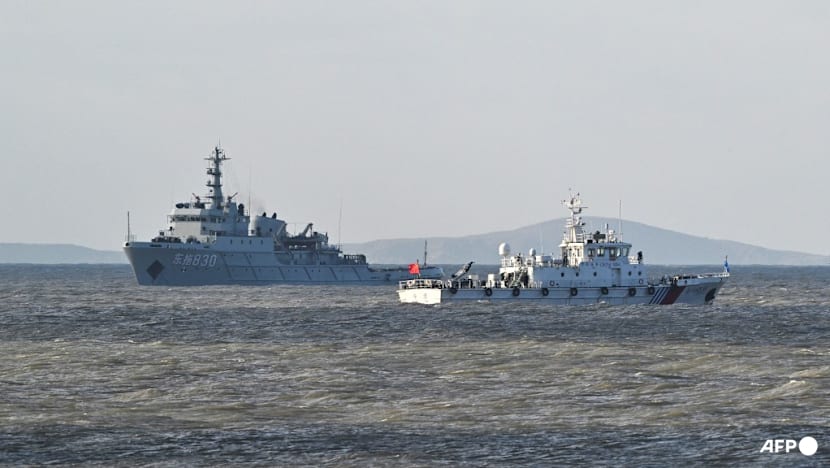
Chong also noted reports from Taiwan this week about a rise in Chinese naval activity recently.
“For all (Xi’s) talk of peace, there doesn't seem to be a corresponding set of actions,” Chong said, pointing to continued Chinese military activity around the island.
Chen of Tamkang University said this reflects a broader “dual-track” approach by Beijing.
“Beijing is well aware of the KMT’s limitations as an opposition party. Continued (People’s Liberation Army) sorties and naval patrols around Taiwan are intended to pressure the ruling DPP, serve China’s national security interests, and deter closer US intervention,” Chen said.
“These represent a dual-track strategy - soft engagement paired with hard deterrence.”
On Cheng’s call for more institutionalised cross-strait mechanisms to prevent conflict, Chong from NUS said the challenge ultimately comes down to trust.
“The basic issue here is that it’s a commitment problem,” he said. “For any mechanism to work, there needs to be credible commitment.”
Without that, he warned, any arrangement would be vulnerable to change. “If the CCP wants to renege … nothing can stop it.”


Cheng arrived in Shanghai on Tuesday evening before travelling to Nanjing, where she visited Sun Yat-sen’s mausoleum - a stop heavy with Kuomintang symbolism tied to the Republic of China’s founding.
The itinerary appeared designed to blend history, economics and politics, observers told CNA.
She later met with senior Chinese Communist Party officials, Jiangsu party chief Xin Changxing and Shanghai party boss Chen Jining, and also held meetings with Taiwanese businesspeople.






