







10 secs to collision: ‘Difficult’ for train driver to react, SMRT says
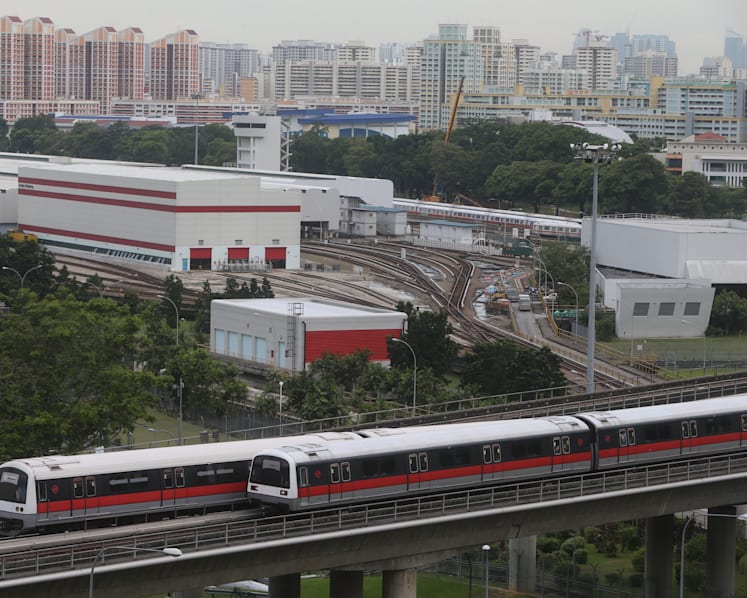
SMRT trains at the Bishan Depot. TODAY file photo




SINGAPORE — SMRT said that the driver involved in the recent train collision at Joo Koon MRT Station was not to be blamed, because it was “very difficult and challenging” for him to understand what was happening and respond to the situation.
While the transport operator said that there was “no human error”, analysts are of the view that the driver had more than enough time to react, and SMRT may want to relook training for its drivers and give them more leeway to apply their knowhow during an emergency.
At a media briefing on Tuesday (Nov 21), SMRT said that the driver’s train stopped about 36m behind another and it took 10 seconds to move from a stationary position to hitting the train in front.
Mr Alvin Kek, SMRT’s senior vice-president of rail operations for the North-South and East-West Lines, said that it would have been difficult for the driver to grasp why the train ahead of it was not moving, since its drivers are “taught that there’s supposed to be at least one ‘protective bubble’” in place to keep a safe distance from trains near it.





This is a safety measure under the new communications-based train control system, but last Wednesday morning, there was an “abnormal” loss of communication between on-board computers on the train in front. This disabled the feature that creates the first protective bubble as it left Ulu Pandan Depot to begin its east-bound route.
A second back-up protective bubble then kicked in, but as the train passed Clementi, a trackside device that had not been modified for the new signalling system knocked this mechanism out, too.
The East-West Line’s old signalling system runs from Pasir Ris to Pioneer stations. The new signalling system, which allows trains to run at shorter intervals, is active between Pioneer and Tuas Link stations, and is supplied by French multinational company Thales.
PROBLEM DETECTED
The disabling of the protective bubbles went undetected until the train reached Pioneer station, where the crossover to the new signalling system occurs. The driver then noticed the problem and alerted SMRT’s operations control centre.
He was directed to move off in restricted manual mode — which caps the train’s speed at 18km/h — and to disembark all passengers at the next station, Joo Koon, before withdrawing from service.
Things went as planned until the driver shut the platform screen doors at Joo Koon, which erased a “closed-track” message to incoming trains. The train behind it then lurched forward and caused the collision, because it could not sense the first train’s protective bubble.
Mr Kek explained that time was needed for the driver of the first train to shut the platform screen doors manually at Joo Koon after the passengers got off. He then had to return to the driver’s cabin to drive off.
Mr Chua Chong Kheng, the LTA’s deputy chief executive for infrastructure and development, said: “The minute (the driver of the first train) lifted the closed-track protection after closing the doors, straight away the train behind would sense that it has a route to be able to move, so the second train started moving.”
HUMAN JUDGEMENT
Was 10 seconds enough time for the driver of the second train to react to the first train’s safety malfunction? One transport analyst thinks so.
Dr Park Byung Joon, an urban transport expert from the Singapore University of Social Sciences, said: “Considering that the first train was stationary and it takes about one second for him to react, the driver (probably) didn’t because he was told during training that the automatic protective feature would kick in.”
Dr Park expressed concern over the increasing reliance on automation. “It seems that safety features are all controlled by software. Are we okay with that?” he asked.
He advocated for train drivers to be given greater jurisdiction to apply their professional judgement and discretion. “For example, when you have a person, or something on the track, if the train is driven in automatic mode, it cannot stop this situation,” Dr Park said.
This is where SMRT could relook its training for drivers, he added.
However, transport economist Walter Theseira from the Singapore University of Social Sciences said that it is difficult to ascertain if the driver of the second train could have intervened. “We don’t have full information about how much control a driver has, or how much training the driver was given in terms of taking control over the automatic system.”
He added: “If the driver was trained to recognise abnormal conditions, then he might have acted. It seems that he expected the automatic system to halt the train, as it should have under normal conditions.”
He also said that SMRT may have to look at whether “it is realistically possible to provide the kind of training and information to allow drivers to act if unexpected conditions develop”.
On whether the network is too heavily reliant on automated systems, Dr Theseira said that “it is ultimately a trade-off between human and software control”.
“But generally, the global consensus is that human failure is far more likely than software failure under routine conditions, which is why driverless vehicles are being developed and autonomous systems are widely used for trains.”




