







Singapore targets four industries for AI transformation, but experts say workforce readiness a key hurdle
The AI missions will focus on advanced manufacturing, connectivity, finance and healthcare – sectors that form the core of Singapore's economy and public welfare, experts say.
“By focusing on these sectors, the government can accelerate tangible impact on both industry transformation and workforce capability,” one expert said.

This audio is generated by an AI tool.




SINGAPORE: The four sectors chosen to front Singapore’s artificial intelligence strategy are "backbone" industries that operate in high-stakes environments and are pivotal to the country's economy, experts said.
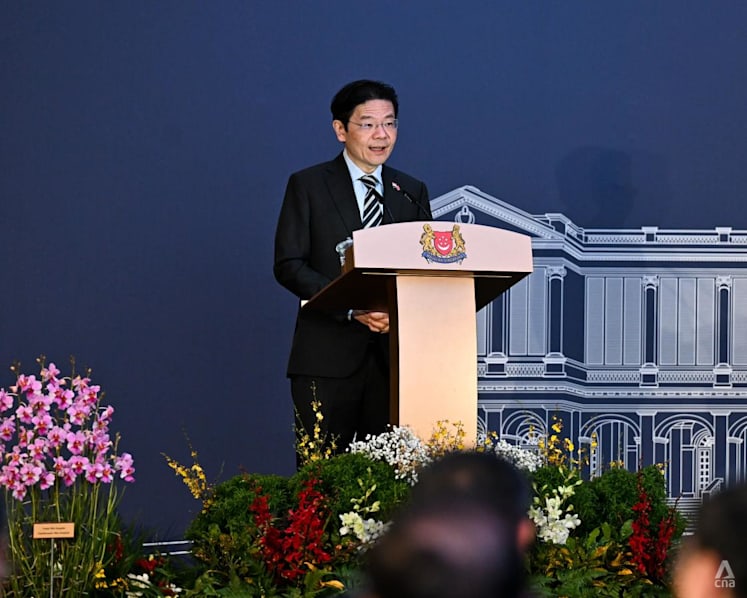
Prime Minister Lawrence Wong on Thursday (Feb 12) announced in his Budget 2026 statement that he will chair a new National AI Council to oversee the development and execution of "AI missions" aimed at pushing the boundaries of "what is possible for Singapore and for the world".
The missions will focus on four sectors – advanced manufacturing, connectivity, finance and healthcare – which make up the core of Singapore’s economy and public welfare.
Experts said the four sectors are closely intertwined, with some being early AI adopters such as finance and technology, alongside fast-growers like healthcare and manufacturing. Advancements in AI in one area can boost gains in others.





Mr Oliver Jay, OpenAI's managing director for international markets, said these sectors are "strong starting points" for national AI deployment, as they combine high-volume, repeatable workflows with high-stakes environments that demand strong governance.
Since these industries handle sensitive data, it raises the bar on governance and accountability. If the foundation is built well, it allows for trusted operating models to be extended to others including small‑ and medium‑sized enterprises (SME) and startups, he added.
Singapore's prioritisation of these sectors reflects a strategy to concentrate AI adoption where economic value creation, productivity gains and real-world deployment potential are strongest, said Dr Stefan Winkler, a professor in the engineering cluster at Singapore Institute of Technology (SIT).
"By focusing on these sectors, the government can accelerate tangible impact on both industry transformation and workforce capability," Dr Winkler said.
WHAT AI CAN DO FOR EACH SECTOR
Advanced manufacturing, particularly semiconductors, has "natural synergies" with AI, said assistant professor of economics Goh Jing Rong from the Singapore Management University (SMU).
AI-enabled computer vision can help identify micro-defects or assembly errors, reducing the need for scrap and rework. AI models can also anticipate equipment failure from sensor signals, allowing maintenance to be planned around production schedules and minimising unplanned downtime, he added.
In connectivity – spanning logistics, global ports and trade networks – AI can improve network management, optimise traffic routing and boost cybersecurity.
It can even be used to instantly detect massive data spikes during major concerts, said Ms Gayathri Peria, general manager for Southeast Asia at open-source software company SUSE.
While the finance industry is among the most advanced adopters of AI globally, experts say deeper transformation lies ahead.
Apart from analysing data-heavy reports, AI systems are progressively being rolled out to improve fraud detection, including flagging unusual transactions in real-time and improving credit-risk assessments.
In an increasingly volatile macroeconomic and geopolitical environment, AI models can also analyse complex interactions across markets and flag early warning signals, giving financial institutions a sharper edge in managing risk, said Asst Prof Goh.
In healthcare, AI could improve both manual operational tasks and clinical decision-making.
This includes rapidly diagnosing patients using digitised medical images and patient data, and formulating tailored treatment plans, said Mr Amit Khandelwal, regional vice-president and managing director for Southeast Asia at global software company UiPath.
With Singapore’s ageing population, AI can also be used to meet demand for services requiring reliable digital connectivity, such as telehealth, transport support applications and mobility services, he added.
When asked which other sectors could benefit from the AI missions, experts pointed to construction, retail, tourism and education, among others.
"At the end of the day it’s about prioritising for impact, which is what the government has clearly done," said Ms Peria. "There are a thousand possible applications of AI, and responsible stewardship means starting with the most critical use cases."

WORKFORCE READINESS A KEY CHALLENGE
Across sectors, workforce readiness remains a key challenge.
Employees need the right skills to effectively use and work alongside AI systems, with operational integration also being critical, said SIT's Dr Winkler.
If the burden of using AI increases, companies may face resistance from frontline staff, added SMU's Asst Prof Goh.
"Even accurate AI can fail if it creates more clicks, alerts or documentation load for ground staff who will rationally resist it," he said.
The skills gap between existing technical abilities and the AI-fluent roles needed to redesign complex workflows also needs to be addressed.
"To succeed, companies must not just use AI tools, but also prioritise workforce upskilling to ensure that humans can remain at the centre of future workplaces where roles will be redefined," said Mr Khandelwal.
Experts also cautioned the risks involved in scaling up, such as overdependence on vendors and AI hallucinations, where the system generates incorrect or misleading information.
Moreover, it is a costly venture for some companies. "AI scaling inherently requires a high allocation of resources, high initial cost of investment and technical complexity," said SUSE's Ms Peria.
OpenAI’s Mr Jay warned that while many companies succeed at using AI in the pilot stage, they struggle to integrate it into multi-step workflows.
"This is what we describe as the 'capability overhang' – the gap between what AI systems are capable of and how they are typically used."
NOT LEAVING SMALLER FIRMS BEHIND
The prime minister also said in his speech that support for all enterprises, especially SMEs, will be strengthened – a move industry players welcomed, noting that the measures will allow these firms to adopt AI without being weighed down by cost.
Under an expanded Enterprise Innovation Scheme, businesses can claim 400 per cent tax deductions on qualifying AI expenditures, capped at S$50,000 (US$39,600) annually for the assessment years of 2027 and 2028.
The scheme encourages SMEs, which employ the vast majority of the local workforce, to step up their AI adoption, said Ms Peria.
"When an SME becomes a 'champion of AI', the transformation happens in the neighbourhood accounting firm or the local manufacturing plant," she added. "This localised adoption ensures that the benefits of AI are distributed across the heartlands and benefit a wider swathe of our populace."
Having national-level "AI missions" also bridges the gap between SMEs and larger firms by providing smaller companies with higher-level ecosystem support they may not have, said Mr Khandelwal.
The ecosystem should not require SMEs to have in-house AI specialists; instead, it should be one that allows them to learn from leaders and access shared resources that can help them move beyond simple experiments to real, productive AI use, he added.
Dr Winkler echoed this sentiment on access, pointing out that lowering barriers to hands-on learning as well as tools and training ensures that "productivity gains are not limited to larger enterprises".
Mr Percy Hung, CEO and founder of Choco Up, a Singapore-based growth financing platform that has supported more than 400 SMEs locally, said that many smaller firms are already adopting AI and the national missions will expedite this movement.
But to sustain momentum, he highlighted the need for clear sector-specific playbooks and case studies that demonstrate measurable returns; equipping founders with the knowledge to make informed AI investments; and flexible capital to help SMEs to pilot and scale solutions confidently.
"With national strategy reinforcing what businesses are already doing, Singapore is well-positioned to ensure AI transformation is broad-based, inclusive and economically impactful," said Mr Hung.





