







Budget 2026 debate: Trust, inclusivity and worker support top MPs' concerns over Singapore's new AI strategy
MPs on both sides of the House supported the Budget's focus on artificial intelligence, but warned of potential hurdles in embarking on this new national strategy.
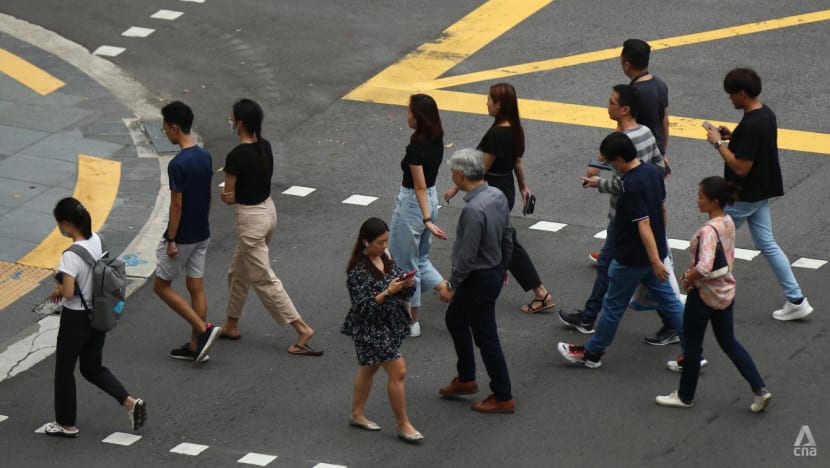
File photo of people crossing the street at the central business district (CBD) in Singapore. (Photo: CNA/Syamil Sapari)

This audio is generated by an AI tool.




SINGAPORE: Singapore’s national AI push must be built on trust, ensure no worker or small business is left behind, and come with clear accountability, MPs said on Tuesday (Feb 24) as parliament debated the national budget.
MPs on both sides of the House supported the artificial intelligence focus of the Budget unveiled by Prime Minister Lawrence Wong on Feb 12, but warned of potential hurdles in embarking on this national strategy.
Mr Wong, who is also Finance Minister, announced that he will chair a new National AI Council to drive Singapore’s AI agenda.
Several MPs said that trust in Singapore's legal framework, governance and institutions is itself a competitive advantage in an AI-driven world.
"Trust is intangible, yet it behaves like infrastructure," said Mr Victor Lye (PAP-Ang Mo Kio). "Trust enables flows, capital, data, talent, goods, decisions. Trust increases resilience to shocks. Trust is the reliability premium that allows counterparties to transact, coordinate and commit to actions at scale."
He called for the government to create trust infrastructure such as regulatory sandboxes and Singapore-verified credentials that would allow foreign companies and professionals to demonstrate compliance skills and experience.
Mr Henry Kwek (PAP-Kebun Baru) called trust "the most precious commodity in the digital economy", noting that businesses will locate their AI operations where they have confidence in the legal system and the government behind it.
"Singapore has spent decades building exactly that trust," he said.
Ms Mariam Jaafar (PAP-Sembawang) said this reputation allows Singapore to overcome its lack of natural resources, limited land space and shrinking labour force.
"We do not compete on scale and spend. We compete on coordination, trust, governance and execution," she said.
Singapore can build "the most trusted agentic systems and applications", creating AI that is safe, accountable and designed for real industries, she added.
Minister of State for Digital Development and Information and for Education Jasmin Lau said that human accountability must remain central to AI governance.
While AI can process and generate, it cannot be held responsible nor own the consequences of its actions, she said.
"We will still need humans for ethics, for creativity and imagination, and for the ability to look someone else in the eye and say, ‘I take responsibility for this’.”


SUPPORTING SMALL BUSINESSES
MPs also highlighted the importance of ensuring that small- and medium-size enterprises (SMEs) are not left behind in AI adoption. They pointed out that while many of these businesses are open to adopting AI, they face structural gaps and uncertainty.
Ms Lau noted that many SMEs have raised concerns that they cannot afford to be “guinea pigs” in AI adoption.
“They have many personal experiences of trying out new technologies and then realising that the technologies became outdated too fast, and they are right to be cautious,” she said.
As such, the government will create lower-risk and structured ways for SMEs to experiment, she said, adding that the government is refining its funding scheme. Initially, the barrier was set-up costs, which are already subsidised.
Now, the barrier is capability and workflow redesign. Funding support will hence shift accordingly towards implementation, business process redesign, rescaling, and the “much harder work” of changing how an organisation actually operates, she said.
“We will make sure we are accountable, but we must also make sure that our SMEs – most of whom are genuine and often already tight on resources – we must make sure they do not get turned away too early by onerous and cumbersome paperwork,” she said.
Nominated MP Mark Lee said that SMEs may lack the capacity for AI integration. AI implementation is expensive, and costs include software, data restructuring and upskilling workers, among others, he said.
“Big firms have both the talent and financial muscle to spread this fixed cost. SMEs often cannot – if transformation succeeds, gains are gradual. If it fails, losses are immediate.”
He added that support for AI adoption must hinge on clarity, or SMEs may misjudge eligibility or misallocate resources.
MP Denise Phua (PAP-Jalan Besar) agreed that SMEs cannot be an “afterthought”. “AI is at the centre of our strategy, but on the ground, many business owners are still unsure what this means for survival, not just growth,” she said.
She proposed providing precision support to them, rather than broad measures. This includes classifying firms into foundational, emerging or advanced stages of AI-readiness, so that support can be tailored to readiness.
Ms Phua also suggested the provision of government-funded AI coaches, and the strengthening of intermediaries, such as the Singapore Business Federation, the National Trades Union Congress (NTUC) and SME Centres.
“The goal is not to push every SME into complex AI systems overnight. The goal is disciplined, intentional transformation. If we get this right, AI becomes a renewal engine for SMEs. If we get it wrong, then we create a two-speed economy, not because help was absent, but because execution lacked precision,” she said.
OPPORTUNITIES FOR ALL
Beyond small businesses, MPs stressed that Singapore’s push for AI should be inclusive to individuals from different backgrounds.
To ensure an inclusive social compact, blue-collar workers in manufacturing and logistics could use “physical AI”, said Mr Gerald Giam (WP-Aljunied).
Examples include using collaborative robots to assist with heavy lifting in factories or employing AI as a translation tool for workers who struggle with English.
“AI should be an equaliser that elevates technical mastery, not a wedge that separates our workforce,” he said.
Mr Giam also proposed that the 400 per cent tax deductions on AI expenses should cover corporate AI subscriptions, to give workers access to corporate AI tools while keeping company data secure.
“Giving every worker a digital assistant should be a baseline goal for a nation that aspires to be an AI leader. This ensures that the benefits of the technology are shared by the employee and the employer alike,” he said.
Ensuring equitable access to AI starts early, noted Mr Darryl David (PAP-Ang Mo Kio).
“Before we can talk about mastering AI software and advanced tools, we must ensure that every student starts from the same baseline. AI readiness depends on digital readiness,” he said.
Advocating for personal learning devices to be extended to primary school students, he added that without reliable access to personal computing devices, students cannot develop foundational skills or experiment with digital tools in ways that will enable meaningful engagement with AI later.
In her speech, Ms Lau also said that the continued evolution of AI will call for a review of "what education means for our children".
"AI will force us to sharpen the focus of education on what truly matters – judgment, values and the ability to work with AI, rather than to compete with it,” she said.
"How do we teach our children about AI, in particular, its limits, biases and blind spots? How do we balance the weightage of our education to emphasise character and social development?”


HELPING WORKERS ADAPT
MPs highlighted the understanding and awareness gap among workers when it comes to adopting AI and tapping the opportunities that come with it.
They also sought clarity on the roadmaps and pathways at the industry and individual levels, for the new growth areas in an AI-enabled economy.
"More than three years after ChatGPT changed the world, AI remains an enigma for much of our workforce and many of our businesses," noted Workers' Party secretary-general Pritam Singh (WP-Aljunied).
He said he looked forward to seeing the “actionable strategies” from the government, calling for clear criteria and standards before AI-related subsidies and grants are disbursed.
"AI-related grants and subsidies must be ringfenced for truly transformative productivity gains so that these taxpayer subsidies are not gamed or abused," he said, citing past lapses under the Productivity and Innovation Credit scheme.
“We cannot repeat that mistake with taxpayer money with this latest productivity push through AI-related subsidies,” he added.
In emerging industries such as AI, quantum, advanced manufacturing and biomedical sciences, many people opt out early simply because they lack exposure, noted Mr David Hoe (PAP-Jurong East-Bukit Batok).
"They do not know what the work actually looks like, what the entry routes are, or what skills matter," he said.
"Those with stronger networks can ask someone, get an introduction, or hear early about internships and externships. Those without networks often find out late, or not at all."
The new statutory board created from the merger of Workforce Singapore and SkillsFuture Singapore would hopefully help students and workers without strong industry networks overcome this hidden disadvantage, he said.
Mr Yip Hon Weng (PAP-Yio Chu Kang) noted that the recent AI coding revolution does not stop at engineers and programmers, but has implications for other knowledge workers.
He called for clearly measurable labour outcomes, with KPIs that are "explicitly job linked" published annually.
These could include the net number of new roles created, the wage uplift achieved and the time taken for workers' redeployment, said Mr Yip.




