







Starting pay for new local bus captains to rise by S$450 with government funding
Sign-on bonuses will be raised by S$2,000, and bus captains who are currently in service will see a "one-time" adjustment in their salaries.
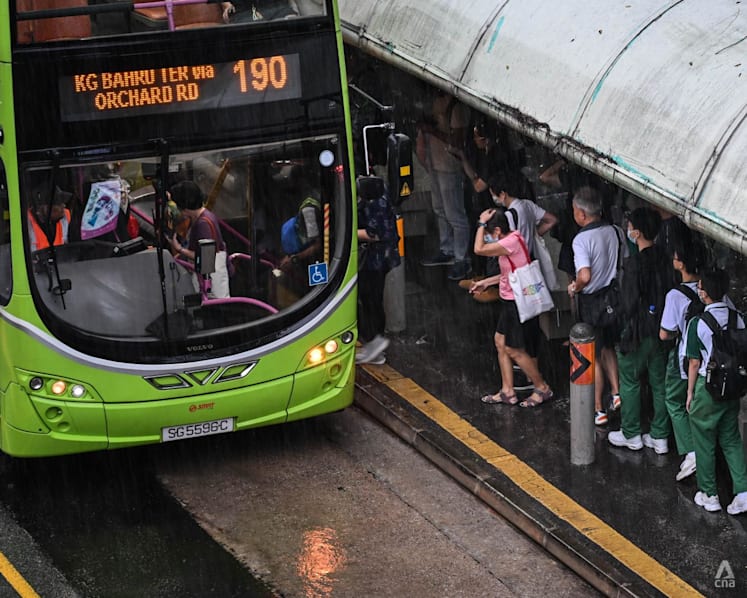
People queuing to board a public bus on a rainy day in Singapore. (File photo: CNA/Lan Yu)

This audio is generated by an AI tool.


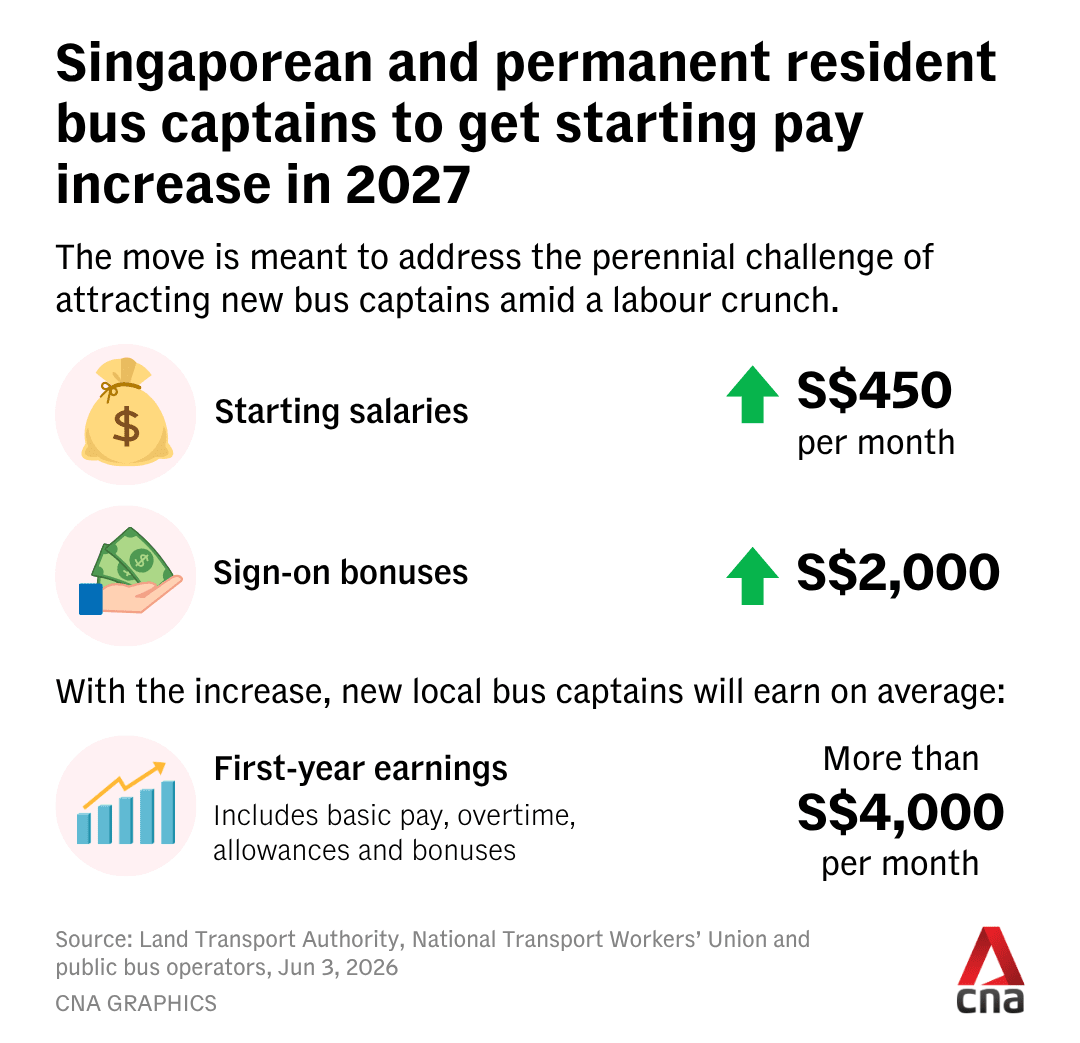
SINGAPORE: To address the challenges of attracting and retaining new bus captains, the government will fund a S$450 (US$352) per month increase in starting salaries and a S$2,000 increase in sign-on bonuses for new Singaporean and permanent resident bus drivers from Jan 1, 2027.
The increased salaries and bonuses will mean that local bus drivers can effectively earn S$600 more per month in their first year of work, which increases their average monthly salaries to more than S$4,000 after including overtime pay, bonuses and allowances.
In addition, public bus operators have also agreed to make a "one-time" salary adjustment of bus captains who are currently in service, so as to manage the relative differences of their pay with the starting salaries, as well as to improve retention and to recognise their contributions.
A "strong pipeline" of bus captains is needed to sustain essential public bus services and deliver enhancements to bus connectivity, said the Land Transport Authority (LTA), National Transport Workers’ Union (NTWU) and the four public bus operators in a joint statement on Wednesday (Jun 3).





Since July 2024, bus connectivity has improved under the Bus Connectivity Enhancement Programme, with 33 new or extended bus routes and improvements to over 60 existing services.
“However, we recognise that bus captains have a challenging job, with shift work being the norm, and the pressures of ferrying passengers safely and punctually through busy roads,” LTA, NTWU and the operators said in the statement.
The workforce is also ageing - for every local bus captain recruited, two are leaving the industry due to resignation or retirement.
As a result, the proportion of local bus captains has fallen from 54 per cent in 2021 to 41 per cent in 2025.
In this regard, the bus operators will continue to improve the attractiveness and safety of the bus captain role, the joint statement said.
Measures include shortening the continuous driving time on long bus routes, as well as reducing split-shift assignments, where bus captains drive only the morning and evening peak with an unpaid period in between.
The challenge of hiring local bus drivers is a longstanding one, with operators raising salaries and dangling hefty sign-on bonuses to attract jobseekers, sometimes after negotiations with unions.
For example, in 2016, discussions between public bus operator SBS Transit and the NTWU led to a 15 per cent wage increase for bus captains in hopes of attracting more locals.
More recently, public bus operators Go-Ahead Singapore and SBS Transit have been advertising sign-on bonuses of up to S$20,000. SMRT advertised a sign-on bonus of up to S$33,000.
Tower Transit has since 2023 offered a S$7,200 sign-on bonus for new bus captains or those who have not driven buses for at least a year. The bonus was raised to S$10,000 earlier this year.
CNA has sought comment from LTA on whether this is the first time the government is stepping in to provide funding support for bus captains' salaries, and the source of these funds.
HOW WAS THE WAGE INCREASE QUANTUM DECIDED?
Responding to queries from CNA, LTA said that for the wage adjustment, bus captains’ total monthly salaries were benchmarked against national wage data and comparable roles in other local industries.
"Based on relevant benchmarks, we assessed the compensation levels needed to attract and retain locals, including mid-career entrants who may currently earn higher salaries," said an LTA spokesperson.
When asked if the government would fund the wage increase indefinitely, LTA said the government will provide support for this round of adjustments until each bus package is retendered or renewed. This includes co-sharing part of the adjustment to salaries for bus captains who joined the industry more recently, with operators funding the remainder.
However, for future tender bids, public transport operators will be expected to consider the higher starting salaries, said the spokesperson. This includes any further adjustments agreed with NTWU to ensure that the wages of bus captains remain competitive.
The operators will also continue to bear the cost of recruitment, training, and retention of their workforce, said LTA.
Fares will not be increasing due to the wage increases.
LTA said that fare increases are decided by the Public Transport Council based on a fare adjustment formula.
"This set of salary adjustments for bus captains is not part of the fare adjustment formula."
For bus drivers who want to join the industry before Jan 1, 2027, LTA said that they will also see an adjustment to their salaries next year.
As to how much the initiative would cost the government, LTA said that it would depend on the number of new local bus captains who join the bus operators.
"The funding will be calibrated based on the needs of the industry over time."
ISSUE RAISED DURING TRANSPORT BUDGET DEBATE
Talk of a new salary bump for bus captains first arose during the debate on the Transport Ministry’s budget in March.
Speaking in the debate, Acting Transport Minister Jeffrey Siow said that there are “just not enough Singaporeans who want to be bus drivers”, in response to Member of Parliament and NTWU executive secretary Yeo Wan Ling’s call to increase the starting salary for bus captains.
LTA said on Wednesday that current starting monthly salaries were around S$3,600.
On Wednesday, Mr Siow said that a larger pool of bus captains will allow for improved working conditions, including shift arrangements, and make bus driving a more sustainable career.
“As we work to expand and improve bus services, we must also support the people who keep them running,” he said. “This reflects our commitment to take care of our public transport workers, so that they can continue serving our commuters well.”
Ms Yeo said on Wednesday that NTWU supports the uplift in local bus captains’ salaries and sign-on bonuses.
“These enhancements recognise the valuable contributions of bus captains and complement ongoing efforts to strengthen the attractiveness of the profession,” she said.
“As the workforce ages, it is important that we continue attracting younger Singaporeans to the sector and ensure that being a bus captain remains a meaningful career with opportunities for skills development and progression.”


PUBLIC BUS OPERATORS SUPPORT MOVE
Commenting on the changes, the four public bus operators said they support the use of wage increases to attract Singaporeans into the industry.
“These latest enhancements, including higher starting salaries, sign-on bonuses and measures to improve working conditions, rightly recognise the value of their contributions,” said Go-Ahead Singapore managing director Leonard Lee.
SBS Transit group CEO Jeffrey Sim said that the wage increases are a “meaningful move” that will grow a “strong local core of bus captains for the long term”.
“Being a bus captain is more than just a job - it is an attractive career with clear progression pathways, where many have successfully advanced to senior operational roles, taken on mentoring and training responsibilities, or progressed into management and operations careers through study awards and sponsorships,” he said.
Mr Tan Peng Kuan, the SMRT Buses managing director, said that the announcement will encourage more Singaporeans to consider a career in public transport.
“Beyond pay, we remain focused on creating opportunities for growth and progression, while making the profession more attractive to new entrants,” he said.
Tower Transit Singapore managing director Winston Toh added that bus captains "do more than drive", as they also provide frontline customer service as well as care for vulnerable passengers, among other responsibilities.
“Ensuring their pay matches this level of responsibility is necessary to attract new blood to the profession and allow our current bus captains to remain and thrive in their jobs,” he said.




