







Planned Circle Line disruption: Station staff, shuttle buses keep peak-hour crowds under control
For three months, trains will run on a single platform between three CCL stations – Mountbatten, Dakota and Paya Lebar – to allow for tunnel strengthening works.
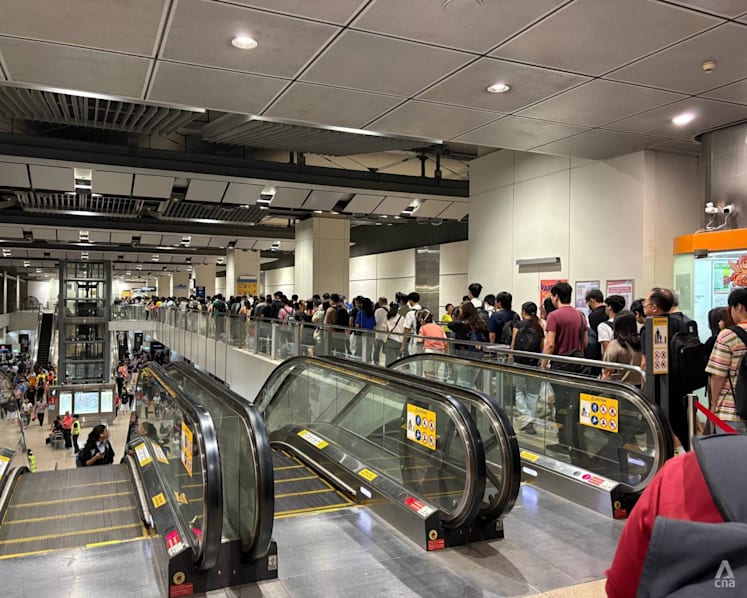
Commuters at Serangoon MRT station ushered along a linkway to the other side of the Circle Line platform to ease crowd congestion on Jan 19, 2026. (Photo: CNA/Justin Ong)

This audio is generated by an AI tool.


SINGAPORE: Crowd levels and waiting times were kept under control at Circle Line (CCL) stations affected by a three-month planned service disruption, although some said their travel time was extended by about 20 minutes.
Crowd management measures were in place at Serangoon MRT station on Monday (Jan 19) – the first weekday since the planned service disruption began on Saturday.
From Jan 17 to Apr 19, trains will run on a single platform between three CCL stations – Mountbatten, Dakota and Paya Lebar – to allow for tunnel strengthening works.
Crowd levels were high during the morning peak hour, but commuters were kept moving at Serangoon MRT station, with staff directing crowds towards alternative routes such as shuttle buses.





During the period of the disruption, about 500 additional people will be deployed to help manage and direct crowds at stations.
Some had loudhailers, while others handed out flyers or spoke to commuters who had questions about the disruption.
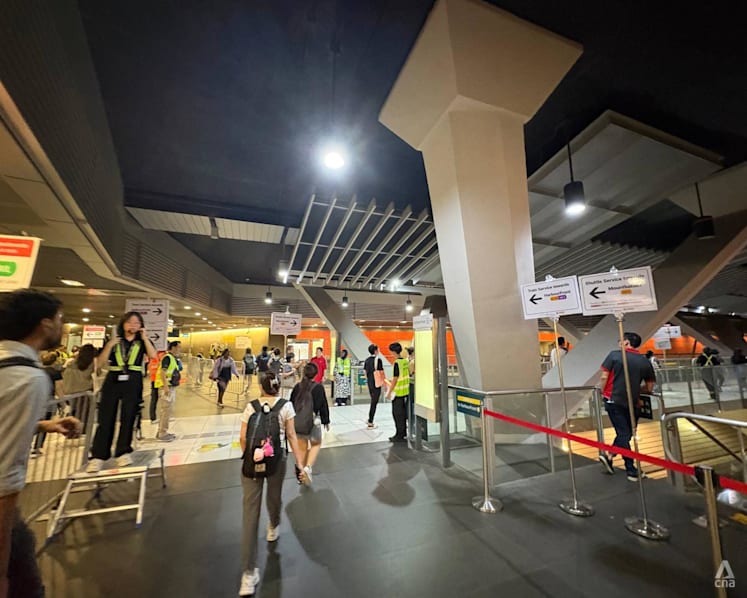
There were also various signs around the station directing commuters to alternative routes, as well as recorded announcements regarding the service disruption being played in the station.
At the CCL platform at Serangoon MRT station, commuters were directed to walk across a linkway to the other side of the platform so as to ease congestion.
Updates were posted on the Land Transport Authority's (LTA) website, with one at about 7.40am saying that there was a queue of up to 20 minutes to get to the platform. That was changed at about 8am to a queue of up to 10 minutes.
CNA observed at 7.50am and 8.30am that crowds continued to move across the linkway without stopping, with the platform kept relatively crowd-free.
Trains toward Paya Lebar MRT station arrived at about three-minute intervals, easing crowd congestion.
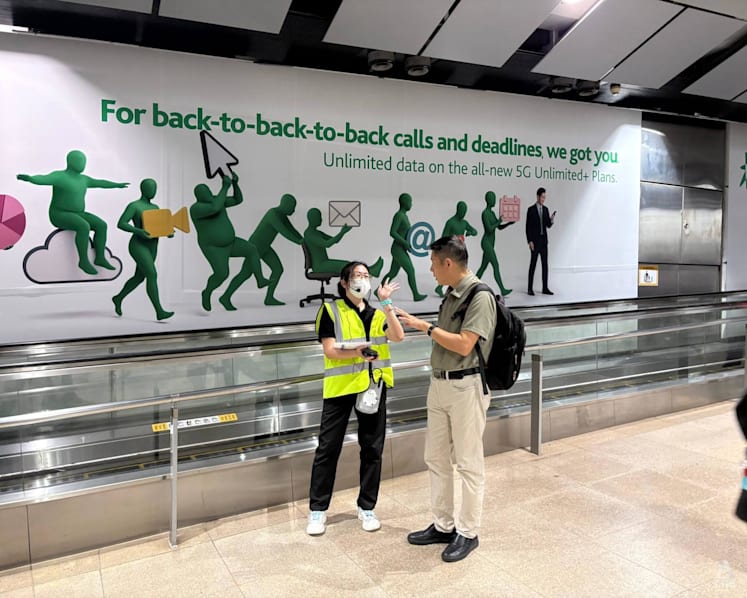
Architect Ramit Shourov, who was travelling from Sengkang to his workplace in Tai Seng, said that the walk to the other side of the platform with other commuters was smooth and orderly, and extended his travel time by five minutes.
“Sometimes, you have to keep patient for the better (transport) in the future,” he said.
Another commuter, who only wanted to be known as Audrey, was frustrated that the disruption had to take place on a workday.
The admin staff member was on her way to Paya Lebar for work and was walking in a crowd to the other end of the platform at Serangoon MRT station.
“Maybe timing-wise, they could have chosen another part of the day, and not every day,” said Audrey, who is in her 40s.
In a Facebook post on Monday afternoon, LTA thanked staff, volunteers and commuters.
The authority had said that to minimise the duration of service adjustments for commuters, the installation will be carried out 24/7 under a single, continuous tunnel closure.
“Due to the scale and complexity of the works, we require longer blocks of engineering hours to ensure that strengthening works can be carried out safely and effectively,” LTA said last month.
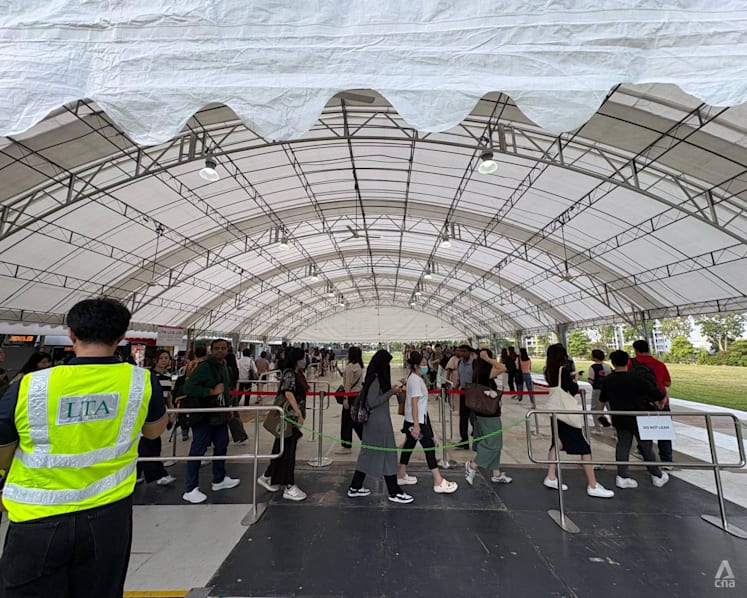
ORDERLY SHUTTLE BUS QUEUES
Commuters who were ushered to the shuttle bus services were also seen queuing in an orderly manner at 8am for shuttle Service 37A, which arrived every three minutes to take commuters to Paya Lebar station.
The peak-period shuttle bus services commenced on Jan 5 - about two weeks before the tunnel closure - so that commuters could familiarise themselves with the new travel options.
A tent had been set up so that commuters could wait in the shelter. The queue moved quickly, even as the line of commuters occasionally snaked beyond the queuing area.
Among those in the queue was Ms Ng, an event planner. She said that she had only waited for about two minutes in the queue before she was able to board a bus.
The 38-year-old had only found out about the disruption that morning, but found the shuttle bus service useful.
“The wait has been reasonable and the service makes it convenient,” she said.

SHUTTLE TRAINS
Commuters at Paya Lebar, Dakota and Mountbatten MRT stations had to wait longer for their trains, which arrived in 10-minute intervals, up from the usual three.
This is because the two parallel tunnels that connect the three CCL stations are closed one at a time, with a shuttle train operating between the stations in the open tunnel.
Road traffic controller Elangovan was at Paya Lebar waiting for the shuttle train to his work site at Mountbatten.
Having come from Sengkang, he felt the transits at Serangoon and Paya Lebar stations were “smooth” with ample help from station staff.
“I expected it to be worse, but so far, it’s okay, it’s not so bad,” said the 36-year-old.
Mother-of-two Hannah Lim was travelling from her home in Dakota to Telok Ayer to take her two children to preschool.
She said she tried taking a shuttle bus at Dakota, but waited for too long and decided to take the train.
She said that she wished there were more train or shuttle bus services, so that she could cut her wait time, which she estimates would add 20 minutes to her commute.
“We prepared for the disruption, but I didn’t expect it to be like this,” said the employment agent. “Now my kids will be late for school and I’ll be late for work.”
LTA had said last month that commuters should expect additional waiting times of up to 30 minutes during peak periods.
Wait times between Mountbatten and Dhoby Ghaut or Marina Bay stations have also increased to about 10 minutes from the usual six.

ENGAGEMENT EFFORTS
LTA said that public engagement for the planned disruption started in December for about seven weeks.
These engagements included door-to-door house visits to estates around the affected stations, engagements at schools, townhalls with residents, and road shows at the stations.
Ms Elynn Han, director of community partnership at LTA, told CNA in an interview on Jan 15 that over 40,000 commuters were engaged through these efforts.
“We understand that any change to daily travel can be inconvenient. We put in a lot of effort to prepare the ground early and to provide alternative travel options such as shuttle bus services by engaging early,” she said.
“We encourage commuters to give themselves time to adjust and try out different routes and approach our staff if they need help. We will be on the ground and ready to respond.”




