







Singapore’s core inflation rises to 1.6% in June, driven by higher prices of food, retail goods and services
The higher global energy prices from April to mid-June 2026 will be reflected in the regulated electricity tariff starting from July, said the Monetary Authority of Singapore and the Ministry of Trade and Industry.
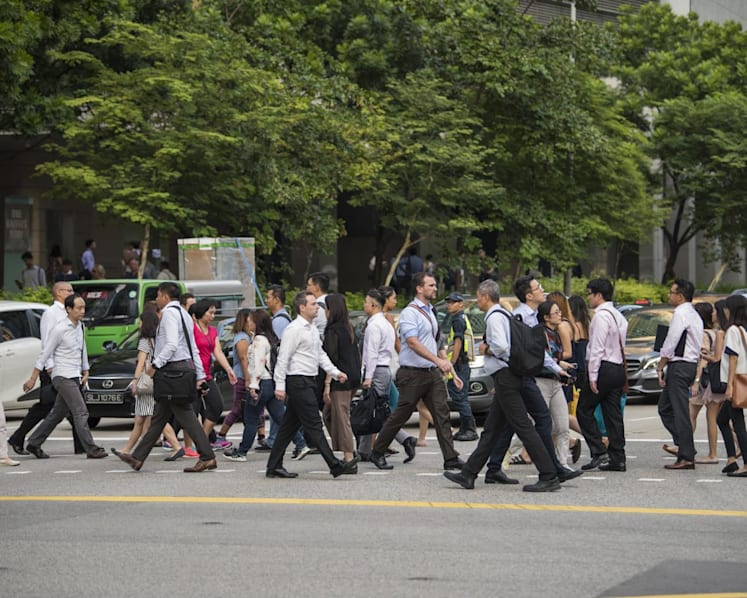
Office workers walking on the streets of the Central Business District. (File photo: iStock/3yephotography)

This audio is generated by an AI tool.


SINGAPORE: Singapore’s core inflation rose to 1.6 per cent year-on-year in June, up from 1.4 per cent in May, according to official data released on Thursday (Jul 23).
This was driven by an increase in food, services and retail and other goods inflation, the Monetary Authority of Singapore (MAS) and the Ministry of Trade and Industry (MTI) said in a joint media release.
On a month-on-month basis, core prices - which exclude accommodation and private transport - increased by 0.1 per cent in June.
June's core inflation rate was in line with the median forecast of 1.6 per cent in a Reuters poll.





Overall inflation, as measured by the Consumer Price Index-All Items, increased to 1.9 per cent in June from 1.8 per cent in May, due to higher accommodation inflation and the pickup in core inflation.
On a month-on-month basis, overall inflation - which excludes non-consumption expenditures such as purchases of houses, shares and other financial assets and income taxes - was unchanged in June.
SECTORS
Official data released on Thursday showed that food inflation rose from 1.8 per cent in May to 2.1 per cent in June as the prices of both non-cooked food and food services increased at a faster pace.
Services inflation increased from 1.3 per cent to 1.5 per cent due to larger increases in airfares and holiday expenses. The June school holidays started on May 29 and ended on Jun 27.
Accommodation inflation edged up from 0.5 per cent to 0.6 per cent in June due to a faster pickup in housing rents, while retail and other goods inflation increased from 1.6 per cent in May to 1.7 per cent in June on the back of larger increases in the prices of both furniture and other recreational goods.
Private transport inflation dipped from 8.6 per cent in May to 8.4 per cent in June because of a smaller increase in petrol prices.
Electricity and gas prices fell at a slower pace (from -3 per cent in May to -2.9 per cent in June) due to a smaller decline in electricity prices.
MAS and MTI noted that the regulated electricity tariff for each quarter is set based on the average natural gas prices in the first two and a half months of the preceding quarter, among other factors.
"Hence, higher global energy prices over the period of April to mid-June 2026 will only be reflected in the regulated electricity tariff in the third quarter of 2026, starting from July."
Meanwhile, average prices in the Open Electricity Market fell at a slower pace in June compared to May, resulting in a smaller decline in the electricity CPI, said the authorities.
OUTLOOK
The authorities noted that global energy prices remain elevated in comparison to their 2025 levels.
"As higher energy costs pass through global supply chains with a lag, they are expected to raise production and transport costs for a wider range of Singapore’s imported goods and services over time," said MAS and MTI.
On the domestic front, services unit labour costs are likely to increase at a slower pace this year as nominal wage growth eases from the firm levels last year. Also, domestic consumer spending could turn more cautious amid the economic uncertainty, they said.
Taking into account these factors, core inflation and overall inflation are expected to average 1.5 per cent to 2.5 per cent in 2026, which is in line with MAS' full-year forecast range.
“At this juncture, the risks to the inflation outlook remain tilted to the upside. A slower-than-expected resumption in global energy supplies or continued shortages in key intermediate inputs to regional supply chains could further raise imported costs for Singapore,” said MAS and MTI.
“However, downside risks are also present. A stronger-than-expected tightening in global financial conditions could lead to a slowdown in economic activity and thus lower inflation.”
FIRST HALF OF 2026
Separate data released by the Department of Statistics on Thursday showed inflation rose across all household income groups in the first half of 2026, with middle-income households experiencing the highest increase in consumer prices.
Overall inflation for the middle 60 per cent of households came in at 1.8 per cent, higher than 1.6 per cent for the highest 20 per cent income group and 1.2 per cent for the lowest 20 per cent. All three groups saw higher inflation than in the second half of 2025.
Overall inflation for general households rose 1.7 per cent year-on-year in the January to June period, up from 0.9 per cent in 2H2025.
Excluding imputed rentals for owner-occupied housing, overall inflation rose across the board, at 2.2 per cent for the middle 60 per cent, 2.0 per cent for the highest-income group and 1.5 per cent for the lowest-income group.
Food, motor cars, health insurance, accommodation and petrol were the main contributors to price increases across all household groups in the first half of the year, the statistics department said.
These increases were partially offset by lower costs for general, vocational & higher education as well as electricity.
The department noted that lower-income households experienced the smallest rise in prices mainly because motor cars and petrol accounted for a smaller share of their spending. They also benefited more from enhanced Ministry of Education financial assistance schemes and lower preschool fee caps, which contributed to a larger decline in education costs for this group.
In addition, higher rebates and subsidies for healthcare services, including interim rebates for selected long-term care services and enhanced subsidies under the Community Health Assist Scheme for dental care, more than offset price increases within the outpatient care services category for the lowest-income households. By contrast, outpatient care costs increased for middle- and higher-income households.




