Can GDP grow while jobs disappear? Economists weigh in on what Singapore's AI push must get right
Good jobs in an AI-rich economy will come not from asking how much labour can be removed, but from identifying which tasks still benefit from human judgment, says one economist.
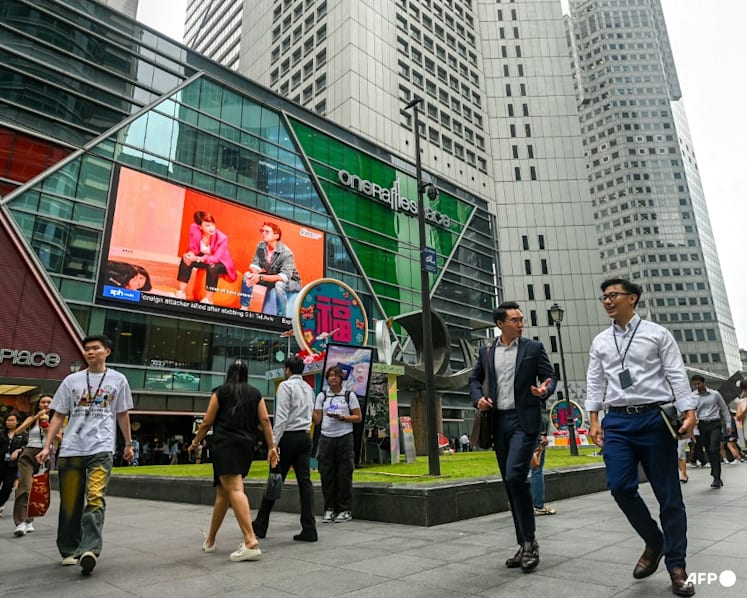
People walk on the street during lunch break at Raffles Place in Singapore on Jan 22, 2025. (File photo: AFP/Roslan Rahman)

This audio is generated by an AI tool.


SINGAPORE: Economic growth alone will not create jobs, economists said on Monday (Feb 2) as they weighed in on recommendations from the recent Economic Strategy Review update and what Singapore needs to get right in its artificial intelligence push.
Economic growth and job creation are often treated as synonymous, but it is worth separating the two, said Professor Nick Powdthavee, associate dean of Nanyang Technological University’s (NTU) College of Humanities, Arts and Social Sciences.
While growth is a necessary condition for job creation, it is not sufficient on its own, said Professor Lawrence Loh, who teaches strategy and policy at the National University of Singapore’s (NUS) business school.
“In other words, for jobs to be there, you need growth. But growth does not necessarily mean jobs," he said.





The Economic Strategy Review released seven recommendations on Jan 30 based on feedback from businesses and workers, aiming to secure economic growth and create quality jobs amid mounting challenges.
The review called for Singapore to establish itself as a global AI leader and push for AI adoption across its economy.
Deputy Prime Minister and Minister for Trade and Industry Gan Kim Yong outlined the challenges Singapore faces: global uncertainty, rapid technological advances, climate change and an ageing population.
“We can no longer assume that growth will automatically generate jobs,” he said during a media interview, describing growth and jobs as “twin objectives”.

Prof Powdthavee noted that in general, the link between growth and employment weakens when growth is accompanied by rising inequality.
“A country can grow even if most of the gains go to a very small group at the top,” he said.
For example, if firms become more profitable by replacing workers with AI, a country’s GDP will rise because output is higher and costs are lower.
“But that kind of growth doesn’t require more workers, and it may even reduce labour demand,” said Prof Powdthavee. “This is why growth doesn’t necessarily, or automatically, generate jobs.”
When productivity gains mainly benefit those who own capital, technology or data, the economy can “look healthy on paper” while wages stagnate and job opportunities “fail to expand for everyone else”, he said.
“In that sense, growth is real, but its benefits are narrowly shared.”
Prof Loh said that AI and automation can now perform tasks at levels comparable to humans, which is a negating factor for job growth.
Innovation and efficiency gain – where companies gain experience and rely on less human capital – also contribute to the issue, he added.
To ensure good jobs in Singapore, there needs to be a clearer definition of what qualifies as a good job, said chief economist and head of OCBC group research Selena Ling. “Is it wages, is it progression or what?” she said.
HUMAN-AI COLLABORATION
Despite its impact on job creation, economists agreed that AI cannot fully replace humans.
Prof Powdthavee noted that while AI excels at some tasks, it still makes mistakes and can be biased in ways that are not always obvious.
“The more sensible use of AI is not to replace people, but to work with them. The biggest gains come from human-AI augmentation,” he said.
“Let AI take care of routine, repetitive or data-heavy tasks, and let humans focus on judgment, context and responsibility,” said Prof Powdthavee.
This raises the value of human labour instead of eliminating it, he added.
“Productivity goes up because people can do more, not because there are fewer people doing the work. This distinction matters for jobs.”
Singapore also needs more dynamic labour market policies, said Prof Loh.
“How do you train people when jobs are continuously redesigned? … It’s so hard to plug and play because every time you hit the market with a new skill, the market has moved on.”
The next AI revolution – agentic AI, which can act autonomously – will be even more disruptive, he warned.
“We’re like riding the AI tiger. It’s hard to dismount without being eaten,” said Prof Loh.
Technological advancements will affect even non-technical aspects, including ethics, governance and change management, calling for both technical and non-technical responses, he added.
“Even the non-technical part will create new job opportunities for people to govern, to manage AI.”

CARVING OUT A NICHE
Singapore could carve out a niche in AI governance and standards, economists suggested.
Assistant Professor Goh Jing Rong from the Singapore Management University’s School of Economics noted that Singapore could lead in shaping AI rules, interoperability and responsible data-sharing, creating an ecosystem of firms and specialist roles.
Singapore could also offer trusted “AI assurance” services – auditing, governance, model risk management, safety testing and privacy engineering – which could generate high-value professional jobs, said Asst Prof Goh.
Prof Powdthavee highlighted Singapore's potential in ethical AI – systems designed to be reliable, auditable and accountable in real-world settings.
“This plays to Singapore’s strengths and creates demand for human judgment rather than replacing it.”
Good jobs in an AI-rich economy will come not from asking how much labour can be removed from a process, but from asking which tasks still benefit from human judgment, accountability and interaction, he said.
Roles should then be designed around those tasks, he added.
“That requires deliberate choices. It also requires resisting the short-term temptation to use AI purely as a cost-cutting tool.”