Retrenchments rose slightly in 2025, but employment growth expanded: Advance estimates
The full-year unemployment rate remained broadly similar to those seen over the past two years, "reflecting the broadly stable unemployment rates throughout 2025", said the Ministry of Manpower.
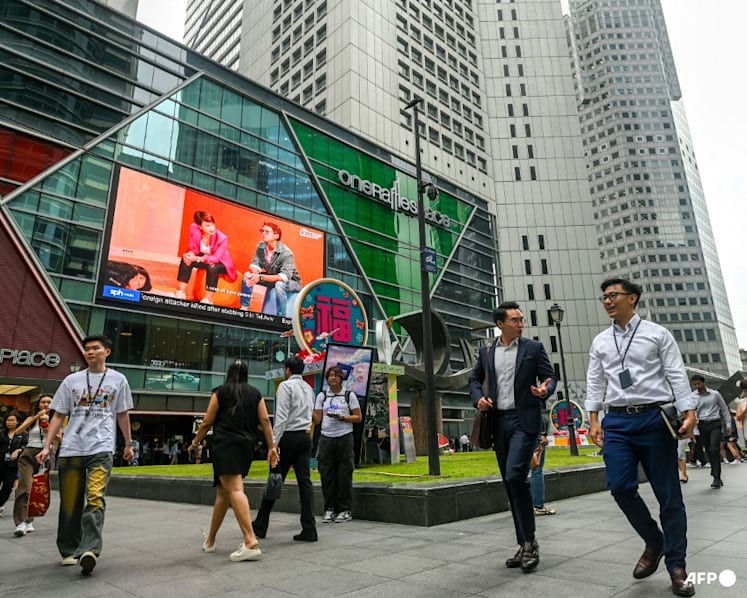
People walk on the street during lunch break at Raffles Place in Singapore on Jan 22, 2025. (File photo: AFP/Roslan Rahman)

This audio is generated by an AI tool.


SINGAPORE: Retrenchments in Singapore saw an uptick in 2025 compared with the previous year, but total employment growth came in stronger last year than in 2024, according to advance labour market figures by the Ministry of Manpower (MOM) on Thursday (Jan 29).
For the full year of 2025, the incidence of retrenchment increased slightly to 6.2 retrenched per 1,000 employees (14,400), from 5.9 retrenched per 1,000 employees (13,020) in 2024.
This was driven mainly by retrenchments in transportation and storage, and financial services, according to MOM.
"The increase largely reflects higher retrenchments earlier in the first three quarters of 2025 compared to the preceding year. Throughout 2025, business reorganisation or restructuring remained the primary reason for retrenchments," MOM said.





On a quarterly basis, the incidence of retrenchment in 2025 remained low at 1.5 retrenched per 1,000 employees in the fourth quarter, which was comparable to the third quarter's 1.6.
The fourth quarter saw 3,600 employees retrenched, similar to the previous quarter's 3,670.
MOM also noted that retrenchments were stable across major sectors, with a majority occurring due to business reorganisation or restructuring.
EMPLOYMENT GROWTH
Singapore’s total employment growth in 2025 was 57,300, stronger than the previous year's figure of 44,500, according to advance estimates.
Resident employment growth was concentrated in financial services and in health and social services, MOM said.
Non-resident employment growth continued to be driven by the construction sector, largely comprising work permit holders.
The total employment growth in the fourth quarter of 2025 was 19,600.
While this was lower than the stronger-than-anticipated growth of 25,100 in the third quarter, MOM noted that it remained higher than employment growth in the first half of 2025 (2,300 in the first quarter and 10,400 in the second).
Employment growth in the fourth quarter was also higher than the corresponding periods in 2024 (7,700) and 2023 (3,900).

UNEMPLOYMENT RATE
MOM said that the overall unemployment rate of 2.0 per cent in December 2025 was broadly unchanged from September 2025, which was also at 2.0 per cent.
Resident and citizen unemployment rates were at 2.9 per cent and 3 per cent in December 2025 respectively, from 2.8 per cent and 3.1 per cent in September.
The full-year unemployment rate for the year remained low at 2.0 per cent overall, broadly similar to those seen over the past two years and "reflecting the broadly stable unemployment rates throughout 2025", said MOM.
OUTLOOK
In its outlook for the first quarter of 2026, MOM said that business expectations suggest continued expansion for the labour market, albeit amid increased hiring caution.
The share of firms expecting to hire in the next three months edged down slightly from 44.1 per cent in September 2025 to 43.3 per cent in December 2025.
"At the same time, a larger share of firms expects to raise wages over the same period, rising from 19.3 per cent to 26.4 per cent, pointing to improving business outcomes and continued competition for labour in certain areas."
While the share of firms expecting to retrench workers also increased from 2.3 per cent to 4.3 per cent over the same period, it remains low, suggesting selective workforce adjustments rather than broad-based job cuts, the ministry added.
"While the labour market continues to expand and remain tight, employers and workers should continue to adapt and transform so as to seize new opportunities," said MOM.
The labour market report for the fourth quarter of 2025 will be released in mid-March 2026, it said.
In a Facebook post on Thursday, Assistant Secretary-General of the National Trades Union Congress Yeo Wan Ling said that the figures are "encouraging signs of resilience".
Noting that restructuring and job redesigning continue across sectors, Ms Yeo said that some workers, including young graduates and those in transforming industries, face uncertainty as skills requirements evolve.
As technologies like AI continue to reshape work, early support for workers to reskill, adapt and move into new roles becomes even more important, she said.
"NTUC will keep working with workers, employers and our tripartite partners to ensure growth translates into quality jobs, fair wages and real opportunities - and that no worker navigates change alone."
Ms Yeo, who is also a member of parliament (PAP-Punggol), added: "We will be calling for stronger support for workers in our Budget 2026 debate."