







Almost 350 fresh graduates find places in government-sponsored traineeships
Less than half the initial capacity of 800 places has been filled under the Graduate Industry Traineeships scheme.
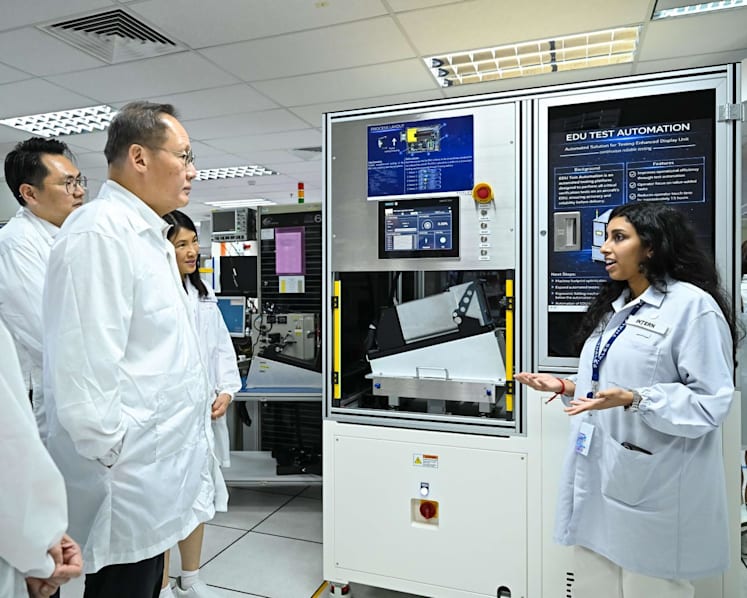
Manpower Minister Tan See Leng listens to a presentation at Thales Solutions Asia on Feb 6, 2026. (Photo: Ministry of Manpower)

This audio is generated by an AI tool.


SINGAPORE: Almost 350 fresh graduates have found places as trainees under a new government-sponsored traineeship scheme, the Ministry of Manpower (MOM) and Workforce Singapore (WSG) said on Friday (Feb 6).
Launched last October, the Graduate Industry Traineeships (GRIT) scheme initially offers up to 800 traineeships across private and public sectors.
The trainee stints last from three to six months and pay a monthly allowance of S$1,800 (US$1,400) to S$2,400, with 70 per cent co-funded by the government.
During a visit to French aerospace and security company Thales Solutions Asia, which has taken on five trainees, Manpower Minister Tan See Leng sought to give assurance to young graduates.





“We empathise with the concerns that young people have about their first job. The encouraging sign is that many opportunities are available for those who are ready to take the next step,” he said.
He pointed to the number of entry-level roles for professionals, managers, executives and technicians (PMETs), which rose from 31,000 in June 2025 to 39,000 in September 2025.
“Singapore’s labour market has been resilient in 2025 despite global economic uncertainties, and we expect employment to continue to grow in 2026,” he said.
Close to seven in 10 of last year’s university cohort had already secured jobs by September 2025, and Dr Tan said this will increase over time as more graduates explore and take advantage of opportunities.
For polytechnic graduates, nine in 10 who were seeking work found jobs within six months of graduation or completing National Service in 2025.
“We will continue to support all of our graduates in their job search, and we will prioritise efforts to help them secure permanent employment,” said Dr Tan.
Resources that have been made available include career events, including at least 14 career fairs hosted by institutes of higher learning, and access to career advisors.
“To our fresh graduates, this is our assurance to you. We remain committed in giving you the support you need for a strong start to your careers,” said the minister.


TRAINEESHIPS
The GRIT scheme is intended for fresh graduates from universities, polytechnics, the Institute of Technical Education and other educational institutions who have no prior work experience. It is open to graduates with master's degrees or doctorates.
Singapore citizens and permanent residents who graduated or completed National Service in 2024 or 2025 can apply.
Engineering graduate Skyler Teo, 25, joined Thales for a six-month traineeship in January. This followed a “tough” job search in which he sent out close to 200 applications in six months.
He sent out about 60 applications through the GRIT scheme, and heard back from three or four companies.
Mr Teo said the traineeship was a good opportunity to gain real experience at work.
He said that in his field, diploma holders were preferred for technical-level jobs as they have more technical training and are less expensive to hire, while work experience is required for higher-level jobs.
“Comparatively, traineeships are a lot easier for fresh graduates to get into,” he said.
Mr Teo said he hoped to stay on at Thales if offered a full-time position.
Thales Solutions Asia employs about 2,100 people in Singapore and is always keen to support young talent, said CEO Emily Tan.
GRIT was a “competitive” process for both the trainee candidates and companies given the limited slots available, she added.
On converting trainees to full-time employees, Ms Tan said there would be a discussion with the trainees for a “mutual decision” on whether the available roles fit their interests and aspirations.
In Friday's update – the first since the scheme started – MOM and WSG said more than 50 companies have come on board to host the traineeships.
The firms span sectors including manufacturing, financial services, information and communications technology and professional services.
Those that have taken on trainees include DBS, GrabTaxi, LinkedIn, Nestle, OCBC, Razer, SATS, ST Engineering and UOB.
The traineeships cover niche technical roles as well as wider cross-functional roles, reflecting the wide spectrum of skills in demand, said MOM and WSG.
These opportunities were identified by WSG in partnership with Enterprise Singapore, the Economic Development Board and the Monetary Authority of Singapore.
Sixty public sector agencies are also offering traineeships coordinated by the Public Service Division, said MOM and WSG.
Trainees have joined MOM, the Ministry of Defence, the Ministry of Education, the Civil Aviation Authority of Singapore, the Government Technology Agency, the Health Promotion Board, the National Library Board, the Urban Redevelopment Authority and Singapore Polytechnic.
GRIT is an initiative of the Singapore Economic Resilience Taskforce that aims to support fresh graduates in gaining hands-on, industry-relevant work experience so they can transition into full-time employment.
When the scheme was first announced at the National Day Rally in August 2025, Prime Minister Lawrence Wong said it would start with a more focused roll-out and be scaled up if the economy worsens.
Singapore's economy beat expectations to grow 4.8 per cent in 2025, although the prime minister has said sustaining this pace would be challenging.
The government projects the economy to grow between 1 per cent and 3 per cent in 2026.
There have been reports of job anxiety among fresh graduates. The resident unemployment rate for workers under 30 dipped slightly to 5.5 per cent in the third quarter of 2025.
Advance estimates placed overall unemployment in 2025 at 2 per cent, similar to the previous two years.





