







Singapore logistics firms could face 50% cost surge as Middle East cargo stalls amid tensions
The Association of Small and Medium Enterprises said firms may be forced to make tough decisions, including cutting manpower and reducing rental costs to cope with the disruption.
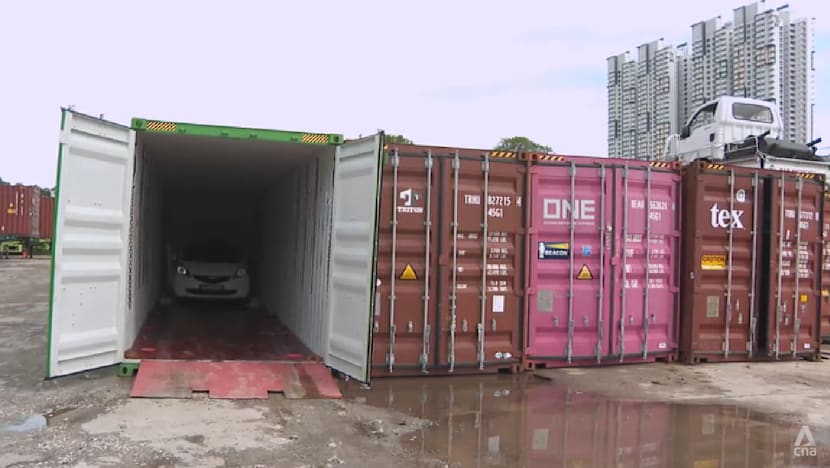
Hermes Logistics, a Singapore-based freight forwarder, currently has 18 containers like these stuck at sea en route to its largest market – the Middle East.

This audio is generated by an AI tool.




SINGAPORE: Singapore logistics firms are bracing for cost increases of up to 50 per cent as cargo bound for the Middle East grinds to a near-halt amid escalating regional tensions that have driven up fuel prices and prompted shipping lines to suspend routes.
Freight forwarders say surcharges, rising energy costs and prolonged delivery delays are disrupting supply chains.
STALLED SHIPMENTS
Hermes Logistics, a Singapore-based freight forwarder, has 18 containers of cars stuck at sea en route to its largest market – the Middle East.
The company has had to pay surcharges of more than S$5,000 (US$3,900) per container, with no certainty that the shipments will reach their final destinations as the situation around the Straits of Hormuz remains fluid.
Traffic through the key trade route remains strangled due to the United States-Israel war on Iran.
For now, the firm is trying to split the additional costs with its customers while exploring alternative options.
“We have quite a bit of cargo going to the Middle East, so stopping cargo going to the Middle East will affect our warehousing costs, because we have to hold the cargo longer in our warehouse,” said Mr Jeremy Lam, business development manager at Hermes Logistics.
He added that payment cycles have also been disrupted.
“Our clients cannot move their cargo, so their payment will be stalled, because money is not going to them, and therefore not going to us,” he said.
Other freight forwarders warn that the ripple effects extend beyond stalled shipments.
Penanshin Air Express said a key concern is rising fuel and electricity costs, which could push overall transport and warehousing expenses up by as much as 50 per cent.
Its executive director, Mr Bernard Chan, is considering the possibility of diverting cargo to Egypt before transporting them overland to Dubai.
He noted that the current disruption differs from the COVID-19 pandemic as cargo has completely stopped moving.
Surcharges of up to over S$2,000 have also been implemented on alternative routes.
“We are very dependent on the shipping lines and airlines, so there's really nothing much we can do,” said Mr Chan.
“This war will not only affect the Middle East. It also affected us as Singaporeans. So right now we are seeing that even at our local petrol stations, the fuel price has really increased.”
MANAGING COST PRESSURES
The Association of Small and Medium Enterprises (ASME) said firms may soon be forced to make tough decisions, including cutting manpower costs to cope with the disruption.
ASME president Ang Yuit called on SMEs to exercise greater prudence, remain vigilant as the situation unfolds and prepare themselves for a potentially turbulent period.
They may also need to reassess their expansion plans in the Middle East region.
“Things are looking messy. So as of now, It doesn't look like it's going to be something that can be untangled in the short term,” said Mr Ang.
“So, I think businesses are reconsidering whatever they thought about,” he added.
“Those that are waiting and seeing may now have been in a state of making a decision to say maybe I should wind down a little or ramp down a little and hopefully reduce my risk and exposure.”





