







Longer MRT closures to come as LTA accelerates rail upgrades after recent disruptions
Planned shutdowns will likely be extended as authorities prioritise upgrades to power, signalling and train systems following a spate of disruptions in 2025.
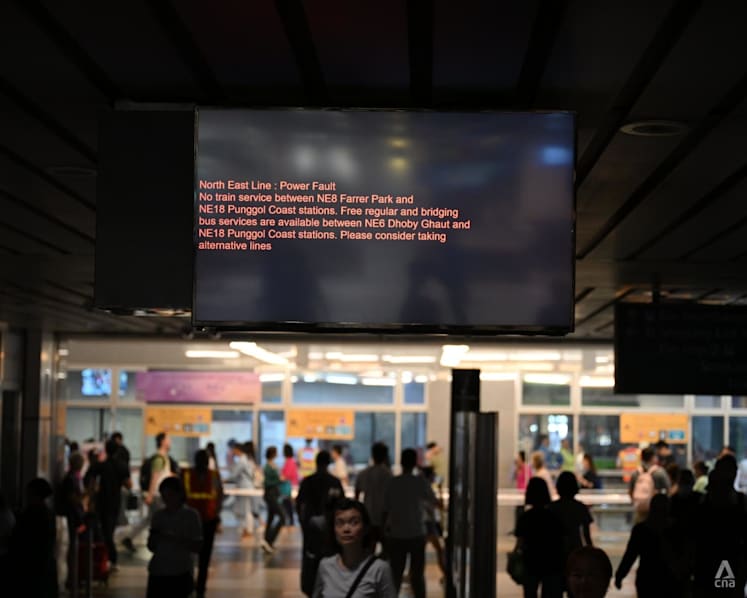
A message on a TV screen informing commuters of a power fault at Sengkang MRT station on Aug 12, 2025. (Photo: CNA/Marcus Mark Ramos)

This audio is generated by an AI tool.


SINGAPORE: Train service closures could last longer in the coming years as the Land Transport Authority (LTA) and operators expedite upgrades to critical rail infrastructure across the MRT and LRT networks.
This comes as the Ministry of Transport accepted a wide-ranging set of recommendations from the Rail Reliability Taskforce, formed in September last year after a spate of disruptions.
Renewal of power, signalling and train systems will be prioritised, as major failures in these areas have direct and significant impact on commuters, LTA, SMRT and SBS Transit said in a press release on Friday (Feb 13).
For instance, renewal of the North East Line (NEL) power supply system will be brought forward to begin this year. Other upgrades include enhancing the power intake at the NEL depot in Sengkang and increasing traction power capacity on the NEL and Sengkang-Punggol LRT through additional substations.





In the longer term, LTA plans to explore building a dedicated higher-capacity backup power intake for the NEL.
SIGNALLING AND TRAIN IMPROVEMENTS
For signalling, LTA and operators will study additional operating procedures and bypass systems to enable faster recovery during faults without compromising safety. These could allow trains to continue moving at slower speeds rather than come to a complete halt.
To address train-related faults, LTA will revise the placement of key mechanical components such as coupling levers and brake isolation valves for easier access during breakdowns. It will also improve trains' electrical circuitry for better fault resilience.
The task force had suggested full-day closures to speed up renewal works.
Responding to queries from CNA on whether this will be implemented, a spokesperson from LTA said some works are more complex and intensive, and can only be carried out safely and efficiently over longer periods than standard engineering hours permit.
"This will require service adjustments. Whether full-day service closures are required depends on the type of works being carried out and their complexity."
Any changes to service hours would be carefully studied and communicated in advance, the transport authority added.
However, more engineering hours will be set aside, including longer service closures where needed.
"This is necessary as renewing multiple systems simultaneously whilst maintaining day-to-day rail operations poses inherent coordination and operational challenges," LTA and the operators said, adding that service adjustments will be carefully planned and alternative transport options provided to commuters.
Plans are also underway to accelerate the deployment of bridging buses during service interruptions to minimise commuter delays.
OTHER IMPROVEMENTS
LTA and the operators will also improve spare parts management, including stockpiling additional spares to enable timely replacements when faults occur and procuring extended service support from manufacturers for critical systems.
In the longer term, more standardised and modular rail system designs will be adopted to enable faster upgrades or replacements and simpler maintenance planning.
Data-driven condition monitoring will be standardised across the network to allow earlier fault detection. Robotics and automation will be further deployed in maintenance, and LTA will co-fund upskilling initiatives for staff.
The Singapore Rail Academy will expand its role to standardise training for operations and maintenance staff, with clearer certification frameworks linked to career progression. LTA aims for 20 per cent of the workforce to be chartered or certified, forming a core pool of master practitioners to mentor others.
LTA will also study the setting up of a separate fund to provide grants for innovative projects, as part of efforts to position the rail sector as one offering high-value, future-ready jobs in a digitalised environment.
The National Transport Workers’ Union (NTWU) said on Saturday that these efforts will strengthen career progression opportunities and uplift the capabilities of rank-and-file rail workers.
"NTWU remains firmly committed to working closely with our tripartite partners to upskill and empower our rail professionals," it said in a Facebook post.
"Together, we will continue to build a resilient, world-class rail system, one that delivers safe, reliable journeys while providing meaningful and sustainable careers for our workers."
15 incidents in 3 months
Jul 1, 2025: TEL service disruption due to a signalling fault. Train services from Napier to Great World stations were affected.
Status: The disruption was due to a faulty computing unit in the signalling equipment housed in Orchard MRT station. The faulty component has been replaced.
Jul 3 and 19: Bukit Panjang LRT service disruption due to a power fault.
Status: A network switch in Bangkit station encountered an intermittent malfunction, resulting in loss of communication to the traction power system. This caused the power supply network to trip for safety reasons. The malfunctioning network switch has been replaced.
Jul 26: Bukit Panjang LRT service disruption due to a power fault affecting the Inner Loop (Service B).
Status: Caused by the train Current Collector Shoe (CCS) on one vehicle having poor contact with the power rail. The CCS has been realigned.
Aug 6: North-South Line (NSL), East-West Line (EWL) service delay due to a point fault after EWL Jurong East station (east bound).
Status: A track point fault caused the start of train services at Jurong East and Kranji stations to be delayed. Faulty cables have been replaced.
Aug 12: Two incidents – NEL and Sengkang-Punggol LRT service disruptions due to a power fault.
Status: A faulty voltage transformer at the Sengkang Depot Intake substation resulted in a double fault, tripping out both primary and secondary protections. The voltage transformer has been replaced.
Aug 15: Sengkang-Punggol LRT service disruption due to a power fault.
Status: A power cable fault between Farmway and Kupang stations resulted in a power outage to the Sengkang-Punggol LRT.
Due to the earlier incident on Aug 12, Sengkang-Punggol LRT was operating on a single intake source from the Sengkang Depot intake substation. The power cable fault resulted in a power outage for the whole network. The power cable has been repaired, and all power cables have been checked.
Aug 28: Downtown Line service disruption due to a point fault affecting services to Bukit Panjang to Beauty World stations.
Status: Due to a mechanical fault in a point machine between Bukit Panjang and Cashew stations (Expo bound). The mechanical fault has been rectified.
Sep 1: CCL service disruption due to a train fault affecting Marina Bay to Promenade stations.
Status: A train between Marina Bay and Bayfront stations stalled and required a haul out by another train. The fault was a result of cable insulation failure connected to an obstacle detector on the train. The cable has been replaced.
Sep 2: NSL service delay due to a train fault affecting Woodlands to Yishun stations.
Status: Signalling equipment on a train near Canberra station malfunctioned and stalled a train, which required a haul-out by another train. A faulty connector was replaced.
Sep 13: Sengkang-Punggol LRT (Punggol) service disruption due to a signalling fault.
Status: A faulty interface component on the signalling system limited the control of trains required for the start of service. The faulty component has been replaced.
Sep 14: NSL service delay due to a train door fault affecting Ang Mo Kio to Newton stations.
Status: Due to a train door fault, a train stalled at the north-bound track at Toa Payoh station (north bound), which required a haul out by another train. The faulty train door component has been replaced.
Sep 16: EWL service disruption due to a signalling fault affecting Aljunied to Tanah Merah stations.
Status: Signalling system lost power arising from a component failure within the Uninterruptible Power Supply system at Eunos station. The power has been restored.
Sep 17: TEL service disruption due to a signalling fault.
Status: The central signalling servers encountered a fault. This required the servers to be rebooted. During this period, the trains were operated manually, which resulted in additional travelling time. Further investigation is ongoing.
The task force, which submitted its recommendations on Dec 30 last year, comprises international leaders who have held key engineering and management roles in the rail sector.
In developing these recommendations, it conducted detailed technical workshops, site visits, ground observations and interviews with operational and technical staff over a three-month period, the transport ministry said.
"This report is the result of four months of very intense work between September and December last year. We had scrutinised every MRT and LRT line for immediate issues that we could resolve together," said LTA chief executive Ng Lang.
"The task force work is taking place at a very opportune time when we are juggling between ageing, existing systems and a rail network that is expanding rapidly.
“We hope that the recommendations of the task force can contribute towards shaping the work that needs to be done going forward to help us sustain the reliability of our rail network,” Mr Ng said.




