







From heatwaves to rising seas: Singapore lays out climate adaptation plan
Singapore's first National Adaptation Plan signals how the country is preparing for a warming world.
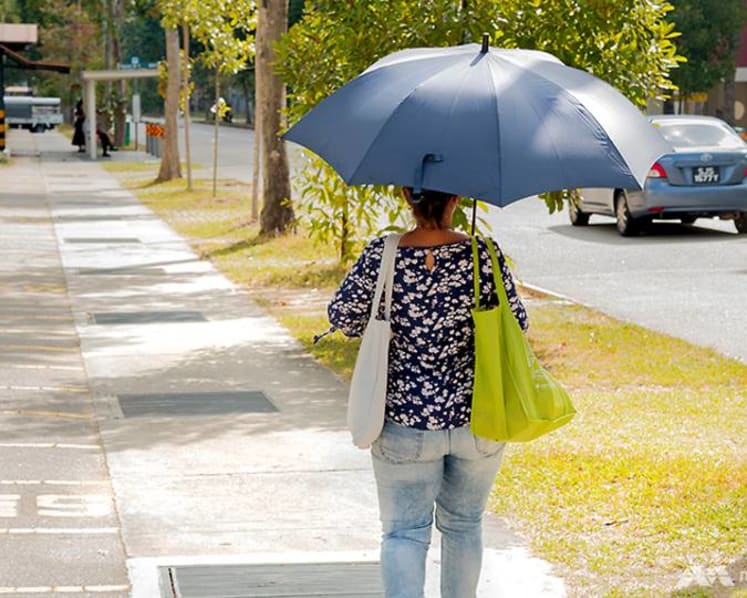
A woman walking down a street in Singapore. (File photo: CNA/Gaya Chandramohan)

This audio is generated by an AI tool.


SINGAPORE: Singapore has laid out its inaugural National Adaptation Plan, addressing heat resilience, flood protection, coastal defence, and water and food security.
Minister for Sustainability and the Environment Grace Fu, who designated 2026 the Year of Climate Adaptation, outlined the key pillars of the strategy – to be published as a formal plan next year – while presenting her ministry's budget in parliament on Tuesday (Mar 3).
Warning of intensifying climate risks, she cited World Economic Forum figures estimating that climate hazards could inflict more than a trillion dollars in economic losses globally by 2050.
Global climate action is under strain, she added.






"Economic instability and geopolitical contestation, like the latest conflict in the Middle East, are clouding our focus on protecting our environment. Major emitters may backslide on their climate obligations as they grapple with the global tensions on security, energy, trade and investments.
"In such uncertain times, the environment becomes an inevitable casualty, and our planet will face the impacts of climate change more severely, and sooner."
Singapore will not be immune, she said, warning that businesses and residents alike could suffer from climate-related disruptions.
"In an increasingly volatile world, we must prioritise building a climate-ready Singapore now. We must prepare our infrastructure, businesses and people today to be resilient in a climate-impaired future," Ms Fu said.
HEAT AND FLOOD RESILIENCE
On heat, Ms Fu said the government will strengthen inter-agency coordination and invest more in research and development to better understand its impact. Singapore is also expanding its heat stress sensor network islandwide.
In a separate speech, Senior Minister of State for Sustainability and the Environment Janil Puthucheary said a new Heat Resilience Policy Office has been set up to "chart the way forward for our heat resilience efforts".
Established by the Ministry of Sustainability and the Environment (MSE), the office brings together agencies including the Ministries of National Development, Health, Manpower and Social and Family Development to coordinate action, oversee research and represent Singapore internationally.
Dr Puthucheary said the office will develop a heat resilience action plan across the infrastructure, health, economic and social sectors.
"The action plan will identify priority areas and develop measures to address them, including by extending proven solutions to other sectors," he said.
"This will also prevent duplicative efforts and ensure that our principles are aligned, while working with individual agencies leading the various initiatives."
The office will also identify high-risk sectors and populations, and assess how to balance additional cooling needs with Singapore's emissions targets, among other issues.
Dr Puthucheary also announced the launch of a heat resilience R&D programme under the Research, Innovation and Enterprise 2030 plan to strengthen research and investment in heat resilience through two pillars – one focused on infrastructure solutions and the other on understanding and managing heat impacts on society.
A S$40 million (US$31.3 million) "Adapting to Heat Impacts" funding initiative will be launched under the programme to step up research in areas including the health impacts of heat, as well as community heat resilience. Vulnerable groups will be a key focus under the new initiative.
"We will devote more resources to study and protect those who are more vulnerable to heat, such as the elderly and the very young, and those who are more exposed to heat, such as outdoor workers," said Dr Puthucheary.
On flooding, several drainage improvement projects are in the pipeline, including works at Bedok First Subsidiary Drain and the Sungei Serangoon Eastern and Western subsidiary drains.
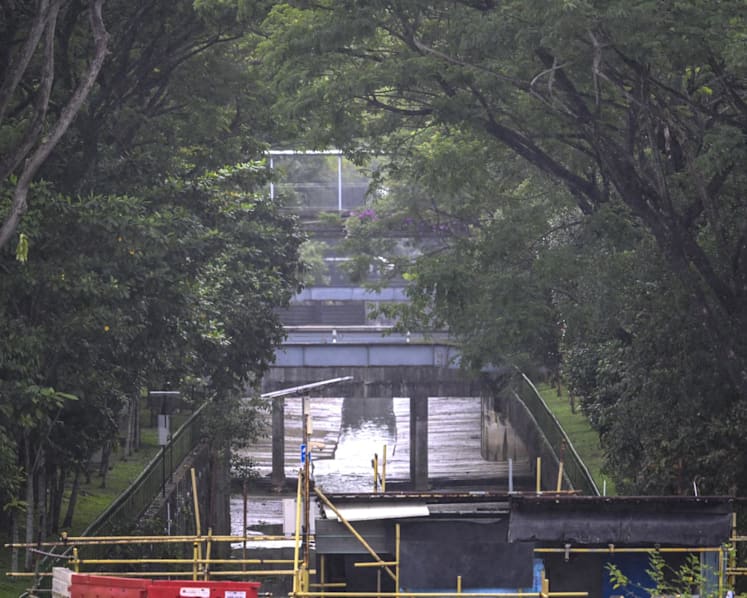
Drainage improvements along a 900m stretch of the Bukit Timah Canal between Rifle Range Road and Jalan Kampong Chantek will also be completed this year.
COASTAL RESILIENCE
"To protect our coastlines from rising seas, we will build a continuous line of defence around Singapore," Ms Fu said.
Singapore's mean sea level is projected to rise by up to 1.15m by the end of the century, while extreme weather events such as high tides and storm surges could push sea levels up by as much as 5m. Around 30 per cent of Singapore's land sits less than 5m above mean sea level.
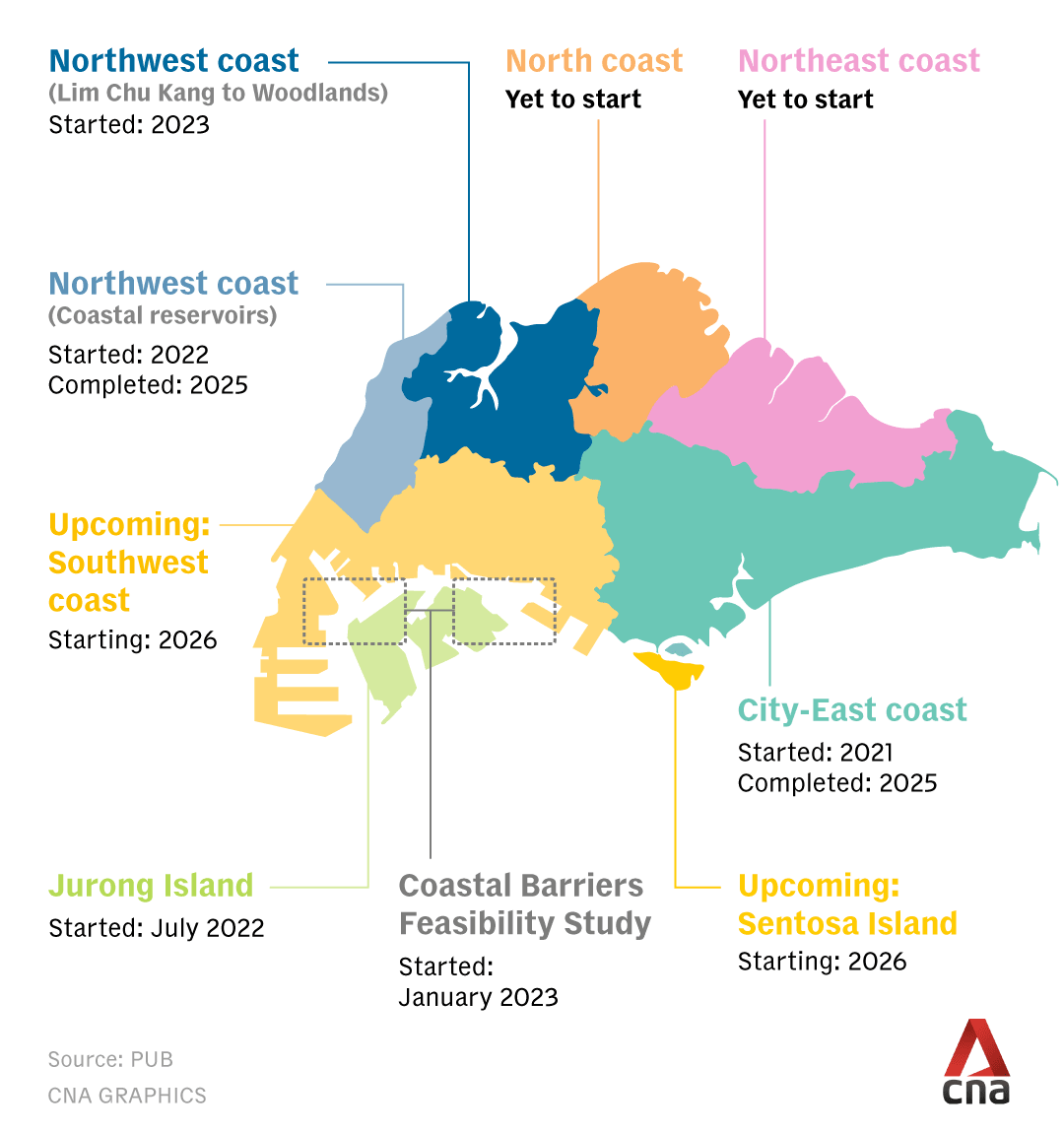
Conceptual studies for the northwest coast stretching from Tuas to Lim Chu Kang have been completed. Recommended measures include replacing tidal gates and raising dykes to protect four coastal reservoirs – Tengeh, Poyan, Murai and Sarimbun – which are critical freshwater sources for Singapore.
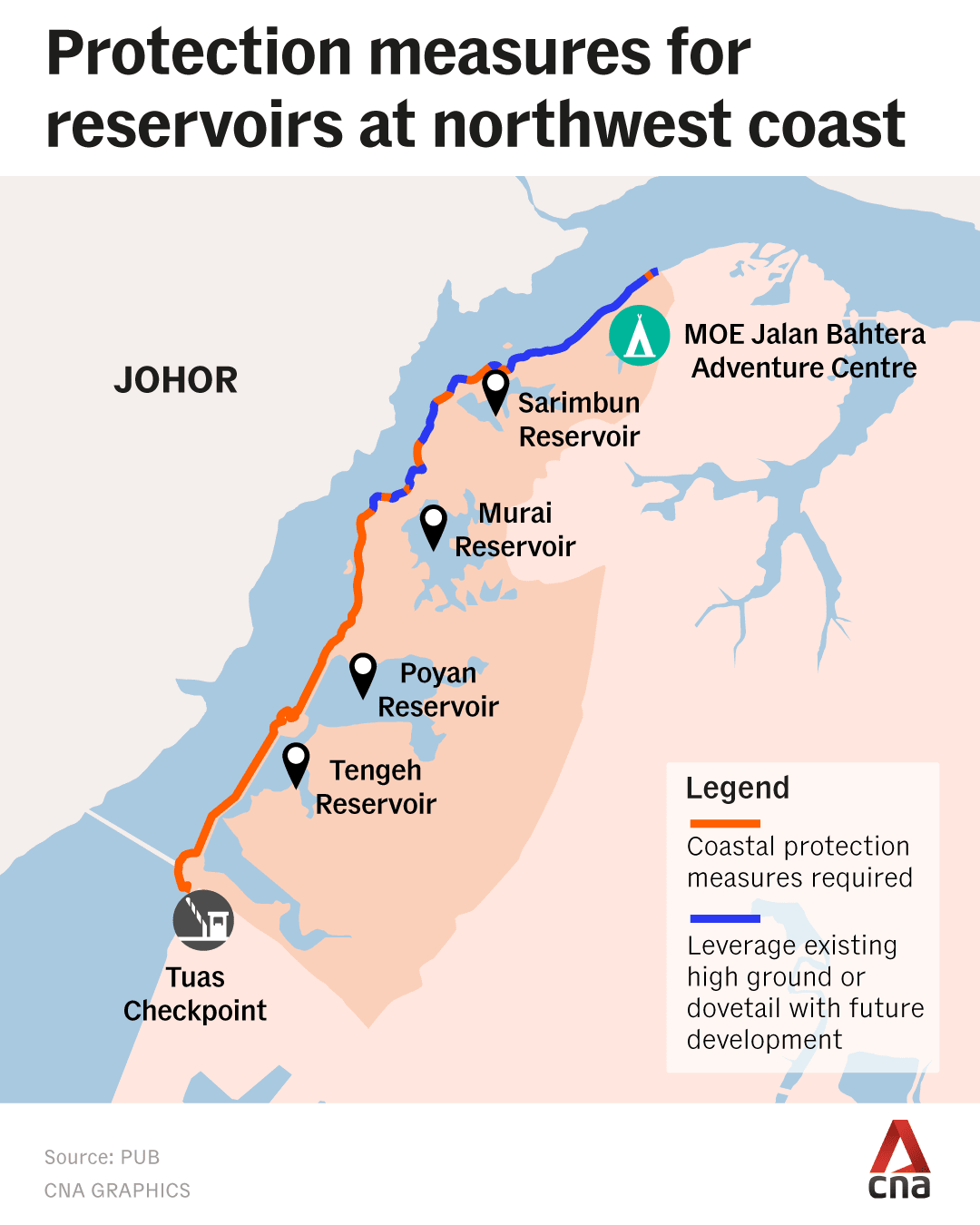
National water agency PUB said in a joint press release with the ministry that the elevated dykes will double as maintenance roadways and incorporate design features to preserve ecological connectivity with the sea.
For other stretches of coastline, the continuous line of defence will draw on existing high ground, integrate coastal protection into future developments, and replace tidal gates at reservoir dykes, PUB added.
Detailed engineering designs for the recommended measures are being developed, with construction targeted to begin from the mid-2030s, subject to further studies. A separate study covering a 15km stretch of the northwest coast from Lim Chu Kang to Woodlands is on track to be completed this year.
PUBLIC ENGAGEMENT
The government will hold focus group discussions and a public exhibition this year to gather feedback on the National Adaptation Plan, Ms Fu said.
To support ground-up initiatives, the SG Eco Fund will broaden its funding scope to include climate adaptation projects.
In a separate speech on Wednesday, Senior Parliamentary Secretary for Sustainability and the Environment Goh Han Yan said Singapore will commit up to S$5 million over two years through the SG Eco Fund to support projects that build climate awareness and inspire community action.
Applications will open year round from May 1, with funding coverage for eligible project costs raised from 80 per cent to 90 per cent.




