







Singapore to bolster middle power, regional ties amid 'geostrategic tectonic plate rupture': Vivian Balakrishnan
"We are now in a world where international relations are no longer driven primarily by rules or by attempts to achieve consensus," the Foreign Affairs Minister says.
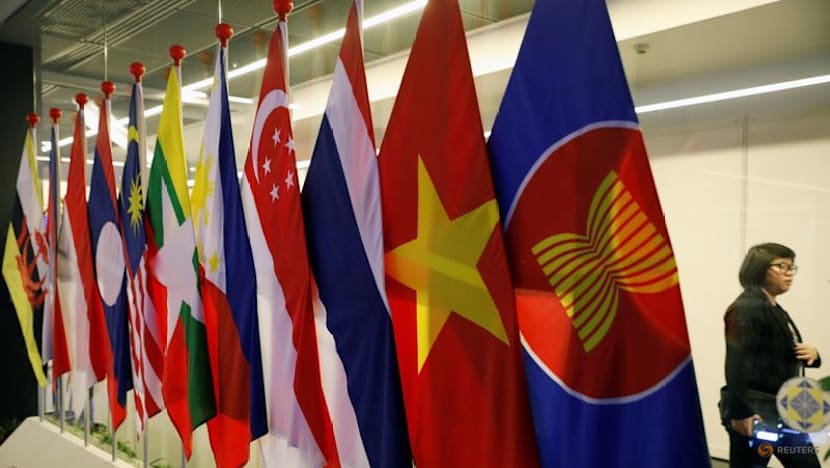
A woman walks past flags of Association of Southeast Asian Nations member nations at Suntec Convention Centre in Singapore on Nov 11, 2018. (File photo: Reuters/Edgar Su)

This audio is generated by an AI tool.


SINGAPORE: Singapore will strengthen partnerships with middle powers and regional blocs as it navigates a "geostrategic tectonic plate rupture", Foreign Affairs Minister Vivian Balakrishnan said.
Speaking in parliament on Friday (Feb 27) as he laid out his ministry's priorities for the year, Dr Balakrishnan said that the post-World War II international order – built on multilateralism, international law, free markets, global supply chains and institutions like the United Nations – has come to an end.
The populist backlash against globalisation has been blamed for widening inequality, middle-class stagnation, job losses, growing despair and deep polarisation, he said.
"This domestic dysfunction has now projected itself onto the global stage, and you'll see that this has undermined the support for the international order," he added.
"This is not just a small tremor. This is a geostrategic tectonic plate rupture."
The consequences, he warned, are already reshaping how nations behave. Great powers are increasingly willing to flex their military and economic power in pursuit of their interests, with "less pretence of legal or moral justification".
"Where there was once economic integration, there is now fragmentation and weaponisation of interdependence and dependence," he said.
"We are now in a world where international relations are no longer driven primarily by rules or by attempts to achieve consensus."
For small states that lack the strategic heft to buffer themselves from turbulence, the world has become dangerous, Dr Balakrishnan said.
"For Singapore, a tiny city-state, the shoals are even more treacherous."
He added, however, that Singapore has "never been naive" and has always operated with a "deep vein of realism".
Size and power matter in foreign relations, and he noted that disagreement, coercion and even conflict are part of the "cut-and-thrust" of international relations. That is why Singapore has spent between 3 per cent and 6 per cent of its gross domestic product on defence for six decades, he added.

FIVE PRIORITIES FOR MFA
Against that backdrop, Dr Balakrishnan outlined five workstreams that will guide the Ministry of Foreign Affairs this year: engaging all major powers constructively; building a wider network of middle power partnerships; strengthening a stable and integrated ASEAN (Association of Southeast Asian Nations); deepening ties with immediate neighbours; and reinforcing a rules-based international architecture.
Beyond the major powers, Singapore will strengthen its network of partnerships with middle powers and regional blocs, the minister said.
"I think in the last couple of years, the need for middle powers, particularly middle powers who share an affinity for international law, multilateralism, free trade, the imperative for middle powers to get together and for us to engage (with) middle powers has become all the more obvious," he added.
Last year, Singapore upgraded its partnerships with Australia, France, India, New Zealand and Vietnam, and established a new partnership with South Korea. It also signed the European Union-Singapore Digital Trade Agreement.
The country will be expanding its global footprint in Africa and Latin America, and establishing new missions in Mexico and Ethiopia to support this.
Dr Balakrishnan said ASEAN remains the cornerstone of Singapore's foreign policy and that strong bilateral relationships with neighbouring countries are critical.
Efforts are already underway to advance initiatives such as the ASEAN Power Grid and the ASEAN Digital Economy Framework Agreement, he added.
Singapore will take on the ASEAN chairmanship in 2027 – coinciding with the bloc's 60th anniversary – and intends to use the opportunity to pursue deeper integration and unity.
"We should give all major powers a stake in the stability and prosperity of our region and ... ensure that ASEAN remains a partner of choice," Dr Balakrishnan said.
"This is the logic behind our open, inclusive, ASEAN-centred regional architecture. The more countries invest in ASEAN's collective progress, the more stable we will be."




