Singapore must use technology for law enforcement judiciously, given privacy concerns: Ong Ye Kung
Coordinating Minister for Social Policies Ong Ye Kung spoke about technology in social governance and the effects of social media following the conclusion of the 5th Singapore-China Social Governance Forum.
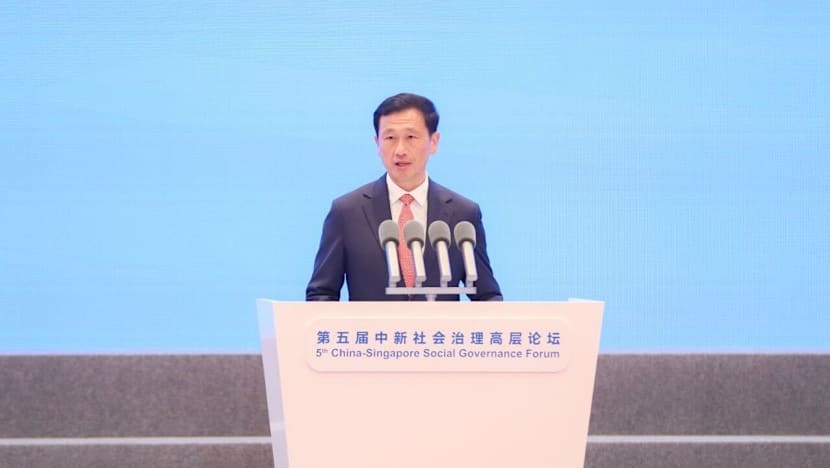
Coordinating Minister for Social Policies and Minister for Health Ong Ye Kung at the 5th Singapore-China Social Governance Forum on Apr 20, 2026. (Photo: Ministry of Social and Family Development)

This audio is generated by an AI tool.


SINGAPORE: Singapore must use technology for law enforcement judiciously, and privacy concerns need to be taken into consideration, said Coordinating Minister for Social Policies Ong Ye Kung on Tuesday (Apr 21).
Mr Ong was speaking to reporters in Hangzhou, China, following the 5th Singapore-China Social Governance Forum on Monday.
The forum is one of the key bilateral cooperation platforms between Singapore and China. It provides an opportunity for officials from both countries to exchange views on issues related to social governance.
Minister for Social and Family Development Masagos Zulkifli, Minister of State for Manpower and Culture, Community and Youth Dinesh Vasu Dash, Minister of State for National Development and Trade and Industry Alvin Tan, as well as Senior Parliamentary Secretary for Law and Social and Family Development Eric Chua, also attended the forum.





Responding to a question on the use of technology in social governance and the implications on privacy, Mr Ong pointed to the use of cameras in common areas of Housing and Development Board (HDB) blocks to tackle the issue of loansharks.
"As a result, the numbers came down. And I think if you ask most residents, they welcome it, (there's) not much infringement on people's privacy, but at least it deterred some of these illegal money lenders," he said.
Mr Ong said the way technology is used and the acceptance by the public are important. "Essentially, we have to use it judiciously," he added.
He said there are spectacles in China that are linked to a database, such that if the wearer sees a murderer, the wearer would be alerted.
"If you do that in Singapore, maybe people will have a reaction," he said. "The use case is important. Technology allows us to ... move into many areas, but our use case is much more simple."
He noted that Mr Masagos wore a pair of spectacles during the trip that would translate spoken Mandarin into English, and display subtitles for him.
Citing one of his Chinese counterparts, Mr Ong said technology is a "double-edged sword".
"By the time enforcers are tying their shoelaces, criminals have already finished the marathon because of technology," he added. "They use technology much more, unfortunately, efficiently and rigorously in committing crimes."
In terms of technology and its impact on social governance, the impact is probably more indirect, he noted.

SOCIAL MEDIA BANS?
Mr Ong, who is also the health minister, said social media changes human relationships "quite profoundly".
"People are just spending less time interacting. They are spending a lot more time by themselves. They are totally self-sufficient in their room. They can order things, they can have entertainment, they can read books.
"They can talk to the whole world, but not their neighbours. So all these actually affect people-to-people relationships.
"We see it in our constituency. It affects the neighbourhood and how people relate to each other, and over time, it can also affect community cohesion. With less mutual respect, understanding and knowing each other, you can create more misunderstandings, and therefore more disputes, and therefore social governance has to come in."
Social media has also had an impact on children. Mr Ong noted that various countries have implemented or discussed implementing social media bans for teens.
Despite some criticising such bans, he said he believes they could be beneficial. But bans are "blunt tools", he said.
Young people do use social media to maintain friendships and for education, so there is a lot of good, he added.
The Ministry of Health's expert panel observed that the "harmful" factors included direct messaging from adults to young people, addictive features such as autoplay and algorithmic feeds, as well as a lack of proper age verification.
Put together, the impact is more detrimental, Mr Ong said.
"We can also take an approach that, instead of banning, let's look at how these features and our concern about these features can be addressed," he added.
The Ministry of Digital Development and Information will be engaging tech platforms on this issue, he said.
"Our options are open, but we will have to do something about this problem," he said.


APPROACHES TO SOCIAL GOVERNANCE
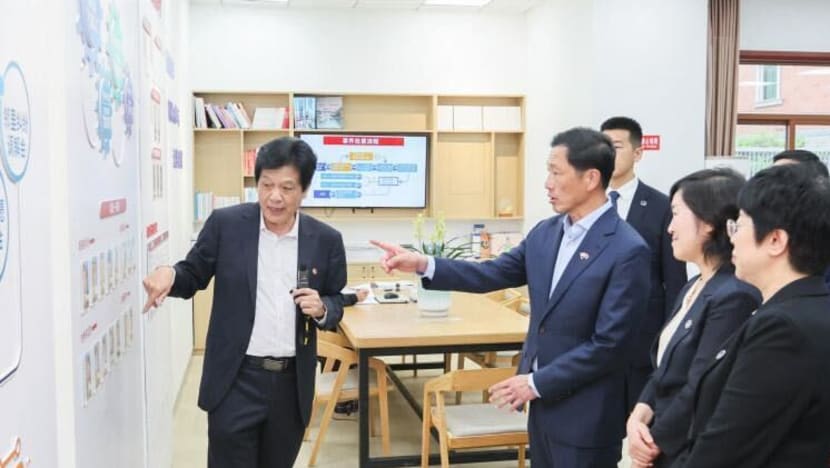
Mr Ong also spoke about his experience co-chairing the social governance forum for the first time.
He said the two countries approach the issue of social governance from different angles. In Singapore, it is about social harmony because the country is multi-racial.
In China, it starts with security, he said. The Chinese government believes society must be peaceful and stable for the country to be strong, said Mr Ong.
That means people must have jobs, there must be economic growth, and disputes must be settled so they do not become uncontrollable.
To ensure disputes are settled, China has a framework that goes all the way down to the village level, and Singapore has mediation centres.
Over the years, the approaches in Singapore and China have converged, he said.
"That shows that learning from each other is valuable. In the end, we take the best from each other's ideas ... and adapt and do the best for our people," he said.