







AI takes centre stage at Mobile World Congress in Barcelona
Beyond product showcases, attention at the event also turned to how artificial intelligence should be deployed transparently and responsibly as it becomes more embedded in networks and services.
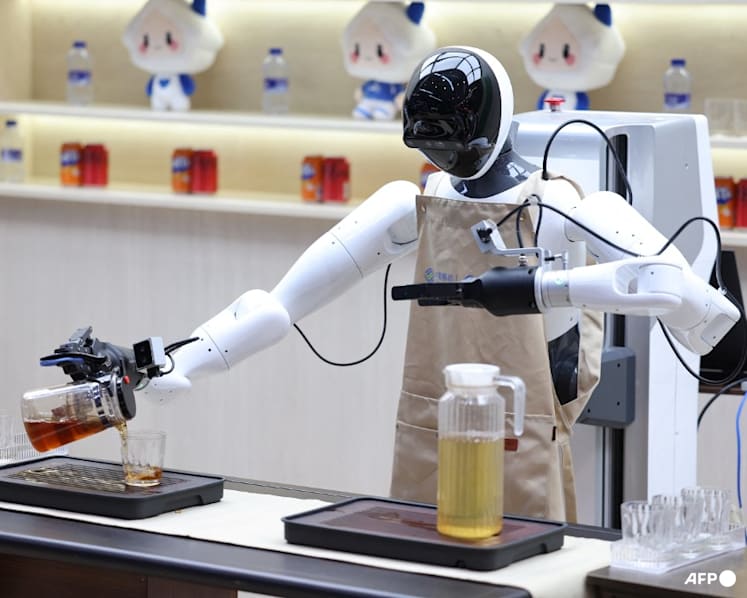
A robot preparing drinks at the China Mobile stand during the Mobile World Congress in Barcelona on Mar 3, 2026. (Photo: AFP/Josep Lago)

This audio is generated by an AI tool.


BARCELONA: Artificial intelligence is not just a buzzword – it is the central theme at this year’s Mobile World Congress, the world’s largest mobile industry event.
The four-day show opened on Monday (Mar 2) at the Fira de Barcelona Gran Via in Spain and is expected to attract more than 100,000 visitors.
This year marks its 20th edition, bringing together major phone makers, network providers, technology firms and policymakers from around the world.
SMARTPHONES SHIFT FOCUS TO AI
Alongside traditional upgrades like improved cameras and slimmer designs, smartphone makers at the show are placing greater emphasis on AI features designed to enhance everyday tasks and integrate more seamlessly across devices.
Samsung, the world’s second-largest smartphone maker after Apple, said it is putting AI right at the heart of its latest devices.
The South Korean company’s new Galaxy S26 series – which it described as its “third-generation AI phone” – uses AI to simplify tasks by anticipating users’ needs.
Chinese brands including Huawei, ZTE, Xiaomi and Honor also emphasised AI-driven hardware and infrastructure at their booths.
Xiaomi, for example, highlighted how AI connects its smartphones, smart home devices and cars, while Honor unveiled an AI-powered “Robot Phone” concept that can track users and adjust its camera using built-in motion technology.





TRANSPARENCY AND TRUST IN THE AI ERA
Beyond product launches, conversations at the event also focused on how AI can be deployed transparently and responsibly as it takes on a bigger role in networks and services.
Experts stressed that AI must be scaled safely and deployed inclusively across industries, particularly as it begins taking on more decision-making roles.
Nokia, once a dominant handset maker and now a key supplier of 5G networks and future 6G technology, said such transparency is critical as AI becomes embedded in telecom infrastructure.
“It has to be crystal clear what is happening – where, what, when, how, so that there is no hidden back door, because it's all about being a trusted supplier to the industry, you can only be trusted and secure if everything is transparent,” said Steph Delvoye, Nokia’s vice president of marketing strategy.


Aside from infrastructure, companies across sectors are also figuring out how to use AI effectively in their operations, experts said.
Mike Ellery, chief creative officer at marketing agency Sparks, said companies need to be clear about what they want from AI.
“If you give it direction, you frame the question really well … make sure it's on point with what your mission is as a company, then sure you can get some great results,” he said, adding that businesses must also review the output to ensure it “aligns with where you're going and what your strategy is”.
BEYOND DEVICES: AI IN THE REAL WORLD
Robots also drew large crowds at the event, as companies showcased how AI is moving into the physical world.
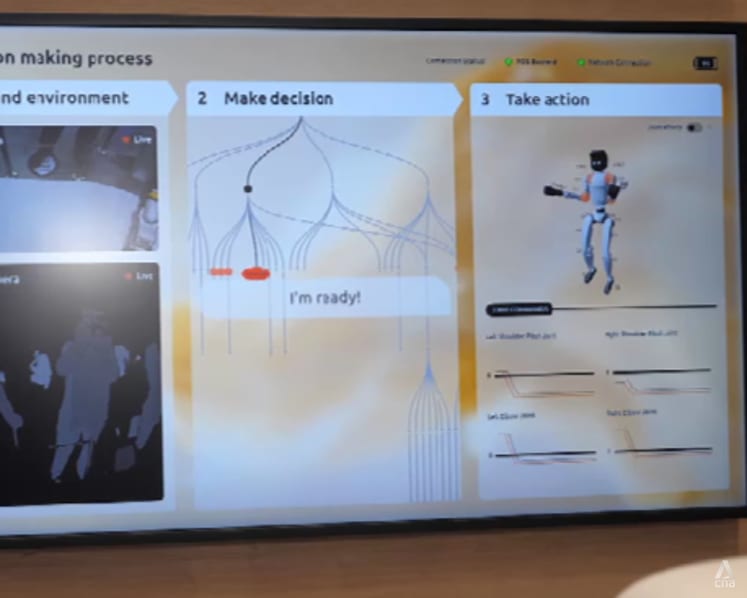
One robot on display is being trained to perform simple human tasks, such as picking up a box. Such an action may seem straightforward, but the machine currently needs around 60 repetitions to learn it.
A nearby screen offers what developers call a “window” into the robot’s brain, showing how it processes information from its surroundings.
Experts said robotics and AI are advancing rapidly as firms push into real-world applications, even as broader industry challenges – including evolving regulations and supply chain issues – remain on the radar.
Wearable technology is also gaining attention. Tech giant Meta demonstrated smart glasses with real-time translation features. It can, for example, instantly translate a restaurant menu.
AI is also being applied to broader challenges such as environmental monitoring.
Wildfires devastate parts of the world each year, and French telecom operator Orange showcased its Forest Smart Guardian platform, designed to strengthen fire prevention and response.
The system collects data from drones, sensors and weather sources, using AI over a 5G network to generate fire risk maps and help predict how a blaze could spread.
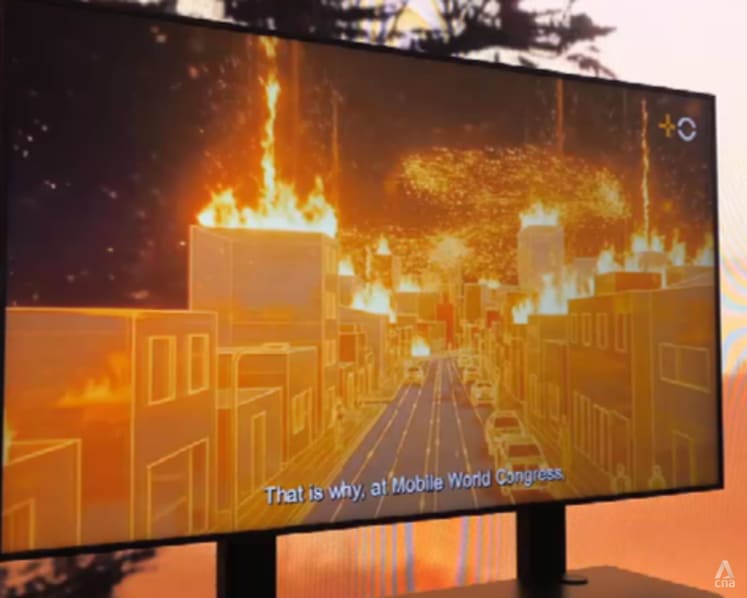
“You can analyse the possible risks according to different parameters, such as the wind, the humidity of the area,” said Orange representative Ana Gonzalo.
Another emerging technology on display is LiFi – short for light fidelity – which uses light rather than radio frequencies to transmit data.
The system can work through LED lighting, potentially reducing the need for additional cabling.
“You should expect much more consistent connectivity … those days of your video buffering or a web page stuttering should be gone,” said Mostafa Afgani, co-founder of UK-based provider pureLiFi.
From robots learning basic movements to intelligent networks, this year’s Mobile World Congress makes one thing clear: Artificial intelligence is no longer an add-on option, but a prominent feature across products.




