







CNA Explains: What a US intervention in Iran could look like as Trump considers options
The US president has warned of potential military action as Iran cracks down on widespread protests, the biggest threat to the country’s rulers in decades.
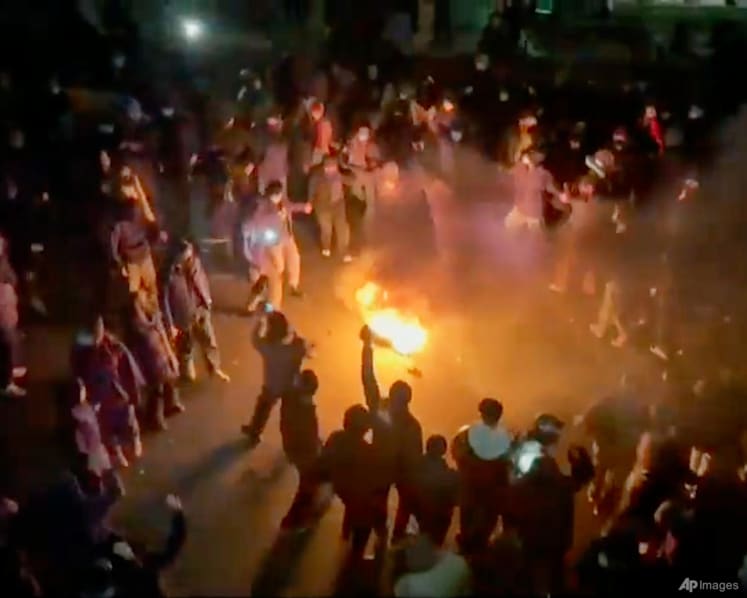
Protesters dance and cheer around a bonfire as they take to the streets despite an intensifying crackdown as the Islamic Republic remains cut off from the rest of the world, in Tehran, Iran, on Jan 9, 2026. (Image: UGC via AP)


As Iran's deadly crackdown on anti-government protests continues, US President Donald Trump faces a delicate moment as he weighs how best to respond.
The US military is considering "very strong options" against Iran, Trump said on Sunday (Jan 11), adding that it "looks like" Tehran had crossed his previously stated red line of protesters being killed.
More than 600 people have been killed, according to a rights group on Jan 12.
The mass protests in all of Iran's 31 provinces, triggered by an economic collapse, pose the biggest threat to the rulers of the Islamic Republic in decades.
WHY DOES TRUMP WANT TO INTERVENE IN IRAN?





The fall of the Iranian regime has been a long-standing goal of the United States for the past four decades, said Dr Jean-Loup Samaan, senior research fellow at the Middle East Institute at the National University of Singapore.
Iran has been a sworn foe of the US since the 1979 Islamic revolution toppled the pro-Western shah.
Since then, the two countries have moved between periods of hostility and tentative diplomacy. Ties reached a high point with the 2015 nuclear deal, which saw Iran significantly restrict its programme in return for the lifting of sanctions.
But Trump unilaterally withdrew America from the accord in 2018, sparking tensions in the Mideast that intensified after Hamas' Oct 7, 2023, attack on Israel.
The US president’s ultimate objective in intervening in Iran would be regime change, likely accompanied by backing for new leadership in Tehran that could restore diplomatic ties with Washington, Dr Samaan told CNA.
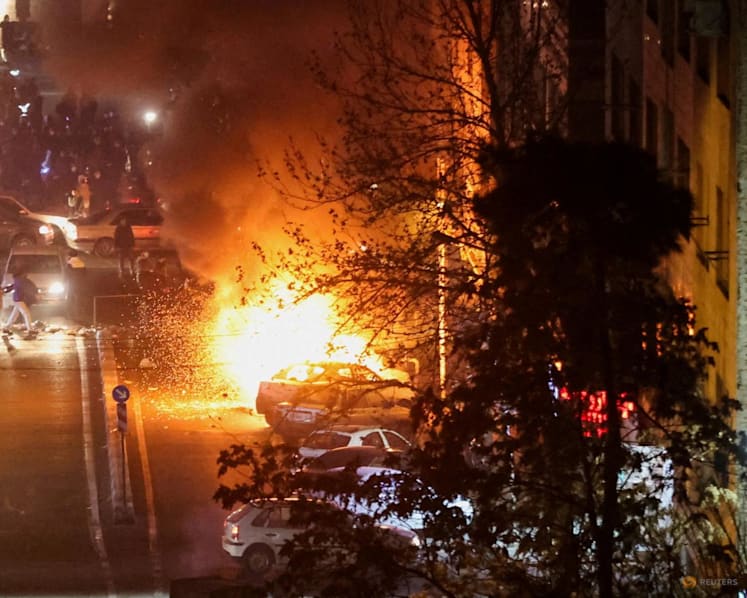
What began as anger over soaring prices has widened into a broader challenge to Iran's clerical rulers, who have governed the country for more than 45 years.
Iranians have grown increasingly resentful of the powerful Revolutionary Guards, whose business interests, including oil and gas, construction and telecommunications, are worth billions of dollars.
“Trump’s motivation builds on these views,” Dr Samaan said.
“His team might assume that if the US intervenes, it can accelerate the collapse of the Islamic Republic,” he added.
“In that logic, it would benefit the US, given the historical grievances (the memory of the US embassy takeover by the Iranian revolutionaries; tensions over Iran's nuclear program and support for its proxies across the Middle East).”
But he noted that Trump is still unlikely to get invested in an ambitious regime change campaign.
“He may decide to intervene to force the regime's collapse, but nation-building is something he abhors. He may opt for a Venezuelan scenario - to decapitate the current regime and leave other autocratic players in place,” Dr Samaan said.
Dr James Dorsey, adjunct senior fellow at the S Rajaratnam School of International Studies, also warned that a US intervention in Iran could turn out to be a miscalculation.
“There's a significant segment of the Iranian population that does not like this regime. But that does not mean that they want to see foreign intervention,” he said.
WILL TRUMP USE MILITARY FORCE IN IRAN?
Both Dr Dorsey and Dr Samaan acknowledged the possibility of US military intervention in Iran following its recent strike in Venezuela, which may have emboldened Trump.
“He clearly feels that the United States has the military power, the military ability and the power to impose its will on other countries,” Dr Dorsey said.
“Military intervention, whether a one-time operation or a series of sustained operations, is designed to embolden the protesters, to give them a sense that the world's most powerful man has their back, and that by doing so, he increases the chances of a regime change,” he added.
Still, Dr Dorsey pointed out that any intervention in Iran would not be as “simple” as the US operation in Venezuela.
“Iran has battle-hardened military forces. It is also a much bigger country than Venezuela and it’s got a very cohesive regime,” he told CNA, noting that the US also does not have an aircraft carrier group in the region at this point.
“Obviously, he has significant forces, including military aircraft bases throughout the Gulf. However, the Gulf States probably don't want to see the United States attacking Iran from their own territory,” Dr Dorsey said.
Dr Samaan said any use of force in Iran would likely be a limited option that involves airstrikes targeting the regime's civilian and military infrastructure, adding that it could look like the US involvement in the Israel-Iran war last year.
“I doubt the White House seriously considers a larger commitment, such as a ground operation,” he said.
With the US mid-term elections this year, the Trump administration will also be reluctant to get stuck in a regional war before then, he added.
Vali Nasr, a professor at Johns Hopkins School of Advanced International Studies, also noted that with protests across 130 to 150 Iranian cities, an attempt by the US to hit security forces in all the cities would take more than just a few airstrikes.
As Trump likely "doesn't want to get his hands dirty, a performative strike may be more where he wants to go", he added.
WHAT OTHER ACTION COULD TRUMP TAKE?
Besides military strikes, the use of secret cyber weapons, widening sanctions and providing online help to anti-government sources are among options being presented to Trump, the Wall Street Journal reported.
The US president on Monday announced that any country doing business with Iran would face a new tariff of 25 per cent on its exports to the US.
"This order is final and conclusive," Trump said in a social media post, without providing further detail about the legal authority he would use to impose the tariffs, or whether they would be aimed at all of Iran's trading partners.
He also said he planned to speak with SpaceX CEO Elon Musk about restoring internet in Iran, where authorities have blacked out services for four days.
WHAT IMPLICATIONS WOULD A US INTERVENTION HAVE?
Domestically, a US intervention in Iran could backfire, Dr Samaan said.
“It could politically serve the narrative of the Iranian regime that protests are orchestrated by the US and Israel,” he said.
Any regional fallout would depend on the scale of the intervention, Dr Samaan said, noting that a limited US air operation would be unlikely to have wider regional consequences.
“The more important factor is the fall of the regime - that would have major implications for neighbouring countries, Iraq, and the Gulf states,” he told CNA.
Dr Dorsey thinks any intervention by the US would send a message to the wider region.
“The message is that we're going to intervene when we think it's in our interest,” he said.
Iran, through the country’s parliamentary speaker, has warned that the US military and Israel would be “legitimate targets” if Washington uses force to protect demonstrators.




