Venezuela's oil supply to rise in years ahead and depress prices, say analysts
Venezuela's oil industry is in disrepair after years of neglect and international sanctions but some analysts are optimistic that it could double or triple its current output to return to historic levels fairly quickly.
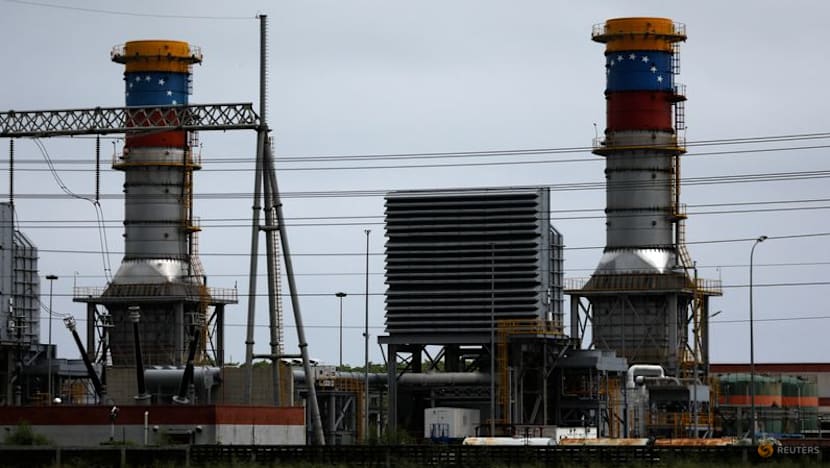
The El Palito refinery of Venezuelan state oil company PDVSA in Puerto Cabello, Venezuela on Feb 10, 2024. (Photo: Reuters/Leonardo Fernandez Viloria)
SINGAPORE: Crude output in Venezuela is set to increase over a period of time following the dramatic US strike and capture of its president, likely raising global supply and weighing on prices longer-term, oil analysts said.
American forces seized Venezuelan President Nicolas Maduro from Caracas over the weekend, and US President Donald Trump said Washington would take control of the oil-producing nation and that the US embargo on all Venezuelan oil remained in full effect.
Oil prices drifted lower on Monday (Jan 5), as adequate global supplies offset concerns about supply disruptions following the raid over the weekend.
Brent crude futures fell 21 cents, or 0.4 per cent, to US$60.54 a barrel by 0452 GMT, while US West Texas Intermediate crude was 28 cents, or 0.5 per cent lower, at US$57.04 a barrel.
The key oil benchmarks were volatile in early Asian trade, opening lower but inching up shortly after, only to pare gains and turn red again as investors assessed the political upheaval in the OPEC member nation and the impact on oil supply.
The Organization of the Petroleum Exporting Countries (OPEC) member holds about 17 per cent of global oil reserves, or 303 billion barrels, ahead of OPEC leader Saudi Arabia, according to the London-based Energy Institute.
Venezuela was producing as much as 3.5 million barrels per day (bpd) of crude in the 1970s, which at the time represented over 7 per cent of global oil output. Production fell below 2 million bpd during the 2010s and averaged about 1.1 million bpd last year, or just 1 per cent of global production.


Venezuela's oil industry is in disrepair after years of neglect and international sanctions, so it could take years and major investments before production can increase dramatically. But some analysts are optimistic that Venezuela could double or triple its current output to return to historic levels fairly quickly.
“While many are reporting Venezuela’s oil infrastructure was unharmed by US military actions, it has been decaying for many, many years and will take time to rebuild,” said Patrick De Haan, who is the lead petroleum analyst at gasoline price tracker GasBuddy.
American oil companies will want a stable regime in the country before they are willing to invest heavily, and the political picture remains uncertain.
“But if it seems like the US is successful in running the country for the next 24 hours, I would say there would be a lot of optimism that US energy companies could come in and revitalise the Venezuelan oil industry fairly quickly,” said Phil Flynn, a senior market analyst at the Price Futures Group.
And if Venezuela can grow into an oil production powerhouse, Flynn said “that could cement lower prices for the longer term” and put more pressure on Russia.
MAJOR SHIFT NOT EXPECTED
A major shift in oil prices was not expected because Venezuela is a member of OPEC, so its production is already accounted for there. And there is currently a surplus of oil on the global market.
JPMorgan analysts led by Natasha Kaneva said in a note that with a political transition, Venezuela could raise oil production to 1.3 million to 1.4 million bpd within two years and potentially reach 2.5 million bpd over the next decade, up from about 800,000 bpd currently.
"These dynamics are currently not reflected in the back end of the oil futures curve," the note added.
"A regime change in Venezuela would immediately represent one of the largest upside risks to the global oil supply outlook for 2026–2027 and beyond," analysts at JP Morgan said on Monday.
Goldman Sachs analysts led by Daan Struyven said in a note on Sunday that any recovery in production would likely be gradual and require substantial investment.
The analysts estimated a US$4 per barrel downside to 2030 oil prices in a scenario where Venezuela crude production rises to 2 million bpd.
"We see ambiguous but modest risks to oil prices in the short-run from Venezuela, depending on how US sanctions policy evolves," Struyven added.
In the short term, Venezuela's oil production outlook this year will depend on how US sanctions policy evolves, the Goldman analysts said.
Goldman's 2026 oil price forecasts remained unchanged, with Brent's average at US$56 and West Texas Intermediate at US$52 a barrel while Venezuela's 2026 oil production is forecast to stay flat at 900,000 bpd.
Additionally, Helima Croft, RBC Capital's head of commodities research, said full sanctions relief could unlock several hundreds of thousands of barrels per day of production.
"All bets are off in a chaotic change of power scenario like what occurred in Libya or Iraq," Croft added.
PROVEN RESERVES
Venezuela is known to have the world's largest proven crude oil reserves so international oil companies have reason to be interested in the country.
ConocoPhillips spokesperson Dennis Nuss said by email that the company “is monitoring developments in Venezuela and their potential implications for global energy supply and stability. It would be premature to speculate on any future business activities or investments”.
Chevron is the only one with significant operations in Venezuela, where it produces about 250,000 barrels a day. Chevron, which first invested in Venezuela in the 1920s, does business in the country through joint ventures with the state-owned company Petróleos de Venezuela SA, commonly known as PDVSA.
“Chevron remains focused on the safety and well-being of our employees, as well as the integrity of our assets. We continue to operate in full compliance with all relevant laws and regulations,” Chevron spokesman Bill Turenne said.
Despite the massive reserves, corruption, mismanagement and US economic sanctions saw production steadily decline from the 3.5 million bpd pumped in 1999.
The problem is not finding the oil. It's a question of the political environment and whether companies can count on the government to live up to their contracts.
Back in 2007, then-President Hugo Chávez nationalised much of the oil production and forced major players like ExxonMobil and ConocoPhillips out.
“The issue is not just that the infrastructure is in bad shape, but it’s mostly about how do you get foreign companies to start pouring money in before they have a clear perspective on the political stability, the contract situation and the like,” said Francisco Monaldi, who is the director of the Latin American energy program at Rice University.
But the infrastructure does need significant investment.
“The estimate is that in order for Venezuela to increase from 1 million bpd - that is what it produces today - to 4 million barrels, it will take about a decade and about a hundred billion dollars of investment,” Monaldi said.
COMPLICATED LEGAL PICTURE
Matthew Waxman, a Columbia University law professor who was a national security official in the George W Bush administration, said seizing control of Venezuela’s resources opens up additional legal issues.
“For example, a big issue will be who really owns Venezuela’s oil?” Waxman wrote in an email.
“An occupying military power can’t enrich itself by taking another state’s resources, but the Trump administration will probably claim that the Venezuelan government never rightfully held them.”
But Waxman, who served in the State and Defense departments and on the National Security Council under Bush, noted that “we’ve seen the administration talk very dismissively about international law when it comes to Venezuela”.