Middle East conflict set to test ASEAN unity as leaders gather in Cebu for summit
Tensions involving Iran and the Strait of Hormuz have disrupted energy supply chains, raising fresh risks for Southeast Asia.
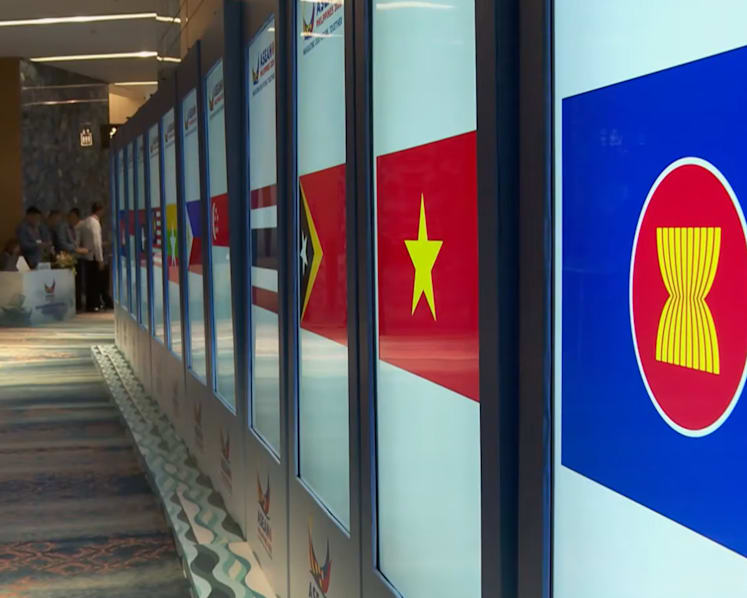
The flags of the Association of Southeast Asian Nations (ASEAN) and its member states.

This audio is generated by an AI tool.



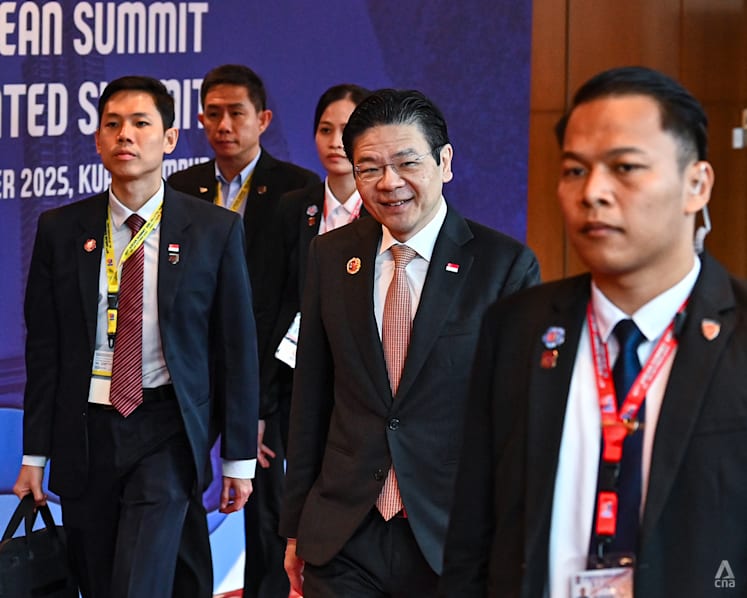
Leaders from the Association of Southeast Asian Nations (ASEAN) are set to gather in Cebu this week for a summit already being shaped by the ongoing Middle East conflict, as concerns mount over energy security and economic stability across the region.
Bloc chair the Philippines had earlier scaled down non-essential activities and tightened the agenda for the in-person meeting, which is the first of two summits expected this year.
Leaders are expected to focus heavily on tensions involving Iran and the Strait of Hormuz, as disruptions to global energy supply chains have heightened risks for the region.
ASEAN has maintained a consistent position: The conflict in the Middle East must be resolved diplomatically and peacefully.
Analysts say, however, that uncertainty from the United States is complicating the picture.
“After all, it is Washington and the Trump administration driving what’s happening in the Middle East … and I think the concern is that US messaging is shifting on and off, blowing hot and cold,” noted Graham Ong-Webb, adjunct fellow at Singapore’s S Rajaratnam School of International Studies.
“Markets are getting nervous because of this and governments are becoming more cautious.”
Even so, ASEAN governments are expected to take steps within their control in order to manage the impact on member states, and minimise disruptions to everyday life.
Ong-Webb said leaders are likely to push for greater self-sufficiency and stronger intra-regional ties.
“(This means) that Southeast Asian countries can lean on one another (for supplies that) this region depends on,” he added.





MEANINGFUL PROGRESS “QUITE LIMITED”
While ASEAN has consistently called for peace, experts note that unity in practical terms remains uneven.
Susannah Patton, a non-resident fellow at Australia-based think-tank Lowy Institute, noted that ASEAN member states have expressed a shared interest through their economic ministers to see a resolution to the conflict.
“They want to see fuel supplies resume and the opening of the Strait of Hormuz,” she said.
“Yet, when it comes to practical cooperation between the countries to boost intra-ASEAN energy trade, meaningful progress has been quite limited.”
Patton added that differing national interests have also surfaced.
Notably, two weeks ago, Indonesia’s Finance Minister Purbaya Yudhi Sadewa floated the idea of imposing a levy on ships passing through the Malacca Strait, as part of a push to maximise the country’s strategic position along global trade and energy routes.
The Malacca Strait is a major shipping lane for global trade and energy. It is primarily bordered by Indonesia, Malaysia and Singapore, and connects the Indian and Pacific Oceans.
Purbaya said the idea to impose a levy was inspired by Iran’s plan to charge ships passing through the Strait of Hormuz, and that the levy could be split three ways between Indonesia, Malaysia and Singapore.
The Strait of Hormuz – which connects the Persian Gulf to the Indian Ocean – handles about a quarter of the world’s seaborne oil trade. It has largely been blocked by Tehran since Feb 28 when the US and Israel launched attacks on Iran.
Purbaya’s proposal was later shot down by Singapore’s and Indonesia’s foreign ministers.
Nevertheless, Patton told CNA938 that it suggests “an interest in exploring whether there could be ways in which ASEAN can benefit, in a direct sense, from this global turmoil”.
“But that's not a position that's shared across the board,” she added.
“It would be quite disadvantageous to ASEAN, which has always been so strong in its support for the rules-based system and international law, to explore these kinds of options … because it would really undermine ASEAN’s legitimacy as a voice on these issues of principle.”
Differences in energy exposure are also shaping responses.
Countries like the Philippines and Vietnam are more reliant on Middle Eastern energy imports, while others such as Indonesia, Malaysia and Thailand have greater domestic capacity and are focusing on subsidies and price controls, Patton noted.
For example, cities across Metro Manila have rolled out energy-saving measures like reducing fuel allocation for government vehicles.
WHAT OUTCOMES TO EXPECT
Given these differences, analysts said expectations for major coordinated measures remain modest, with national-level responses likely to dominate the summit.
“With ASEAN, it's always about the process rather than the destination. You can't necessarily expect ASEAN to produce a really tangible outcome on these challenging issues where member states have different priorities,” Patton said.
She added that she expects the bloc to issue a statement of solidarity amid these challenging global times.
Still, leaders are expected to discuss practical steps to cushion economic shocks, protect maritime traffic and manage escalation risks.
Key issues on the agenda include fuel supplies, food prices and the welfare of migrant workers.
Beyond the Middle East crisis, the summit will tackle a range of ongoing regional challenges. These include disaster resilience – a priority for the Philippines – as well as economic cooperation, trade tensions and supply chain resilience.
Leaders are also expected to discuss developments in Myanmar, Timor-Leste’s recent accession to ASEAN, and broader geopolitical pressures, including competition from China and tariff uncertainties linked to the US.
DEEPER INTERNAL, EXTERNAL COOPERATION
ASEAN’s longer-term resilience will depend on deeper internal cooperation, particularly in energy, said experts.
For instance, the ASEAN Petroleum Security Agreement – which the bloc is pursuing the ratification of – is voluntary and non-binding in nature, noted Patton.
“The amount of value that it can really add in this immediate crisis seems to be quite limited,” she warned.
“(It) would make a difference over time to realise the vision for the ASEAN power grid, because having genuine cross-border trade arrangements that are applicable to multiple countries would provide an element of resilience, and would also strengthen the collective bargaining capacity of ASEAN as a group.”
The bloc is also expected to leverage external partnerships, including with the Gulf Cooperation Council (GCC), to diversify energy sources and strengthen strategic ties.
Last year, then-ASEAN chair Malaysia moved to deepen ties with the Gulf nations, which experts say can support the bloc in meaningful ways – including in energy security.
Countries like Oman have already established ties with ASEAN members by procuring defence equipment from Singapore, including Al-Ofouq-class patrol vessels, said Ridzwan Rahmat, a principal defence analyst at intelligence company Jane’s.
“For ASEAN, the advantage is in diversification,” he added.
“This cooperation will diversify our energy sources, our diplomatic channels and also as proven with all (the various) defence contracts, our strategic relationships.”