'Insane scale': A close-up look at scam compounds along Cambodia's border with Vietnam
In the second of a two-part series that looks into scam operations in Cambodia, CNA travels along the country’s eastern border with Vietnam, where new roads, casino zones and guarded compounds have transformed agricultural land into a frontier for online scams.
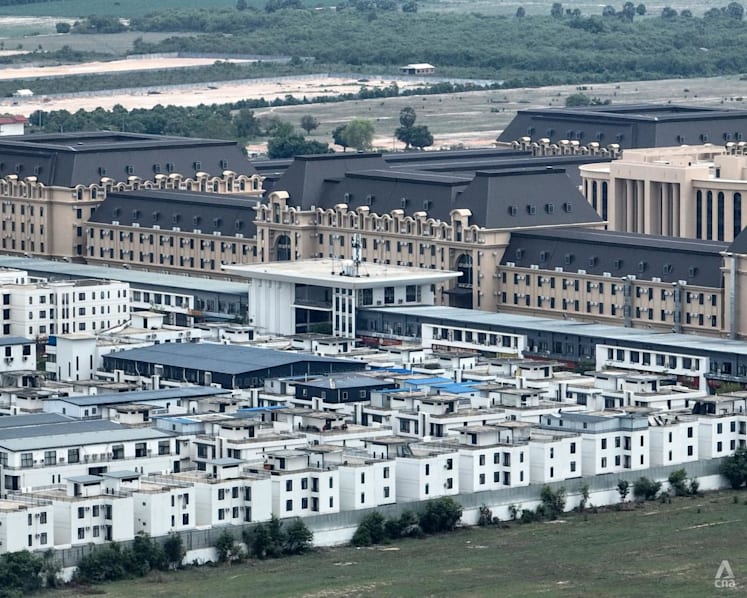
The expanse of the #8 Park compound in Prey Veng province, Cambodia, believed to have been the country's largest scam complex. (Photo: CNA/Jack Board)

This audio is generated by an AI tool.


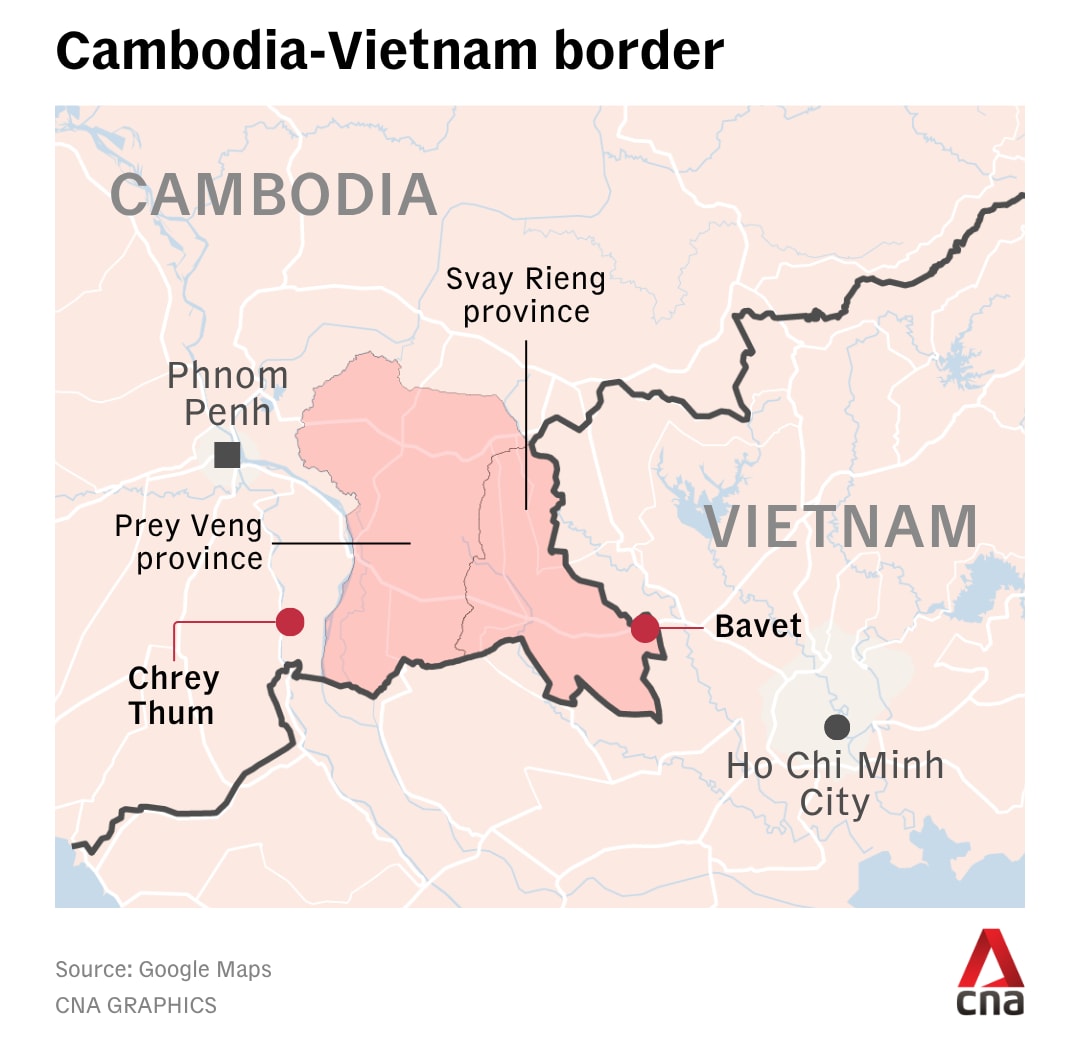
PHNOM PENH: It is a chaotic and dusty artery that links Cambodia to Vietnam through the frontier town of Bavet.
Dozens of workers pack into the backs of trucks, shipped to and from factories and building sites. Children play beside guarded compounds, rubbish burns near golden casino entrances and luxury vehicles pass stark worker dormitories.
There is one thing that stands out among it all: the flood of advertising for online gambling, everywhere despite it being illegal in Cambodia.
The lures of multiple cyber casino brands and Chinese sports betting companies loom over the highway. Security guards shelter from the sun under umbrellas adorned with poker chips and women in bikinis.





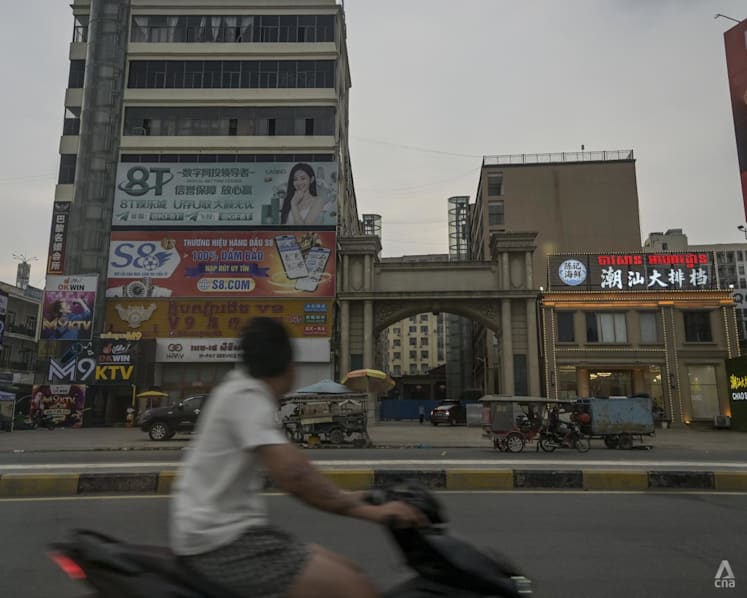
They are the signposts to the shady world of vice that has been incubated here for years.
To something larger and hidden, often beyond and above the casino floors, and in the apartment complexes and business parks.
To the human trafficking, the violence and torture, the illegal gambling and the sophisticated scamming operations targeting people all around the world.
“It’s wild. It’s unbelievable. This is a mafia playground,” said Nathan Southern, the operations director of Eyewitness Project, an organisation investigating crime, conflicts and corruption in the region, as he drives through the border traffic, past the seafood restaurants and boxes of Chinese beer.

Bavet and towns like it have long been magnets for casinos, gambling and organised crime that typically thrive in porous border areas.
Now, these same towns have become part of a larger global fraud machine where victims are trafficked into compounds and forced to target others online.
The fraud can look like romance, investment advice, cryptocurrency trading, online gambling or fake job offers.
Researchers have estimated Cambodia’s scam industry may generate between US$12.5 billion and US$19 billion a year, though the figures are difficult to verify because much of the money moves through cryptocurrency, underground banking and offshore structures.
While much attention has focused on better known scamming hotspots like Sihanoukville in Cambodia’s south, and Poipet on the western border with Thailand, along the country’s eastern flank, a parallel ecosystem has quietly emerged.
Cambodian authorities say they are now trying to shut this multi-billion dollar system down. The country has new anti-scam legislation, enacted since April, and has been targeting compounds for months.
But these networks have deep roots. And they have made significant inroads along the Vietnamese border that experts say will be difficult to erase.
“These are highly integrated forms of transnational criminal enterprises. They're not contained within one country. They don't recognise borders,” said Jason Tower, a senior expert for the Global Initiative Against Transnational Organised Crime, an international non-governmental organisation headquartered in Geneva.

Large compounds and clustered operations within reach of the Vietnam border appear to be using an old playbook that takes advantage of long-established smuggling routes and cross-border broker networks to move people, equipment and money, said Lindsey Kennedy, research director at the Eyewitness Project.
Casinos were already embedded in these border areas, and they sat alongside older illicit economies such as timber and drug trafficking.
In many cases, the same networks behind those trades also controlled the casinos, using them to move and clean dirty money, she said.
“Often these are already heavily logged areas. The people who'd taken over that land were looking for new ways to exploit the value of the area as well.
“Even though this looks from the outside like a very strange progression, it's actually been very logical,” she said.
The smuggling of people, especially from China and Vietnam itself, across the 1,158 km long Cambodia-Vietnam border and into scamming compounds, has been widely documented.
“Some of the compounds even appear to be in a kind of no-man's land between the two countries. It's really easy to get people in and out,” Kennedy added.


SECRETIVE AND GROWING FAST
Tucked against the Vietnamese border, straddling a small reservoir, the A7 Country and Resort Casino in Bavet is exactly the type of large-scale scam complex the Cambodian government says it will no longer tolerate.
Authorities have launched major crackdowns on scam complexes throughout the country, action that has intensified in the past couple of months.
Some 300 different facilities have been targeted by police action since July, Chhay Sinarith, senior minister and chair of Cambodia’s Commission for Combating Online Scams, told CNA in an interview.
CNA was given access to the A7 facility, which provincial officials from Svay Rieng province said was running scams before being raided earlier this year.
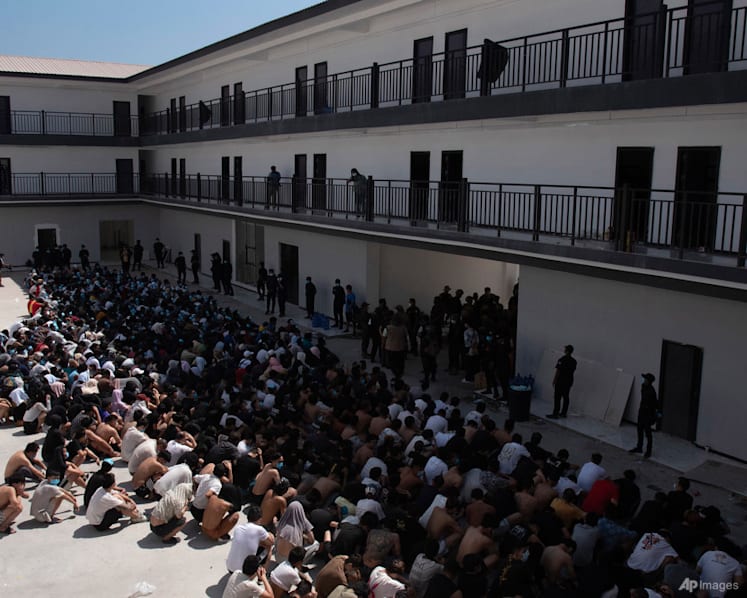
With dozens of heavily armed personnel on hand, the locked complex was opened up to reveal dozens of buildings inside.
One of them, shown to the media, contained a cache of evidence of the alleged criminal activities that took place, including identification cards, household registries, boarding passes, dozens of credit cards, medicine and abandoned food.
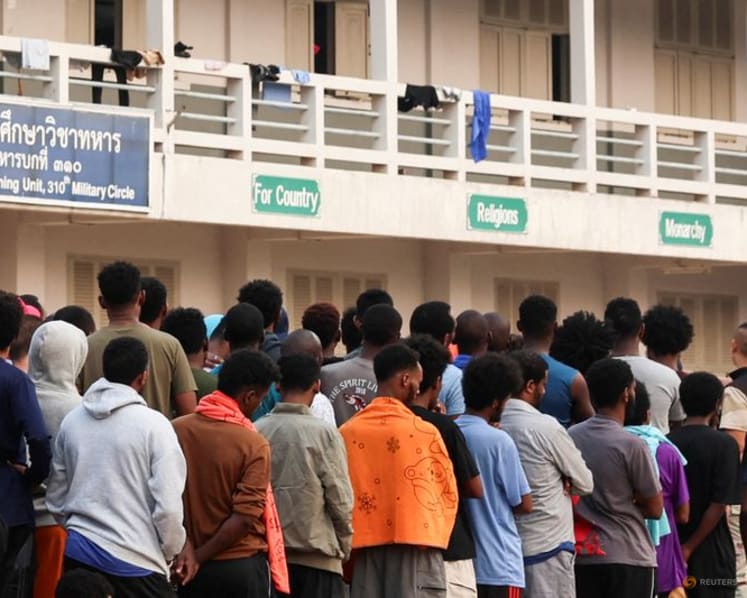
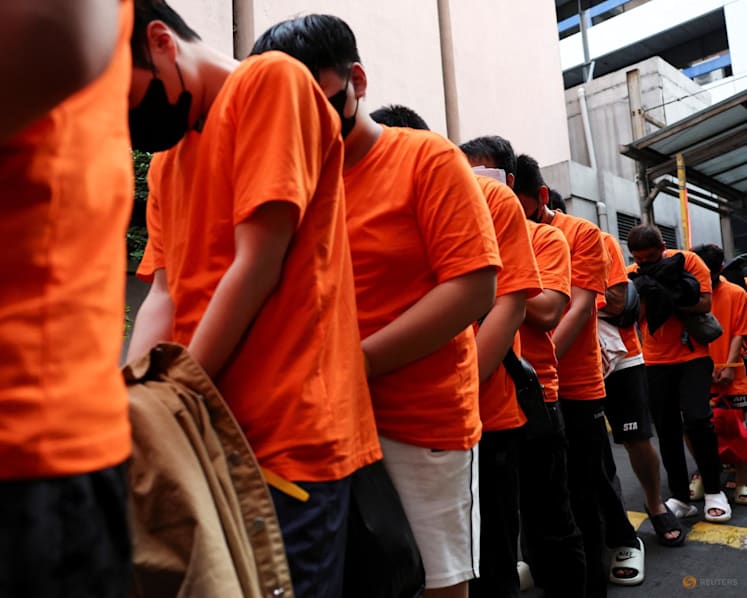
More than 2,200 people found to be inside the complex were arrested, authorities said, with the vast majority of them from China, as well as nationals from Myanmar and Vietnam.

For now, Peng Pursa, the governor of Svay Rieng province, said it was unclear who owns the land or who was responsible for running the operations. It had been masked as a housing estate, he said.
“Before they were small in size, so it was highly secretive, which made it hard for the government to crack down on all of them. They were growing fast, especially in 2025 and this year, 2026,” Pursa said.
“Cambodia is not a country that supports or helps to hide the criminals and scammers. We will suppress it and not allow it to rise again. Our campaign is far from over. It will continue for five, 10, 20, 30 years, or even longer.”
Closer to the main border crossing in Bavet, an entire estate of townhouses, comprising nearly 200 residential houses, has also been mostly emptied out by police, apart from a multitude of mattresses, trash and burnt out cigarettes.
In one, rows of tiny rooms with soundproofing where scammers would purportedly pose as police officers from different countries. Miniature US$100 bills are scattered on the filthy floors.
And handwritten scripts lie alongside target lists of potential scam victims from India, including names, phone numbers and email addresses.
In police lots in Svay Rieng, hundreds of Indonesian identification cards are among the confiscated evidence.


Muhammad Fadly, a 29-year-old from Sumatra said he was there, in a compound in Bavet, physically harassed and even tortured while conducting love scams.
“It’s because we didn’t reach our targets. There was pressure every day,” he said in Phnom Penh, while in the process of trying to leave the country, after escaping from a complex alongside other Indonesians working there.
“My worst torture was being handcuffed, soaked with water, stripped naked, and then electrocuted. It was very painful. But even if someone was tortured, we just focused on ourselves. Even if someone died, we kept working.”
The lights of Bavet’s gambling sector have not gone out, despite the government’s cleanup efforts and the many investigative reports from international groups connecting casinos with human trafficking and scamming.
Any online gambling company working out of Bavet should be considered a criminal enterprise, Kennedy argued, because of the government’s own ban on such activities that has been in effect for more than six years.
Pursa the provincial governor confirmed that 10 casinos continue to legally operate in the Bavet area. “Those that still operate do so because they have a licence and do not engage in online scams,” he said.
And on the online gambling signs seen throughout Bavet, he replied, “we never allow this kind of advertising”.

AN ‘INSANE’ SCALE
Away from the Bavet cluster, farther north, the landscape opens up to the lowlands of Prey Veng province, where the astonishing scale of the infrastructure built specifically for the scam industry is revealed.
For generations, this land was defined by rice fields broken by canals, palm trees, ponds and villages strung along raised roads.
Today, what resembles entire cities rise from the remote flats. Some complexes are so large, they were estimated by foreign governments to house tens of thousands of people, apparently all for one purpose.
These are areas with little to no industry. And no population centres except for tiny agricultural hamlets. New border crossings, established in just the last few years, now exist on the map, yet appear lightly used.
“The scale is insane. And they are just for scams and just for exploiting people and trafficking victims,” Kennedy said.
“It's obvious that these entire areas have been urban planned along that border. There is no real reason why you would choose to move a large-scale business with 10 or 20,000 international workers to a remote area of Cambodia, unless you were trying not to be seen.”
#8 Park, also referred to as Mansion 8, is one example. It is a vast facility with rows of housing blocks and a central courtyard area with grand architecture and towering walls. It is believed to be the country’s largest scam compound, according to the UK government.
“This is beyond a small contained area. This is a fortified city,” said Erin West, the founder and chief executive officer of Operation Shamrock, a non-profit that fights global scams.
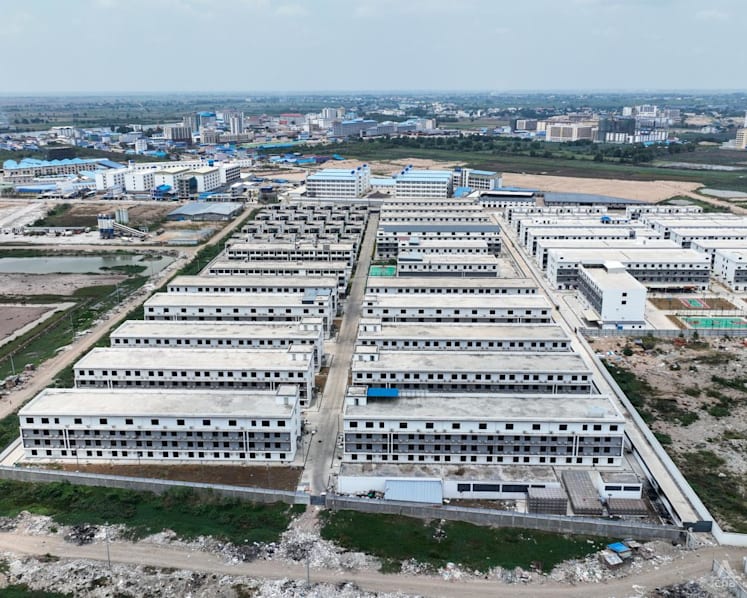


Researchers have connected the complex to both Prince Group and Huione Group, two conglomerates whose former chairmen have since been extradited from Cambodia to China over alleged links to transnational fraud and gambling networks.
Legend Innovation Co is the company publicly identified by the UK government as the operator of #8 Park. In March, Britain sanctioned the company and its director, Eang Soklim, saying the compound was linked to Prince Group.
Researchers have also pointed to links with Huione, including registration details, payment systems and logistics services connected to the wider complex.
When CNA visited the area in May, the complex appeared entirely evacuated, with posted documents on the front gate from the Phnom Penh Municipal Court confirming the seizure of evidence and the closure of the facility.
Within just a few kilometres of #8 Park, several other enormous complexes have also been constructed in recent years, including a sister #7 Park development.
There were signs last month that expansion was still in the pipeline, despite the crackdowns.

Tight security also remained in the vicinity of a nearby complex referred to as “Space”, while diggers and dump trucks were active below cranes suspended over skeletal expansion renovations.
“For everybody involved, that border area is a real frustration,” said Michael Brosowski, the founder and strategic director of Blue Dragon Children's Foundation, a Vietnam-based non-profit organisation dedicated to rescuing and supporting street children and survivors of human trafficking.
“There's no case for them to be built. They’re so obviously for nefarious purposes, and yet they’re still there. The tall barbed wire fences, the armed guards, the massive compounds, that's not what you would expect to see in a trading zone,” he said.
Further south, Chrey Thum used to be a sleepy riverside town. In recent months, it has been promoted by the government as a dynamic new economic hub.
Here too, whole new districts appear to have risen from the rice fields. New roads lead to vast compounds - their cameras facing inward - cement facilities and construction sites.
Around them are the unusual accessories of a frontier gambling town: nail clinics, Botox services, restaurants and signs from Chinese construction firms.
Much of it is quiet now, caught in the crackdown.

But construction continues at the edges, Range Rovers still pass through and recent online job ads were still seeking foreign-language workers for the area.
The syndicates appear to have pressed a soft pause on activities amid heightened scrutiny and pressure, said Tower. But they have not fully abandoned these major investments.
“Many of the higher level players are at a point of inflection. It's wait and see,” he said. Maybe they're hanging out in a comfortable capital city, somewhere in ASEAN or in South Asia.
“The minute the pressure is alleviated a bit, I think you'll see it rebound in an unprecedented way in Cambodia. You've already seen that happen in Myanmar,” he said.
But the Cambodian government has a different view. That this is the end of the road for the criminal groups.
“The locations where we conducted crackdowns are now under control and have been converted into state property,” said Sinarith.

Once held captive, trauma lingers even after escape from scam compound
Selam’s dream was to make it to Australia. The former flight attendant from Ethiopia had found a way to get there too. An agent had promised her and her husband visas Down Under. All they had to do was make it to Thailand and everything would be processed.
In January this year, after a month of waiting in Bangkok for their documents to be readied, eventually the couple were told to move to one last hotel. But instead of this being the final stage in their big journey, it was a trap. They were smuggled across the border to Cambodia to a frontier town and straight into a scamming compound.
With the pair separated, Selam - who asked that her full name not be used - was put to work on love scamming - targeting victims from around the world using the social media networks LinkedIn and Facebook. Her task was to win trust and extract money.
But deep anxiety set in for her fast. She said she could not do the job. But the bosses of the compound would not release her. And from that point, her life became much more difficult.
“They dragged me. They injected me. I still don't know what they injected me with. I couldn’t open my eyes, and I couldn't move after that time.
“They took me into one room, and I have a lot of bad memories about that place. They raped me in there every day. When I had no energy left, they would take me to another place and give me glucose. I did not eat anything else. I would wake up and they would take me again. They did the same thing for three months,” she said.
After this prolonged period of torment, a rare moment presented itself to Selam. After a man was found dead after falling from the scam complex building, and with her captors distracted, she made an attempted escape. Running through the gates, the one other person who tried the same thing was her husband, who she had not seen for months.
“We just ran from that place, and we got into a taxi and got out, even though we didn’t have money to pay the driver,” she said.
They made it across Cambodia to a shelter being run by an international non-governmental organisation connected to the Catholic Church. Eventually, with the support of some fundraisers, they managed to raise the money to get a flight back to Ethiopia.
Returning home did not ease her pain.
“I just remember a lot of things about what happened back in Cambodia." Selam said.
“I have hepatitis B virus in my blood now. It cannot be cured, and I worked in airlines before, and my airlines don't want to hire me again because of this disease."
She understands why people across Africa are seeking opportunities abroad. She says the allure is real and that some people are openly willing to scam to make money. But she said agents exploit that desperation.
“Agents, they sell people like cheap things. They don't even see you as a human being,” she said.
But she wants her story to be a warning for those acting on impulse, or heading to situations that may not be safe or legitimate. Especially, she warns of the dangerous people running the scamming syndicates, increasingly all over the world.
“If they cannot get what they want from you, they will kill you. They don't have humanity. You are useless unless you give them money. This is a bad reality.
“Now I have lost everything. I lost my money. I lost myself.”

VIETNAM’S PUSH AND PULL
While the Vietnam border has become one of the most important and least examined frontiers of Cambodia’s scam economy, it could be an area where regional cooperation could make more permanent inroads, Tower said.
Thailand and Vietnam could better coordinate efforts and exchange information, for example.
“That might accelerate some of the crackdowns and prevent scam centres from becoming increasingly embedded on the Vietnam border, just as they move off of the Thailand border,” he said.
Rampant grey industry activity on Cambodia’s border with Thailand has been illuminated by the extended period of conflict between those two countries.
Much of the border has been militarised and crossings closed for nearly one year, after clashes over disputed territory along the international divide in 2025.
Thailand has used the presence of scam compounds along the frontier to argue that its military actions are also targeting transnational criminal infrastructure, not just Cambodian military positions.
During clashes in December, it struck several Cambodian casino and hotel complexes, allegedly being used by opposing forces but also identified by monitors as scam hubs.
The government has pledged coordinated international action and said such compounds posed a threat to Thai national security.
“None of that's really happening on the Vietnam side, so the asymmetry that's there, the fact that Vietnam hasn't mobilised the same way that Thailand has, really points to where you could put in place a more effective mechanism for cracking down,” Tower said.
Broadly, Vietnam has tried to present itself as a country that does not tolerate scam compounds on its own soil, while also dealing with two outward-facing problems: Vietnamese citizens being trafficked into Cambodia and Vietnamese suspects operating from Cambodian sites, said Brosowski.
The Vietnamese government has repeatedly arrested Vietnamese nationals after Cambodia handed them over from scam operations, including 343 people arrested in Dong Nai province in March.
“Vietnam has done an excellent job at just arresting these people quickly when they start up and refusing to allow it to prosper. There's a really powerful message that Vietnam doesn't tolerate this,” he said.
There are still powerfully influential push factors that are leaving Vietnamese nationals vulnerable to trafficking, despite the well-known risks and rising unease that has developed about taking a job in neighbouring Cambodia, or even close to the border.
Blue Dragon’s research has shown that many Vietnamese victims shuttled into scam compounds were young men from poor rural backgrounds, often with limited education and few job opportunities.
“Things are hard at home. There's no work. You go out, you migrate and look for work, but that need for an income puts them at risk. It makes them vulnerable to these traffickers,” Brosowski said.

About 98 per cent of victims get deceived and trafficked through false job offers precisely because of that need to migrate, the organisation found.
The border is long, socially fluid and economically active. People cross for trade, family, work and informal business making it hard to police. In those gaps, traffickers have thrived and Cambodia’s reputation has grown more dangerous.
“Cambodia has become synonymous with scamming. It's not great to have that negative view of your neighbour, even if it's not fear," Brosowski said.
According to the International Organization for Migration (IOM), Vietnam is one of the three main source countries for victims forced into criminal activity.
Blue Dragon found that forced criminality was the third most commonly prosecuted form of human trafficking in Vietnam between 2022 and 2024. Its analysis covered 21 court cases, involving 130 victims and 43 traffickers, and found that the number of cases reaching trial tripled over that period.
Even if Vietnam has not seen Cambodia-style scam cities on its own territory, there are still social and human costs to bear.
Brosowski said recovery from the scamming experience can take years. Survivors often return home with trauma, debt, shame and few clear options for work.
On a patch of pavement in central Phnom Penh, Sumatran Muhammad Fadly was living the start of that transition in real time.
With his young family in tow, he waited for his air ticket and a chance to start again. He was adamant about not coming back to Cambodia.
“I will open a small business in Indonesia,” he said. “Start small. For my family, for my wife and child, and my mother.”