India, EU reach landmark trade deal, tariffs to be slashed on most goods
The trade deal is expected to be implemented within a year, said an Indian government official.
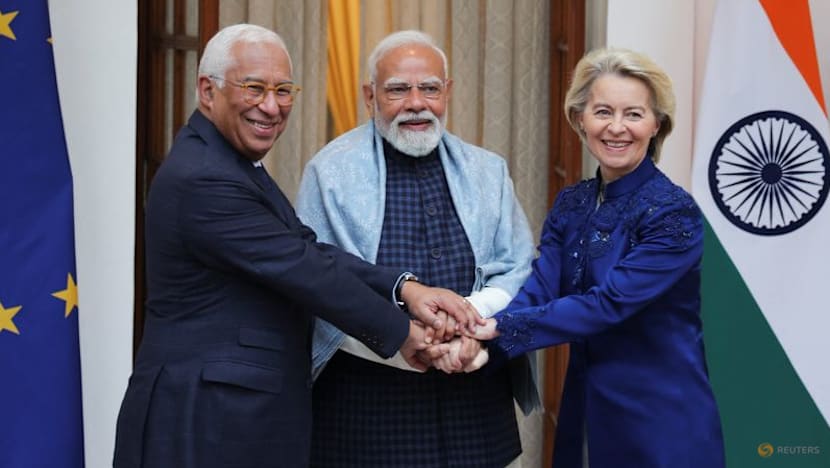
European Council President Antonio Costa, Indian Prime Minister Narendra Modi and European Commission President Ursula von der Leyen pose during a photo opportunity ahead of their meeting at the Hyderabad House in New Delhi, India, Jan 27, 2026. (Photo: REUTERS/Altaf Hussain)
NEW DELHI: India and the European Union struck a long-delayed deal on Tuesday (Jan 27) that will slash tariffs on most goods, aiming to boost two-way trade and reduce reliance on the United States amid growing global trade tensions.
The deal is expected to double EU exports to India by 2032 by eliminating or reducing tariffs in 96.6 per cent of traded goods by value, and will lead to savings of 4 billion euros (US$4.75 billion) in duties for European companies, the EU said.
The EU will cut tariffs on 99.5 per cent of goods imported from India over seven years, with tariffs to be cut to zero on Indian marine goods, leather and textile products, chemicals, rubber, base metals and gems and jewellery, India's trade ministry said in a statement.
India and the EU said agriculture-related items like soya, beef, sugar, rice and dairy have been kept out of the purview of the trade deal.





"Yesterday, a big agreement was signed between the European Union and India," Indian Prime Minister Narendra Modi said earlier.
"People around the world are calling this the mother of all deals. This agreement will bring major opportunities for the 1.4 billion people of India and the millions of people in Europe," he said.
The two-decade-long EU–India trade talks gained momentum after Washington imposed a 50 per cent tariff on some Indian goods, and as US allies pushed back against President Donald Trump’s tariff threats and his bid to take over Greenland.
Canada's Prime Minister Mark Carney, in a speech that got a standing ovation in Davos last week, urged middle powers to come together to avoid becoming victimised. He is planning to visit India to sign deals on uranium, energy and minerals, after striking a deal recently with China
Before signing the deal with New Delhi, the EU agreed a pact with the South American bloc Mercosur, following deals last year with Indonesia, Mexico and Switzerland. During the same period, New Delhi finalised pacts with Britain, New Zealand and Oman.
"Europe and India are making history today," European Commission President Ursula von der Leyen said. "This is only the beginning."
Trade between India and the EU stood at US$136.5 billion in the fiscal year through March 2025, compared to US$132 billion of trade between India and US, and US$128 billion between India and China.
The formal signing of the India-EU deal would take place after legal vetting, expected to last five to six months, an Indian government official aware of the matter has said.
"We expect the deal to be implemented within a year," the official added.
The vetting process in the EU region could be subject to some setbacks, as in the case with Mercosur. EU lawmakers have voted to challenge the EU-Mercosur agreement in the bloc's top court.
OPENING UP GUARDED SECTORS
The EU accord with India would open up the South Asian nation's vast and highly guarded market, with New Delhi slashing tariffs on cars to 10 per cent over five years from as high as 110 per cent, according to an EU statement, benefiting European automakers such as Volkswagen, Renault, Mercedes-Benz and BMW.
The reduced tariffs on autos would be granted to 250,000 cars a year valued at over 15,000 euros and will be cut to 30 per cent-35 per cent as soon as the deal is implemented, both sides said.
India is also slashing tariffs on alcoholic beverages like wines to 75 per cent immediately from 150 per cent, which would be lowered to 20 per cent gradually. Tariffs on spirits will be lowered to 40 per cent, the EU said.
The deal will also cut tariffs on a slew of EU goods coming to India, including machinery, electrical equipment, chemicals and iron and steel, the EU said.
However, there was no immediate relief for Indian companies hit by the carbon tax under the EU's Carbon Border Adjustment Mechanism (CBAM) that started on Jan 1.
Besides steel, the decarbonisation-oriented levy applies to cement, electricity, fertilisers and other products as well.
India said it has got a commitment from the EU that it will get flexibilities on the carbon tax if it is granted to any third country.
Separately, the EU agreed to provide financial support of 500 million euros over the next two years to help India in cutting greenhouse gas emissions.