analysis Asia
How exposed is Southeast Asia’s energy supply to the Iran war - who is most vulnerable and what’s next?
Rising tensions in the Middle East have exposed Southeast Asia’s growing reliance on imported energy and are testing the region’s economic resilience, say experts.

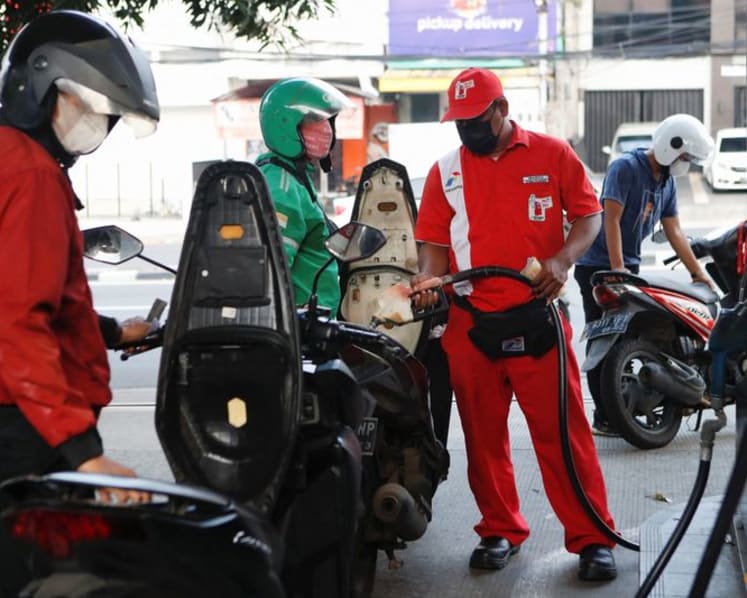
A driver looks on as he refills his jeep with diesel as the price of oil and gas surged amid the US-Israeli conflict with Iran, at a gas station in Quezon City, Metro Manila, Philippines, on Mar 6, 2026. (Photo: Reuters/Noel Celis)

This audio is generated by an AI tool.


BANGKOK: The latest military escalation involving Iran is unfolding thousands of kilometres from Southeast Asia. But for a region that depends heavily on imported oil and gas, the economic effects could arrive quickly, testing energy security, inflation control and long term planning, say experts.
Instability in the Persian Gulf, sparked by targeted air strikes by Israel and the United States on Iran since Feb 28, is disrupting shipping routes and unsettling markets, with policymakers facing renewed questions about how secure the region’s energy supplies really are.
If the fighting drags on, it could push up electricity prices and fuel costs across Southeast Asia, and shape long-term decisions about the region’s energy mix.
“The conflict provides a powerful demonstration of the risks of relying on imported fossil fuels,” Indra Overland, head of the Centre for Energy Research at the Norwegian Institute of International Affairs, told CNA.
Broad upheaval in shipping and aviation routes have stretched into a second week; thousands of flights have been cancelled, including at major hubs such as Dubai, Doha and Abu Dhabi, affecting passenger and cargo transport across Asia, Europe and the Middle East.
Critically for Asia’s energy supplies, missile and drone attacks have targeted oil facilities, refineries and storage sites in Saudi Arabia, the United Arab Emirates and other Gulf states, prompting output cuts or shutdowns at key facilities, such as a major Saudi Aramco oil refinery.
“The shutdown (of refineries) will last for as long as shipping is halted. Flows will not resume until there is a clear resumption and assurance of safety of passage in the Strait,” said Pang Lu Ming, a senior gas and LNG analyst at Rystad Energy.
He added: “If the risk of vessel damage and loss is too high for shippers to bear, the disruption and subsequent supply reduction will be further lengthened.”
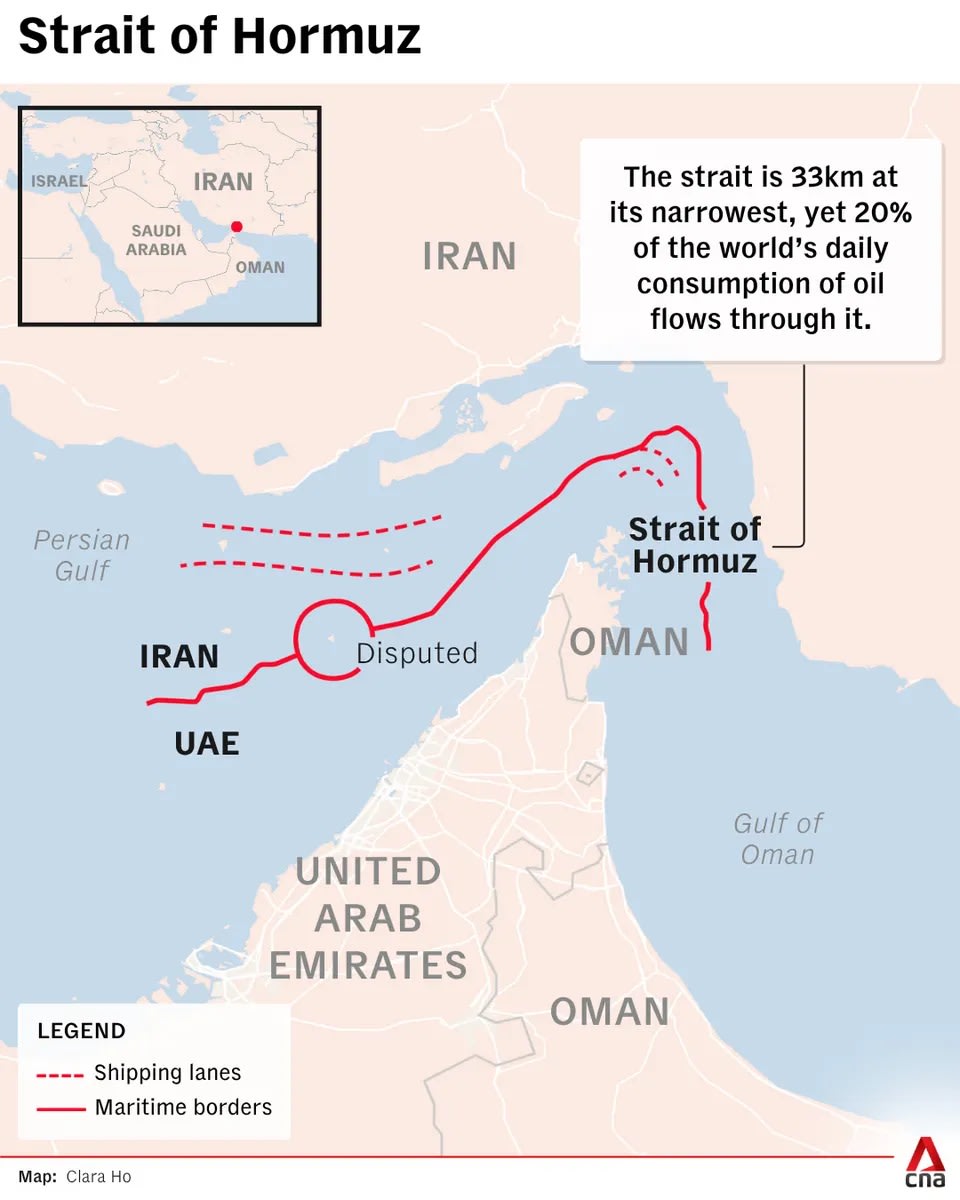
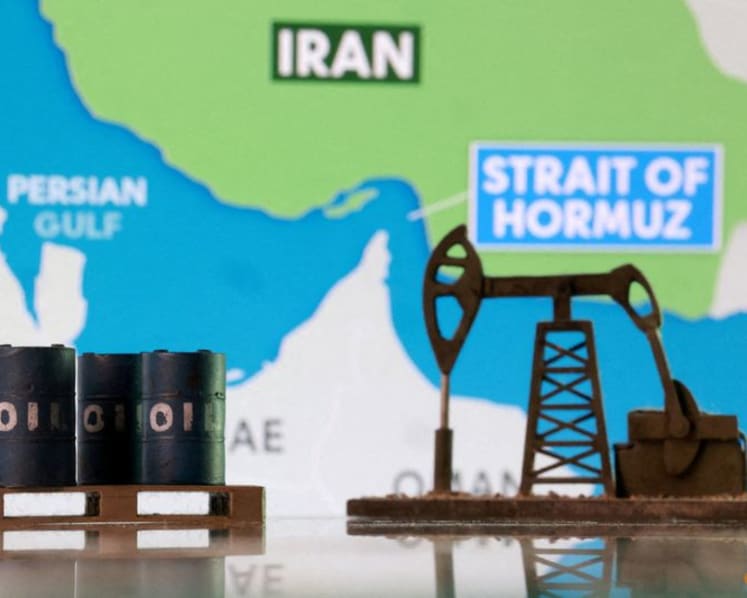
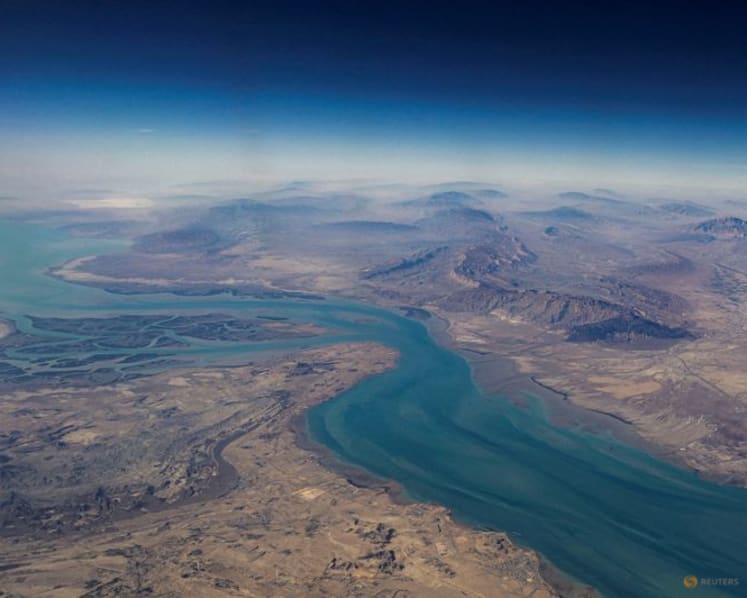
Nearly a third of Asia’s liquefied natural gas (LNG) imports and about 60 per cent of its crude oil move through one narrow shipping route: the Strait of Hormuz, a narrow sea passage separating the Arabian Peninsula and Iran.
Last year, an average of 20 million barrels per day of crude oil and oil products were shipped daily, making it one of the world's most critical oil transit chokepoints, according to the International Energy Agency (IEA). Last year, almost 90 percent of the total volumes exported via the Strait of Hormuz was bound for Asia.
Disruptions to flows have huge consequences for world oil markets; prices surged above US$100 a barrel on Monday (Mar 9), well above the levels seen for most of the past two years, when prices generally hovered between US$70 and US$85.
The price topped at nearly US$120 a barrel before snapping back to below US$90 on Tuesday after US President Donald Trump suggested the conflict could be nearing an end.
Southeast Asia sits directly downstream of the risk, given how heavily it depends on energy shipments passing through the Gulf.
LONG LINES FOR PETROL, CUTTING BACK AIR CONDITIONING
But not all Southeast Asian countries face the same level of exposure to higher costs and blockages to supply. Some rely heavily on Middle Eastern oil or LNG, while others have limited reserves or fragile public finances.
“The most immediate, near-term risk for Southeast Asian countries is the risk of physical supply disruptions,” said Sam Reynolds, a researcher on Asia’s LNG and gas for the Institute for Energy Economics and Financial Analysis (IEEFA).
“But all countries also face a more indirect, immediate risk of higher costs in global commodity markets.”
Over the past decade, Southeast Asia has grown more reliant on imported fossil fuels. Domestic oil and gas production has declined in several countries even as energy demand has risen.
Governments have expanded LNG import terminals and increased crude imports, tying their power systems and transport networks more closely to global markets. That deeper integration has supported growth, but it has also increased exposure to geopolitical shocks.
The Philippines sources 96 per cent of its oil from the Persian Gulf, while Vietnam and Thailand buy roughly 87 per cent and 74 per cent from that region, respectively.
During this latest conflict, that reliance is already being felt through various regional economies. Southeast Asian countries are trying to find ways to cushion strong price increases while making sure that local demand is met.
Governments in the Philippines and Thailand have both been searching for ways to conserve fuel; public officials were ordered to use less air conditioning and reduce travel, for instance.
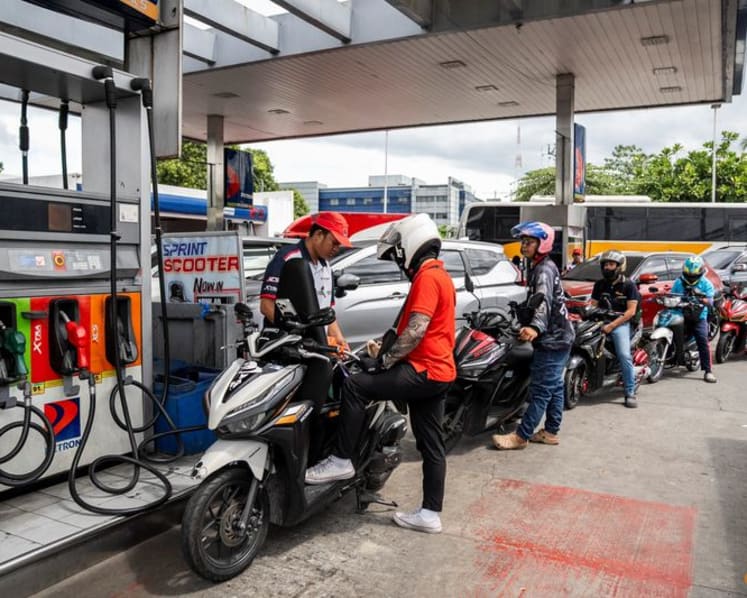
Myanmar’s authorities have imposed alternate-day driving rules and queues have appeared at petrol stations as fuel costs have climbed. Laos has seen similar pressure at filling stations, while Cambodia is also heavily reliant on imported fuels from other Southeast Asian countries, such as Thailand, Vietnam and Singapore.
“The decision by these exporting countries to reduce exports of petroleum products will put the importing countries under a higher degree of stress,” said Alloysius Joko Purwanto, an energy economist at the Economic Research Institute for ASEAN and East Asia (ERIA).
ERIA studies suggest that most Southeast Asian countries can hold oil and gas reserves equivalent to 20 to 50 days of demand.
As a result, they are trying to diversify their sources and extend their reserves of oil and gas products to meet domestic demand and prepare for a prolonged crisis, Purwanto said.
Thailand has more than 60 days of cover, Indonesia has no more than 21 to 25 days while Vietnam has less than 20 days of supply. This, Reynolds said, means that extended disruptions to oil flows could impact physical supplies depending on storage capacities of the different Southeast Asian countries.
Any economy with a reliance on energy imports will see energy price inflation, according to Pang.
“The only economies to not be as affected are those with a strong domestic fossil fuel production, although that may vary across different countries in the region,” she said.
Indonesia, now a net oil importer despite being an energy producer, sources crude from a wider range of suppliers, giving it slightly more flexibility. Still, analysts say it could still be hit hard, given it consumes 1.6 million barrels of oil per day amid soaring prices.
The country has allocated 381 trillion rupiah (US$22.4 billion) for petrol and diesel subsidies in its 2026 budget, based on an assumption that oil prices would remain at around US$70 per barrel.
“If the state budget is not sufficient to subsidise fuel, there is no other way but to share part of the burden with the public - which means there will be an increase in fuel prices,” Finance Minister Purbaya Yudhi Sadewa said at a media briefing on Friday.
However, raising fuel prices so close to the Muslim holiday of Eid - when the cost of goods and transportation has already surged - carries additional risks.
“Raising the prices of subsidised fuel and diesel would certainly trigger inflation and reduce purchasing power. This could spark a strong public backlash, especially if the increase is significant,” Fahmy Radhi, an economist at Indonesia’s Gadjah Mada University, told CNA.
On Monday, Energy and Mineral Resources Minister Bahlil Lahadalia pledged that “there will be no increase in subsidised fuel prices until Hari Raya”, using another term for Eid, which is expected to fall on Mar 21, depending on the sighting of the Syawal new moon.
Malaysia, meanwhile, remains a net exporter of oil and gas, providing some buffer against physical supply disruptions.
However, Prime Minister Anwar Ibrahim warned that an extended closure of the Strait of Hormuz could affect how the country subsidises fuel prices, local media reported.
Malaysia maintains the price of RON95 grade fuel at RM1.99 (US$0.50) per litre for citizens, and last Friday, Anwar said the government could hold off raising prices for “one or two months”.
“Let’s be honest, sincere and clear to the community. We must monitor the situation and let us not be complacent as if nothing is happening,” he said, while calling on Malaysians to manage their finances carefully and avoid wasteful spending as global conflicts drive up the costs of energy and goods.
Analyst Adib Zalkapli from Malaysia-based geopolitical consultancy Viewfinder Global Affairs said that any prolonged conflict would likely further push up fuel prices and, in turn, consumer prices in Malaysia, echoing Anwar’s warning.
“In fact, most countries are not insulated from such developments, as disruptions to oil supply tend to ripple through global markets and directly affect energy costs worldwide,” he told CNA.
Beyond mitigation measures, Adib said the government should communicate clearly the potential domestic effects of the Middle East conflict, and manage public expectations early if the situation drags on.
But if fuel subsidies are cut due to prolonged conflict, Adib predicted that “there will be a lot of angry people”.
Separately, Abdelaziz Albogdady, the market research and fintech strategy manager at FXEM, said that despite being exposed to a global energy shock, Malaysia “is better positioned than many of its neighbours” because it is an oil and gas producer.
“While higher oil prices could generate larger revenue levels from exports, the cost of crude imports could negate the gains and could also strain the country’s subsidy system.
“As a result, a prolonged period of elevated global oil prices would still raise Malaysia’s domestic fuel bill and increase the cost of shielding consumers,” he warned.
GAS PRICES ON THE RISE
Generally, Asia is even more heavily reliant on the Middle East’s LNG supplies. In 2025, almost 90 per cent of the total volumes exported via the Strait of Hormuz was destined for the Asian market.
Together with South Asia, Southeast Asia is the fastest-growing region in terms of natural gas demand.
An inability to secure LNG imports in the short term could primarily affect the power generation sector of several countries and the region’s long-term plans in developing natural gas-based economies, said Purwanto.
Even if the Strait of Hormuz opens, Rystad Energy’s Pang expects that it could take up to six weeks for gas production to resume in Qatar.
In an optimistic scenario, that would translate to about 9.64 million tonnes of LNG removed from supply.
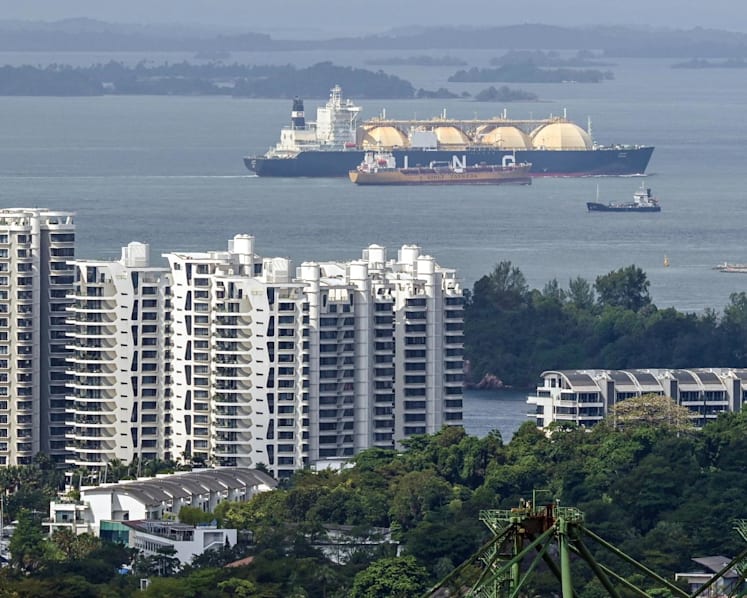
Meanwhile, about 42.5 per cent of Singapore’s LNG imports came from Qatar last year, compared to 20.5 per cent of Thailand’s, according to data from Rystad. Both nations heavily rely on gas to keep their economies powered.
LNG storage throughout Southeast Asia is also very limited, meaning that any disruption in flows could cause a more immediate dependence on spot market prices, which are spiking, Reynolds said. Spot market prices are the current, real-time market values for purchasing or selling an asset.
Industry pricing data showed spot LNG prices in Asia jumping to about US$25 per million British thermal units (MMBtu) in early March, roughly double where they stood a week earlier. The price has since eased but remains elevated at around US$15 to US$16 per MMBtu.
The Philippines and Vietnam are “potentially staring down the barrel of unaffordable LNG supplies”, given that they are almost entirely dependent on spot markets, Reynolds said.
If Southeast Asian countries are priced out entirely, this can leave households and businesses facing fuel shortages and power outages, he warned.
And if they opt to pay skyrocketing prices, this can lead to higher fuel and power costs for consumers, financial instability for energy industry players, rising subsidy burdens for governments, inflation, and potentially slower economic growth.
When gas prices rise sharply, power utilities look for the cheapest available fuel to keep electricity flowing. In parts of Southeast Asia, coal remains that fallback option, especially in Thailand, Vietnam and Indonesia.
System operators can increase output from existing coal plants instead of running gas turbines at high cost.
With the region prioritising reliability and affordability over decarbonisation, in the short term, there is expectation that coal will be switched on, said Linda Zeng, a senior power and renewables analyst at BMI, a unit of Fitch Solutions.
MORE RENEWABLES TO COME?
Analysts are split on whether this crisis will deepen fossil fuel dependence or accelerate the deployment of renewables, like solar, wind and battery storage technology.
The nature of renewables means they are far less impacted by broader geopolitical shocks or fluctuations of commodity markets.
The fluctuation in fossil fuel prices may incentivise Southeast Asian nations to incorporate more renewables into the grid, in order to strengthen energy security and import reliance, Pang said.
But geopolitical turbulence in the Middle East is not a new phenomenon and governments are already acutely aware of the risks of relying on the region for a steady supply of energy, said Stephen Olson, a visiting senior fellow at the ISEAS – Yusof Ishak Institute in Singapore.
“Nothing has been exposed by the Iran conflict that was not previously evident. Anyone with a map and even just a basic understanding of the geopolitical realities in the region would have already understood these vulnerabilities long before the bombs started to fall on Iran,” he said.
Olson argued that any short-term impetus to accelerate the green transition as a result of the war on Iran could fade as soon as the associated price shocks recede.
“Governments sometimes have incredibly short memories,” he said.
The conflict certainly strengthens arguments for self-sufficiency through increased use of domestic energy sources and in the broader context it can help tip the balance in favor of renewables, said Overland.
But given the track record of governments in the region, he was not confident this crisis would fundamentally shift energy policies.
“The insistence of Asian countries on continuing and increasing fossil fuel imports is already such a paradoxical and self-contradictory situation that it is unlikely that the current events on their own will dramatically change the situation,” he said.
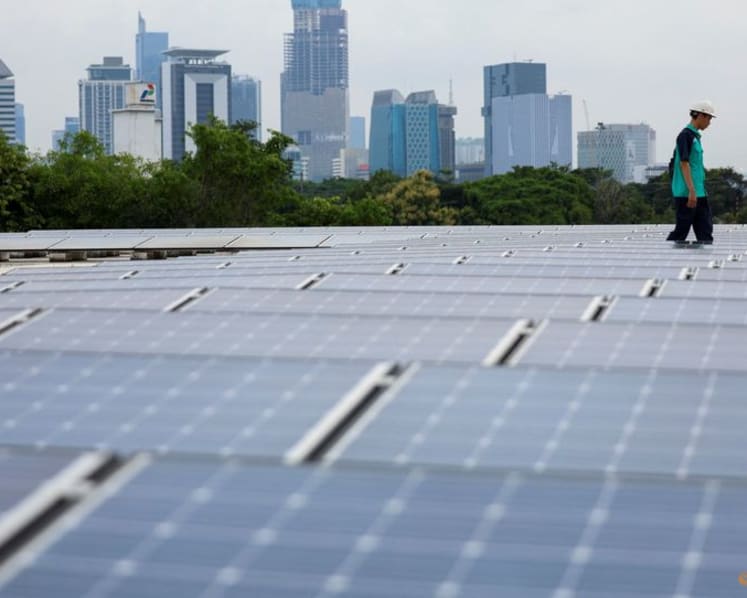
Overland encouraged the removal of fossil fuel subsidies, development of grids within individual Southeast Asian countries and improved regulatory frameworks for investment in renewables.
Currently though, power development plans in the region still envision a continued expansion of LNG-to-power facilities, sold by the global gas industry as a “bridge fuel” from coal to renewables, Reynolds said.
Given the exposure to two major global conflicts in just the last four years, and the soaring gas prices as a result, such expansion is “fundamentally antithetical to energy security and resilience”, he said.
At the same time, renewables present a critical hedge against fossil price insecurity.
“The urgency of a clean energy transition for Asia’s energy security has once again become unmistakably clear,” he said.
Experts agreed that better regional interconnectivity and accelerating the development and implementation of the ASEAN Power Grid as well as building strong supply chains for materials and components related to renewables could improve energy security in the long term.
There are signs that regional governments are open to more coordination. According to Thai media, the country’s Foreign Minister Sihasak Phuangketkeow on Monday called for a special meeting of ASEAN foreign ministers to discuss the escalating situation in the Middle East and its potential impact on regional energy security.
The next few weeks could determine whether the response is focused on handling a temporary price spike or a lasting shift in how the region powers itself, Overland said,
‘Its impact will depend on how long it lasts, how intense it is and whether the Strait of Hormuz remains closed for a long time,” he said.
Additional reporting by Nivell Rayda, Aqil Haziq Mahmud and Izzah Aqilah Norman