Thailand Election 2026: Debt worries, economic uncertainty loom large on voters’ minds
With Thai households under financial strain, economists say debt and global trade risks could hugely impact who voters pick on Sunday (Feb 8).
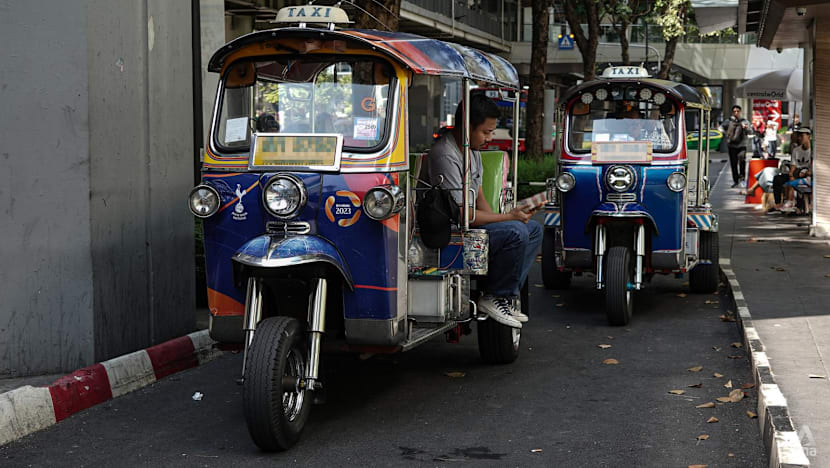
A tuk-tuk driver plays with his phone while waiting for a customer in Bangkok, Thailand, on Feb 2, 2026. Thailand’s household debt stands at around 89 per cent of GDP, one of the highest levels in Asia. (Photo: CNA/Zamzahuri Abas)

This audio is generated by an AI tool.


BANGKOK: The sharp aroma of chillis and garlic slice through the air as Anantaya Klangprapan stands over a sizzling wok at a corner stall in a nearly deserted cafeteria in downtown Bangkok.
Since 7am, the 58-year-old has been frying krapao gai, Thailand’s ubiquitous stir-fried basil leaves with chicken and rice, even though most neighbouring stalls are shuttered for the weekend lull.
But for Anantaya, the few customers she can attract during these offpeak hours means another chance to earn money — and to chip away at a debt that has come to define her daily life.
Her business never fully recovered after the COVID-19 pandemic. To cover household and operating costs, she borrowed heavily, racking up around 100,000 baht (US$3,180) in debt.
With few formal lending options, the widow turned to illegal moneylenders, paying interest rates far beyond what banks charge.
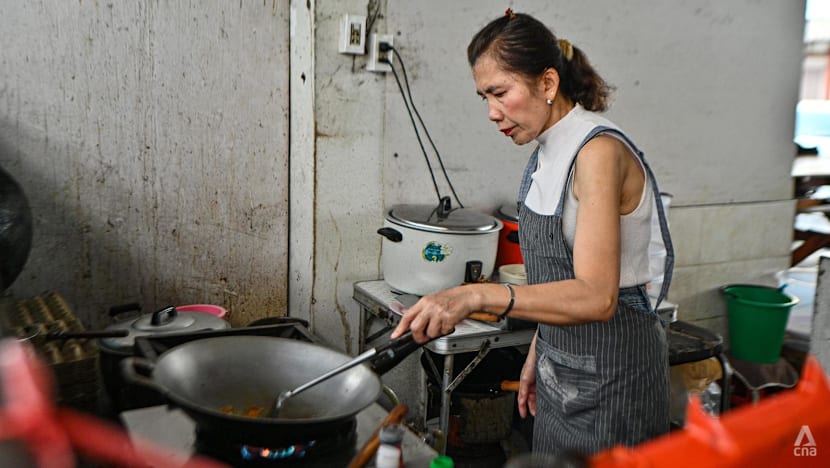
“I had to borrow from loan sharks. The interest was 20 per cent every 24 days,” said Anantaya.
“If I borrow 10,000 (baht), I repay 12,000, and I have to pay every day,” she added.
Anantaya also had to borrow money to buy medicine for her sick husband who recently died.
To pay off her debt completely, Anantaya needs to fork out 3,000 baht a month, but she typically pays only between 1,500 baht and 2,000 baht. This means that her debt snowballs with interest and she is stuck in a vicious cycle.
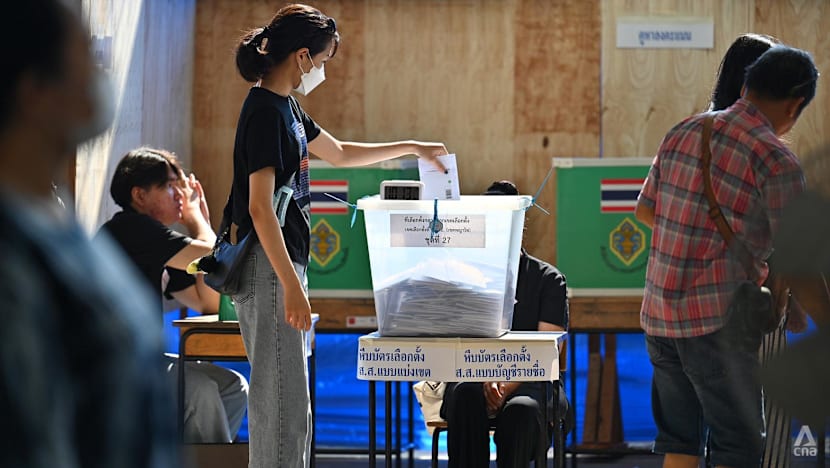
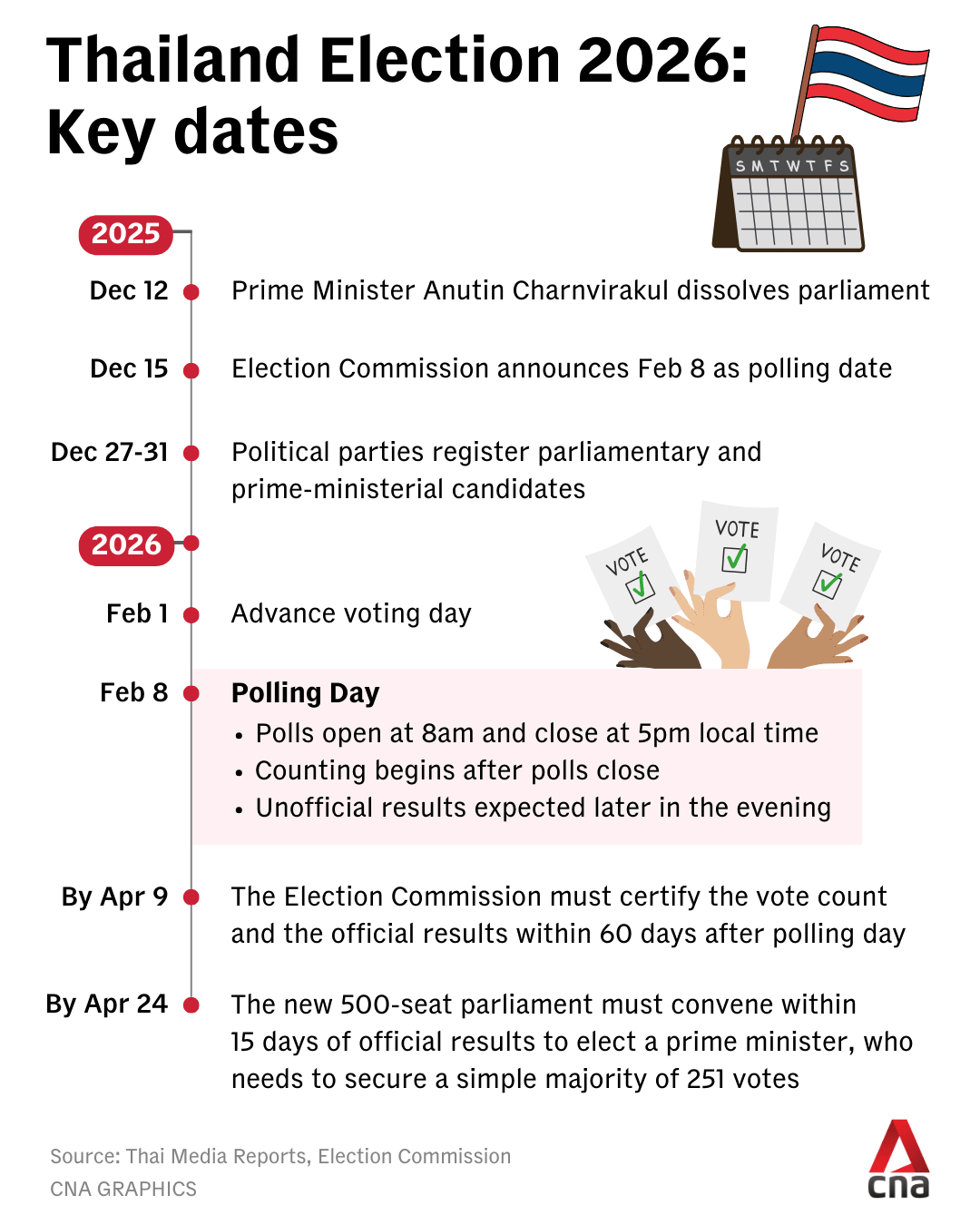
As Thailand heads into a general election on Sunday (Feb 8), voters like Anantaya have pushed household debt to the forefront of the political debate.
Thailand’s household debt now stands at nearly 90 per cent of GDP — among the highest in Asia, according to the International Monetary Fund.
Economists warn it has become a major economic fault line, weighing on consumption, slowing growth, and eroding Thailand’s competitiveness.
“With such high household debt, combined with domestic political instability, Thailand risks standing at the back of the line when it comes to regional attractiveness,” said Pavida Pananond, a professor of international business at Bangkok’s Thammasat University.
As voters head to the polls on Sunday, parties are now foregrounding economic promises to win support – from cash handouts and lottery schemes to pledges of technocratic leadership.
But Pavida warns continued political volatility could further undermine investor confidence and delay critical reforms.
“The more political instability Thailand has, the more dangerous it becomes — not just for investor confidence, but for the country’s ability to push through the structural reforms needed to move ahead,” she said.
Thailand’s economy has struggled to regain momentum since its heyday in the late 1980s and early 1990s.
After the Asian Financial Crisis in 1997, Thailand recovered briefly under then-prime minister Thaksin Shinawatra in the early 2000s but has since been unable to reach similar heights.
Growth has hovered between 1 and 3 per cent a year since 2021, with official projections putting expansion at 2.2 per cent in 2025.
Thailand's economic growth projections for 2026 have also been cut from 2.2 per cent to 2 per cent by the ministry of finance, citing weaker manufacturing output.
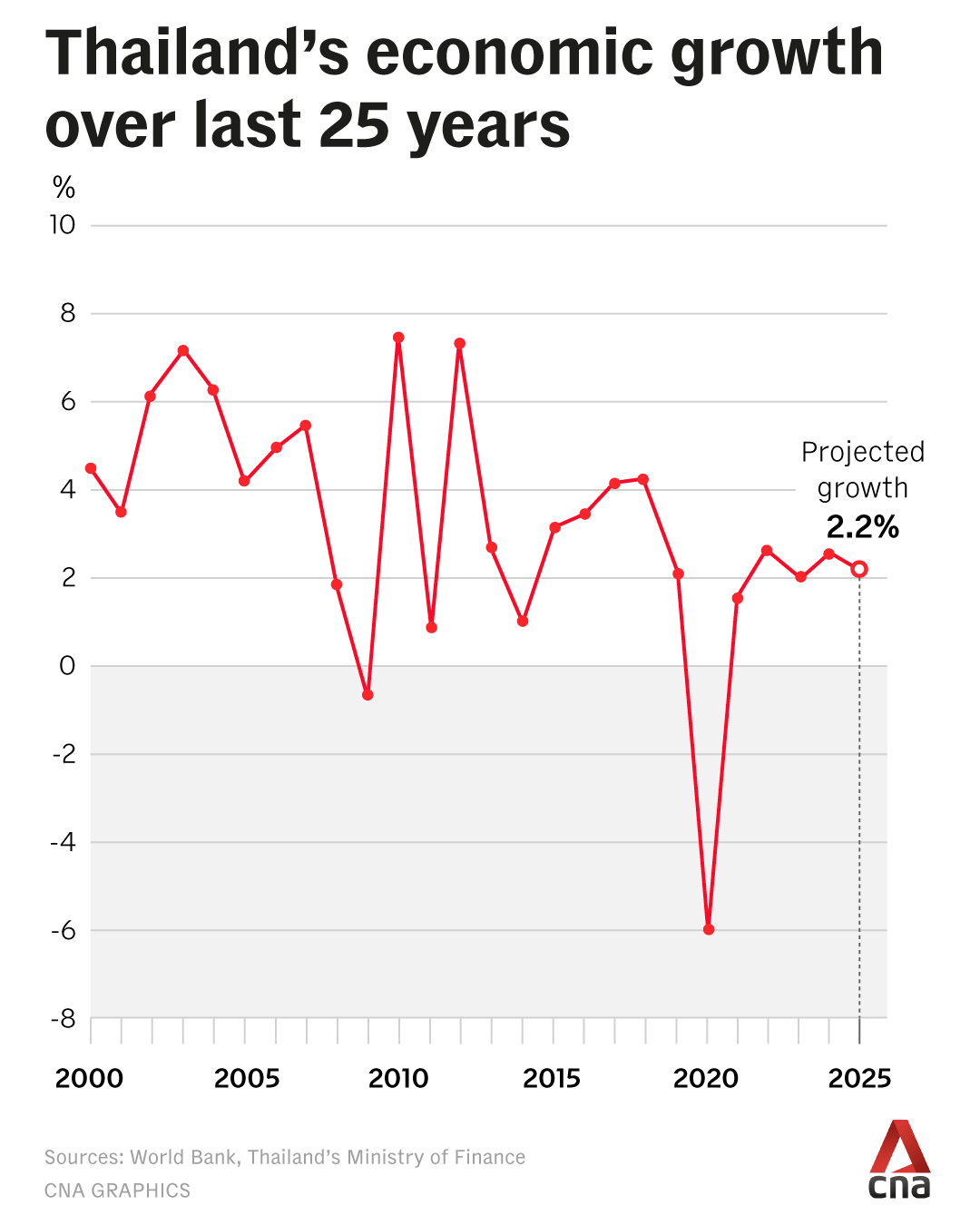
That lags behind regional peers such as Vietnam, the Philippines and Malaysia, which have posted stronger and more consistent growth.
Analysts say political instability has compounded the problem. Thailand has cycled through three prime ministers since the 2023 election, limiting policy continuity and reform.

CASH HANDOUTS VIA LOTTERIES: PLOY OR SOUND POLICY?
Economic pledges by some political parties have made national headlines, including eye-catching promises of cash handouts, lotteries, subsidies and debt moratoriums.
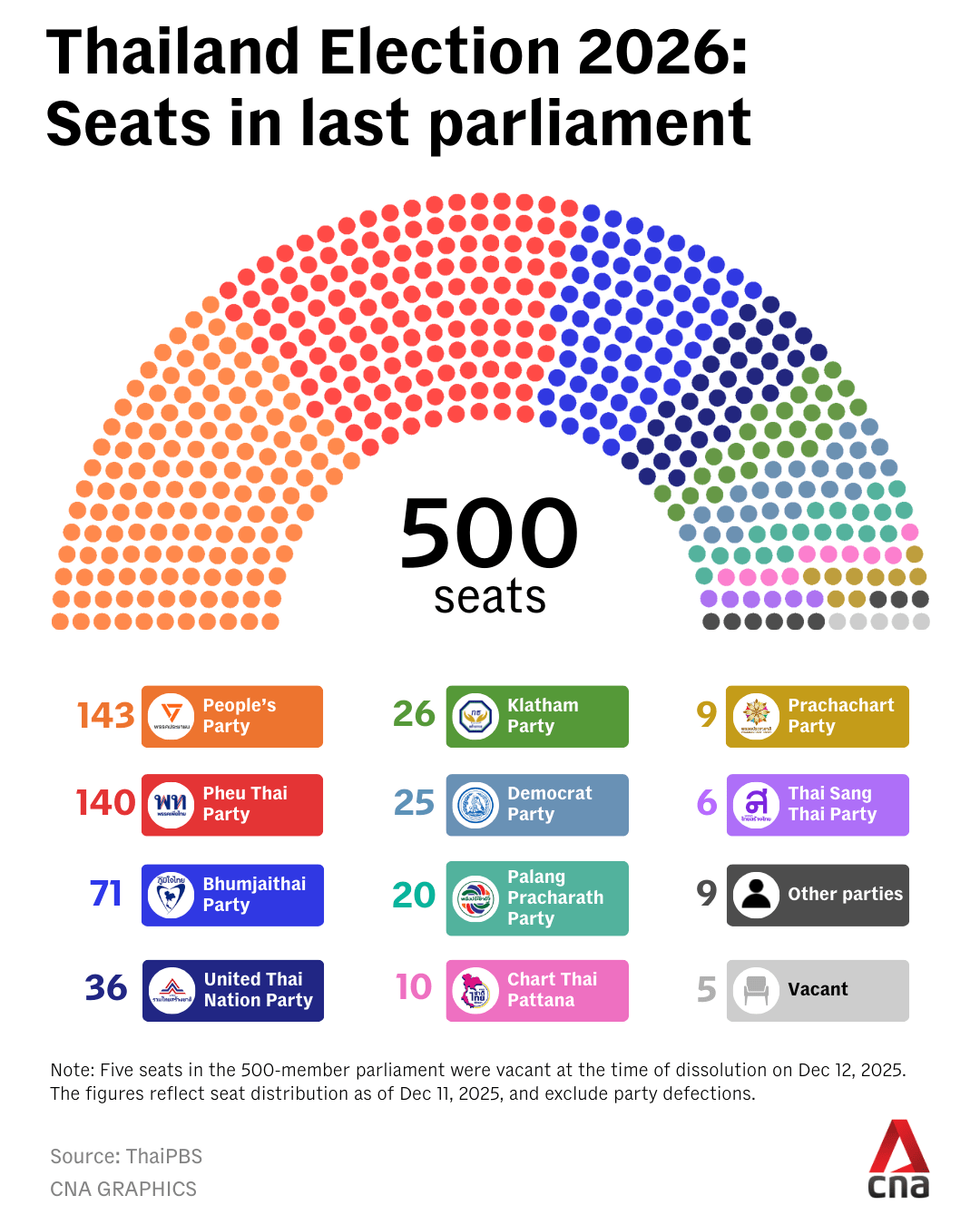
Parties are offering fiscal policies such as the second phase of Bhumjaithai's co-payment subsidy scheme, that in stage one covered half of the cost of selected food and consumer goods, or Pheu Thai's income top-up for those earning below 36,000 baht per year. The People's Party has also pledged to provide a 1,000 baht co-payment top-up for 12 million people.
Parties have also pledged monthly cash handouts for different groups - from mothers to the elderly and people with disabilities.
However, what has garnered more attention from voters has been lottery schemes rolled out by various parties.
The Pheu Thai Party, a dominant force in Thai politics for decades, has unveiled what it calls a “millionaire-maker” scheme.
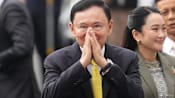
Pheu Thai, which was founded by currently jailed billionaire Thaksin Shinawatra, is renowned for huge electoral war chests and pushing through populist policies that have garnered support from the working class.
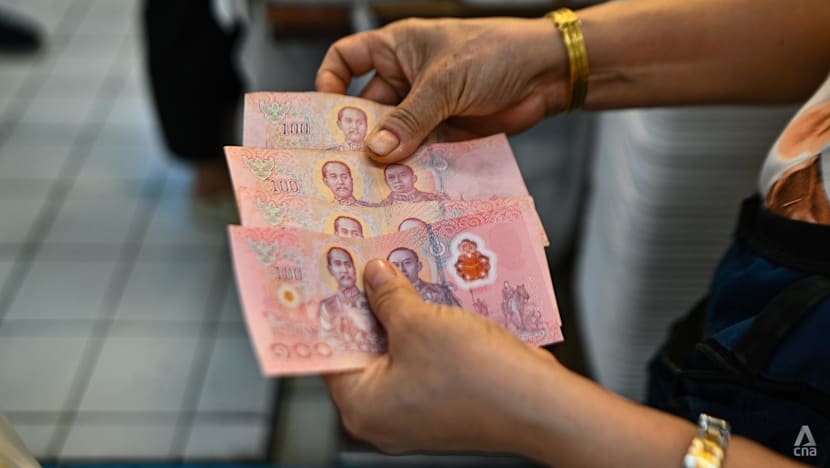
If elected, it proposes a daily lucky draw, giving nine people 1 million baht each day.
The People’s Party, a progressive movement that grew out of the Move Forward Party- which garnered the most votes in the 2023 election before being dissolved by the Constitutional Court in August 2024 - is pitching a receipt lottery scheme.
Under the proposal, official receipts from smaller businesses would double as lottery tickets. This gives buyers an incentive to ask for receipts for their purchases, making it harder for businesses to hide sales.
Political analyst Virot Ali, who is also an international relations academic at Thammasat University in Bangkok, told CNA that many Thai voters can identify with such policies because they are more tangible than complicated economic reforms which may take a longer time to implement.
“(These lucky draw policies) are easier for people to grasp and understand,” he said.
The parties have defended their stance. Both Pheu Thai and People’s Party representatives told CNA that their policy is designed at bringing more companies and people into the tax system as the lotteries would incentivise consumers to ask for official receipts.
Pheu Thai election candidate Pichai Naripthaphan, who is also former commerce minister, said that the lottery is engineered to boost the government’s tax revenue for income tax and value-added tax (VAT), describing the move as “very smart”.
People’s Party International Affairs Deputy Leader and election candidate Chaiwat Sathawornwichit maintained that its policy is less about tax revenue and more about legitimising businesses. He said that the receipt lottery is designed at moving companies from the underground, informal economy into the mainstream.
“The policy incentivises the buyer to ask for receipts which also promote the merchants to get into the formal economy,” he told CNA.
However, these policies are not wholly well-received by everyone.
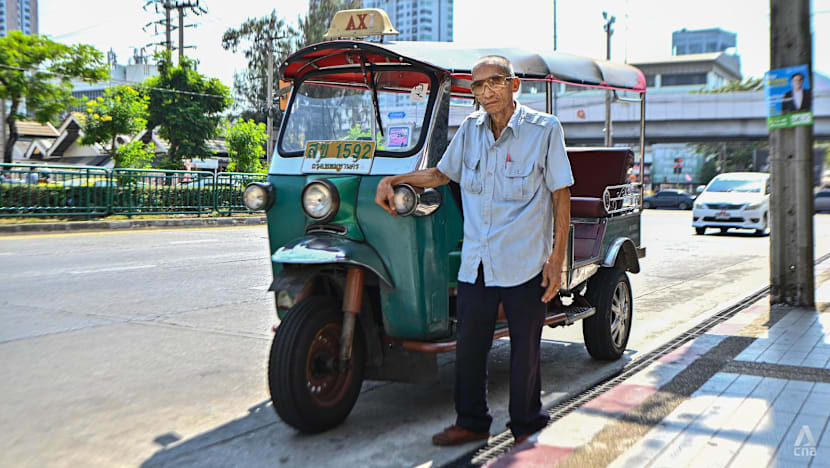
Tuk-tuk driver Torsak Pohklin told CNA that he would prefer that the government channel these resources into educating the public and increasing skills of workers, despite being in debt of around 80,000 baht.
“I don’t support cash handout policies because they drive up prices. I think the government should focus on making it easier for people to earn a living, so they can stand on their own feet,” the 64-year-old told CNA.
Some experts have also raised questions on whether the finances for these policies could be channelled into better long-term reforms.
Policy think-tank Thailand Development Research Institute (TDRI) issued a report cited by the Bangkok Post on Tuesday saying that the campaign pledges by five major parties competing in the election could place an unsustainable burden on the country’s finances.
The report cited that the five parties which have the strongest chances of forming the next government - People’s Party, Pheu Thai, Bhumjaithai led by the incumbent prime minister Anutin Charnvirakul as well as the Klatham and Democrat Party - are suggesting policies that could cost the state up to 740 billion baht per year to fund.
Economic expert Pavida said that the policy of lottery tickets does not only take away money resources from real educational and bureaucratic reform, but also does not move the needle in addressing Thailand’s economic problem.
“It's like you are taking (common painkiller) Tylenol to address something that might have been caused by a deep cancer issue. And that would not take away the real root of the problem,” she said.
IMPROVING EXTERNAL TRADE
Another issue that has hampered Thailand’s economic growth is its exports market, which has been hit by uncertainty due to tariffs imposed by United States President Donald Trump.
The tariff rate imposed on Thailand exports to the US was initially 36 per cent in April 2025 but - following a brief hike to 37 per cent - this has since been reduced to 19 per cent, a rate similar to some of its ASEAN neighbours - Malaysia, Philippines, Cambodia and Indonesia.
Exports to the US continue to make up a significant share of Thailand’s GDP, especially in sectors like electronics, machinery components and agriculture.
TDRI has estimated that Thailand’s growth has been hampered by between 0.4 percentage points of GDP to 0.77 percentage points of GDP due to the relatively high tariff rates on Thai exports and broader global trade uncertainty.
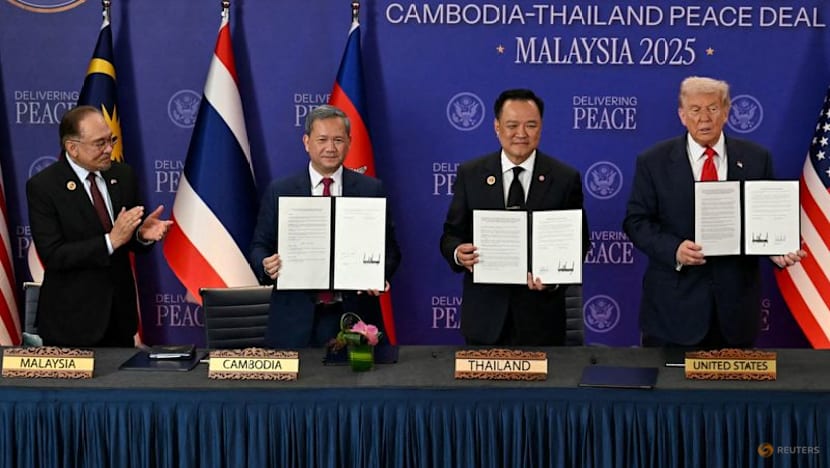
Anutin’s hardline stance on the border dispute with Cambodia risks complicating Thailand’s relations with the US, analysts say.
While Washington has signalled support for de-escalation and third-party mediation, Anutin has emphasised sovereignty and bilateral resolution, downplaying external involvement.
Analysts said that this posture may play well with nationalist voters at home, but it limits diplomatic flexibility and could frustrate US efforts to position Thailand as a stable, cooperative partner in Southeast Asia, particularly at a time when Washington is seeking to strengthen regional ties amid growing competition with China.
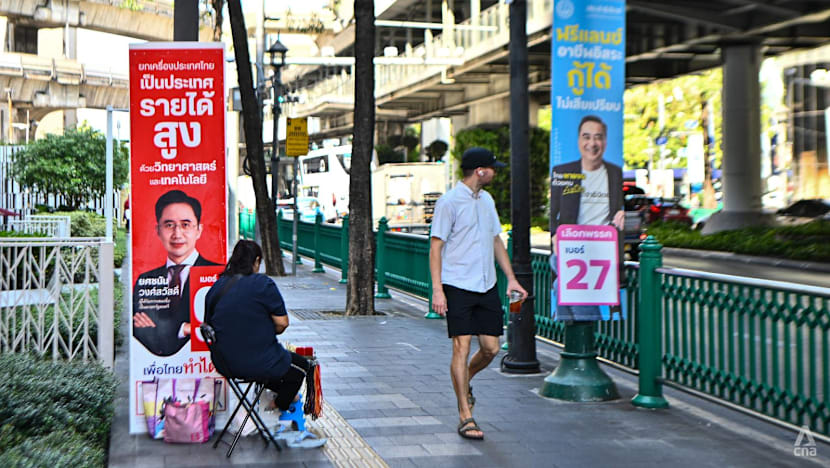
Virot, the foreign policy expert, told CNA that the political parties are aware that Thai nationalism sentiment on the Cambodian issue remains strong, and this plays higher on the minds of voters than the tariff exports issue when they go to the polls.
“For whoever will be in government, if you want to deal with the tariff issue, you have to deal with the Cambodian issue as well at the same time, and this issue is very high (on the agenda) in Thailand at the moment.
He added that many Thais are firmly behind their country in the conflict with Cambodia and are keen for the government to neutralise this threat, even if these actions go against US peace policy.
“So we'll be in this limbo of tariffs not being dealt with quite effectively yet, until the Cambodian issue is resolved,” he told CNA.
Pheu Thai’s Pichai, who was commerce minister when the tariffs were first imposed last year, had led Thai negotiations with his US counterparts.
He told CNA that having strong personal ties with US leaders played a part in discussions.
“I met (US Trade Representative) Jamieson Greer a couple of times, I remember one of the meetings was two days after I had gall bladder surgery, but I told myself I had to go, otherwise the country will be in trouble,” he said.
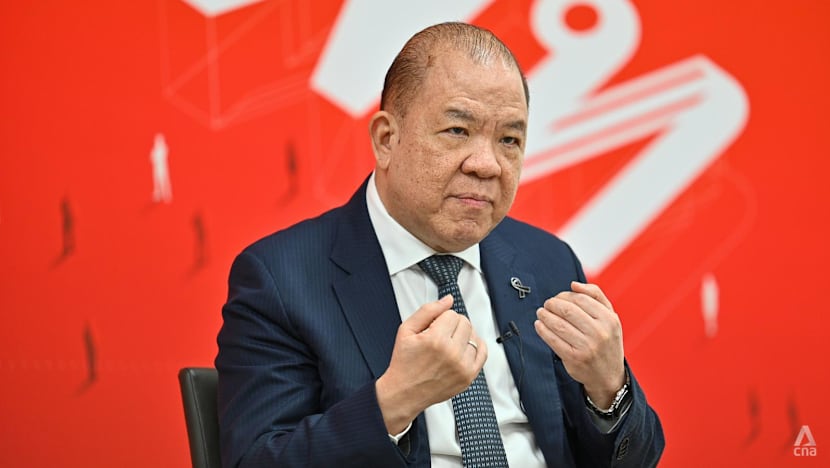
Pichai, who was also Minister of Energy between 2011 and 2012, believed that showing commitment to maintaining a good relationship with US officials had helped reduce Thai tariffs from 36 per cent to 19 per cent.
“I still keep good ties with them and hopefully if I am (in government again) I can help to reduce the tariff rates even further so Thailand can be more competitive,” he added.
CAN TECHNOCRATS HELP RESTORE ECONOMIC GROWTH?
Analysts told CNA that to help with external trade policies and economic growth overall, the main parties - especially Bhumjaithai and the People’s Party - have unveiled leadership line-ups with a higher profile of technocrats for this election.
The observers added that this is perhaps a trend to look beyond just seasoned politicians, and introduce professionals who have expertise in areas like tourism, technology and engineering.
They cited examples like Suphajee Suthumpun, who was Group CEO of hospitality chain Dusit and held senior regional positions in IT firm IBM, who is being fielded by Bhumjaithai.
She is also incumbent Minister of Commerce after her appointment in Anutin's Cabinet in 2025.
Another example is Auttapol Rerkpiboon who previously headed Thai energy company PTT, and is running under Bhumjaithai. He is widely tipped to be Energy Minister if Bhumjaithai forms the new government, a position he currently holds under Anutin.
One of the key prime ministerial candidates put forth by the People’s Party -Veerayooth Kanchoochat – is an academic economist with international policy experience. Experts predicted that his expertise would come in useful to help shape Thailand’s foreign trade and economic policies.
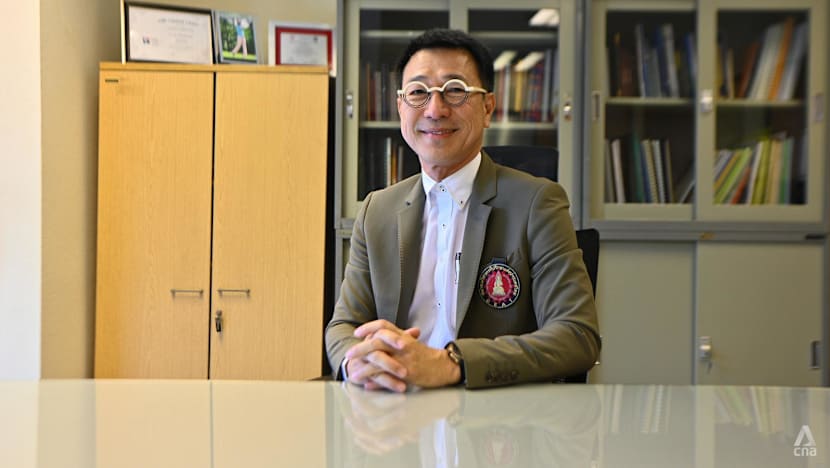
Structural engineer Niwat Thanpitinan, whose firm oversees several national rail projects, told CNA that he is buoyed by how the three main prime ministerial candidates - Bhumjaithai’s Anutin, People’s Party’s Natthaphong Ruengpanyawut and Pheu Thai’s Yodchanan Wongsawat - come from professional backgrounds.
Anutin is a trained industrial engineer who was previously president of Sino-Thai construction firm founded by his father. Natthaphong, who has a background in software engineering, founded his own tech firm, while Yodchanan has experience in technology and electrical engineering and later became an academic.
“We want leaders with knowledge on how to develop the country and implement reforms, not just rely on laws and bureaucracies,” said Niwat.
“We want people who understand business, who have been entrepreneurs. They have a clearer picture of how to formulate (good economic policies),” he added.
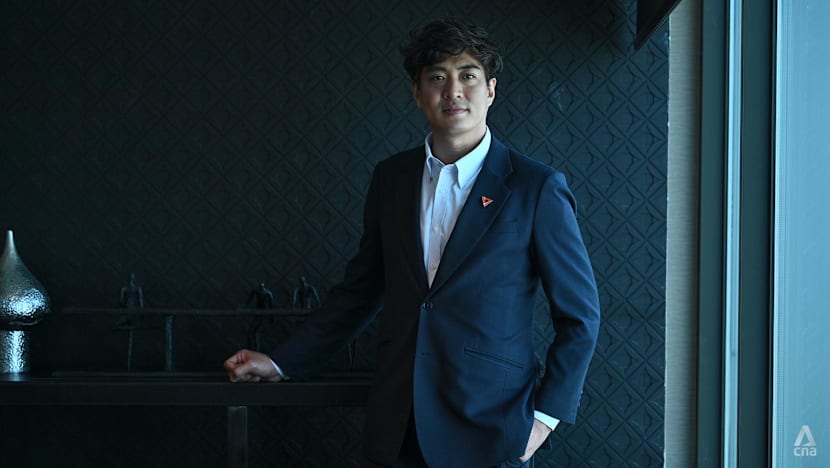
People’s Party International Affairs Deputy Leader Chaiwat, himself a computer science PhD graduate with banking experience, told CNA that if it forms the government, the party wants to build a Cabinet line-up based on merit and capabilities rather than being appointed as a result of political wrangling or negotiations.
“Some of these ministers have been sitting in Cabinet since I was a young boy, they have been there for like 30 years and nothing has changed. We are not getting better,” said Chaiwat.
For food stall operator Anantaya, whoever gets elected into the next Thai government after Sunday, she hopes that the Thai economy can return to its golden period.
"During that period, the money flowed, trade was good, and the economy was prosperous," she said.
"Back then leaders could deliver what they promised."
Additional reporting by Jack Board