Thailand Election 2026: Youth-linked orange wave propelled a party to win last poll – will history repeat itself?
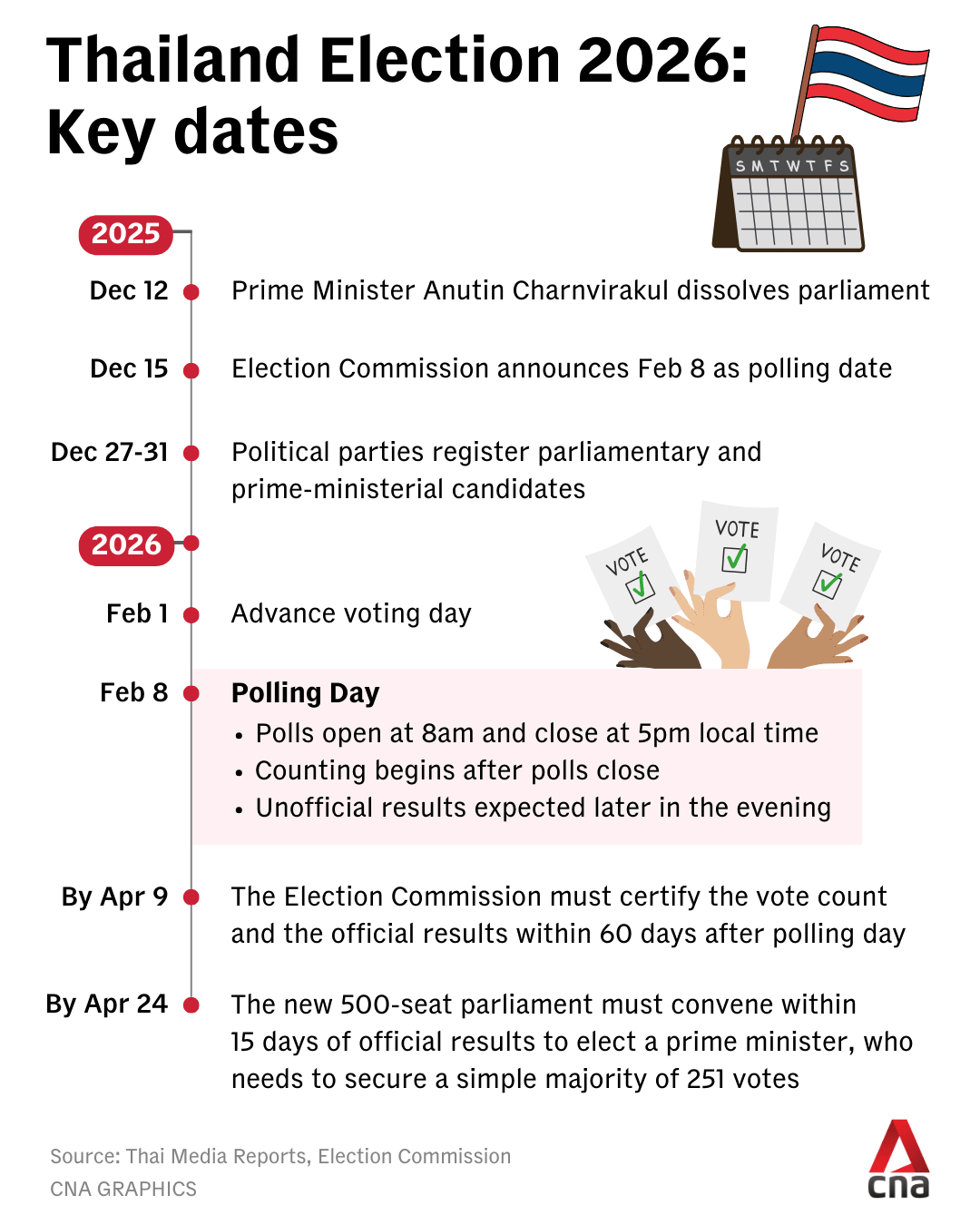
As Thailand heads into a fragmented and unpredictable election on Sunday (Feb 8), reform has become harder to sell, analysts say. But even without the street protests of the recent past, youth politics continues to shape the electoral race and the ways parties are campaigning.
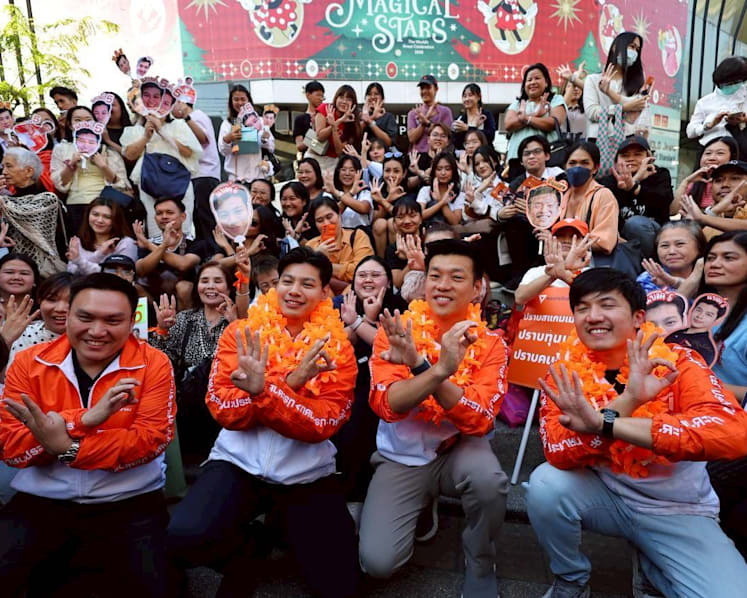
People's Party members including leader Natthaphong Ruengpanyawut (front row, second from right) campaign in Bangkok ahead of the 2026 election. (Photo: People's Party)

This audio is generated by an AI tool.


BANGKOK: Thailand’s last general election in 2023 was marked by the stunning victory of a party leading a progressive movement.
As Thais head to the ballot box again on Feb 8, all eyes are again on where the movement stands today and how voters relate to it.
At the last polls, much of the country was awash in an orange progressive wave led by rookie politician and leader of the Move Forward Party Pita Limjareonjat.
Propelled by support from youths and Thais seeking change after years of political polarisation, it defied the opinion polls and won more parliamentary seats than any other party.





Its approach had been emboldened and complemented by mass youth-led protests in the streets in the years prior. But the movement would run aground as it sought to form an unlikely government.
The party failed to secure enough support in a joint parliamentary vote, after most military-appointed senators in the 250-member upper house opposed it, seen as a pushback by the conservative royalist establishment.
With other parties joining forces to form a governing coalition, Move Forward Party found itself in opposition as it continued to press for the end of decades-long cycle of military intervention in politics and the dismantling of the influence of traditional elites.
A year later, the party was dissolved by the Constitutional Court over its pledge to amend the royal insult law, also known as lese majeste.
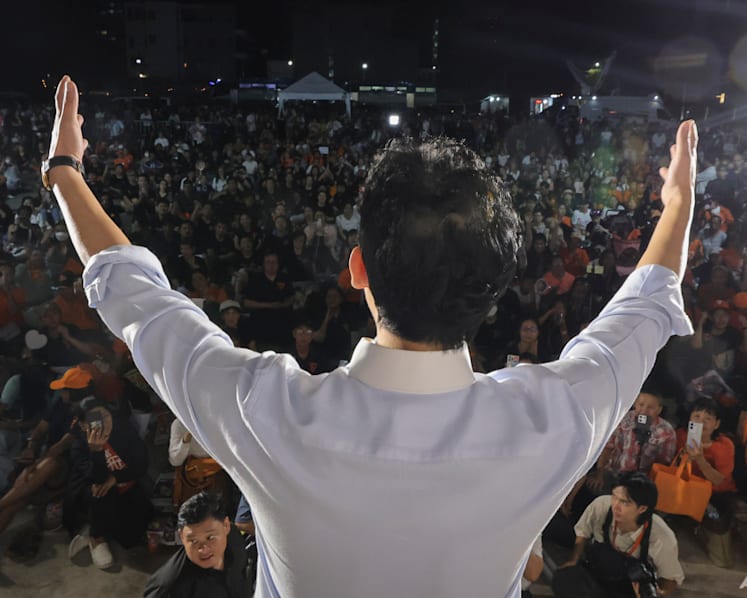
A platform centred on democratic reform, changes to education, justice and social policy and a seemingly fresh approach to governance ultimately left the party on the wrong side of the parliament floor, under its new banner as the People’s Party.
Real change has long been promised in Thai politics, yet for many - particularly young people - it has remained out of reach.
As Thailand heads to the polls this weekend after another period of political instability, voters are weighing whether momentum for progress towards institutional reform has stalled, or whether it has adapted to a more constrained reality.
Interim Prime Minister Anutin Charnvirakul called the snap election in December after facing a looming no-confidence vote led by the People’s Party.
Overall, a progressive agenda seemed to be struggling to take root amid a wave of populism and nationalism that is shaping this year’s election campaigning, said Stithorn Thananithichot, a senior research associate at Chulalongkorn University.
The border crisis with Cambodia, a struggling economy, a huge bloc of undecided voters and the legacy of vote-winning spending have together shaped a campaign driven more by immediate concerns than by a clear contest of values or ideas, he said.
“The feeling to change, to reform, is still there, but nationalism is also lighting up. Many people are thinking about pragmatic policies that can make their well-being better. So there is no focus point that the people can pay attention to,” said Stithorn.
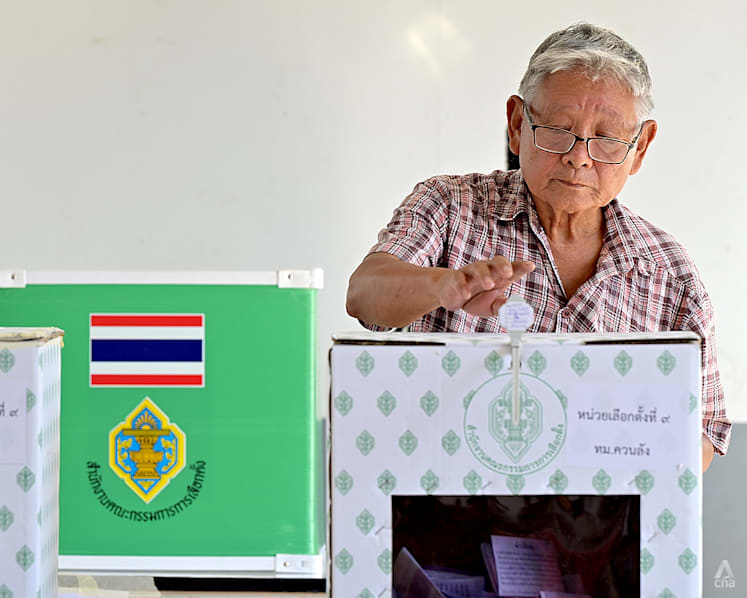
Analysts said the clear divide between pro-democracy and pro-military camps that defined the previous two elections in 2023 and 2019 has ebbed, leaving a vote that is highly unpredictable and largely unanchored to policy.
“In this election in particular, there's really no ideological divide that is discernible,” said Napon Jatusripitak, a visiting fellow and coordinator of the Thailand Studies Programme at the ISEAS – Yusof Ishak Institute in Singapore.
This is especially so when compared to the last election, which he described as “pretty much a referendum” on whether to allow the continued rule of coup leader General Prayut Chan-o-cha. He had overthrown the Yingluck Shinawatra government in a 2014 coup, Thailand’s 13th successful one since the end of absolute monarchy in 1932.
It does not mean, however, that the People’s Party cannot contend, the experts said. Instead, the party has needed to adapt to new realities rather than continue to push on broad reform ideologies.
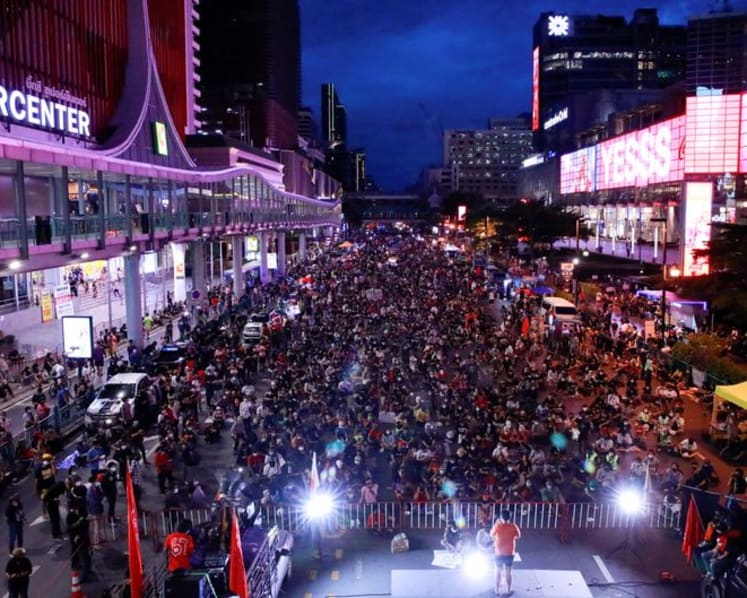
Some political observers see a meaningful shift in dynamics taking place: among young voters, the party that embraced and mobilised them as well as its traditional rivals looking to make the youth vote a genuine contest this election.
Leaders of the People's Party told CNA that it is recalibrating further away from the streets and into a more mature party that can attract the votes and trust of the entire country.
Meanwhile, other major parties that have long relied on political stalwarts are refreshing their ranks in Bangkok with fresh professionals in a bid to win over young urbanites - most of whom had voted for the People's Party predecessor in the last election.
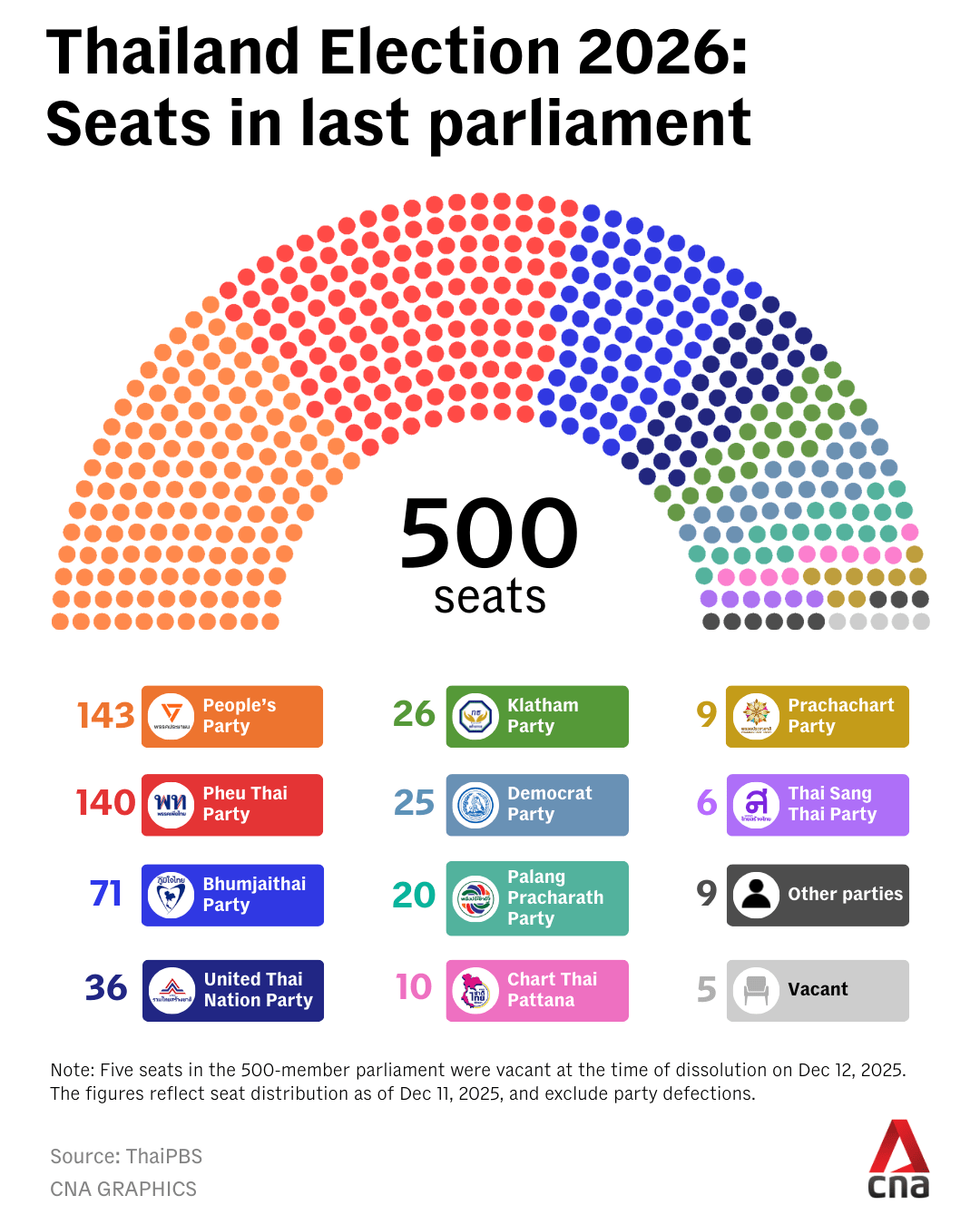
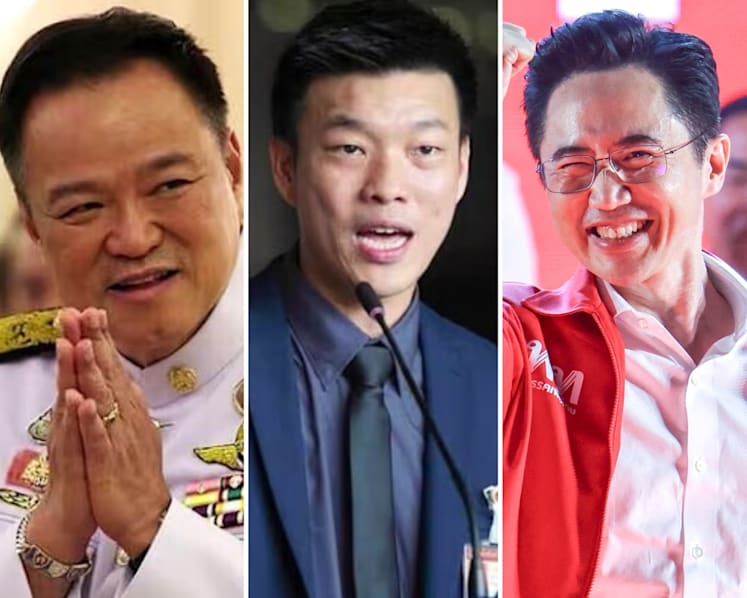
National opinion polls such as those by Suan Dusit University and the National Institute of Development Administration in the lead-up to the vote have consistently rated the People’s Party leader Natthaphong Ruengpanyawut, 38, as the clear preferred prime minister, ahead of Bhumjaithai Party leader Anutin, 59 and Pheu Thai’s Yodchanan Wongsawat, 46.
The People’s Party itself is also the clear frontrunner, polling between 30 and 34 per cent in major surveys released by these two well-regarded pollsters in the past month, ahead of Bhumjathai (18-22 per cent) and Pheu Thai (15-16 per cent).
Any party that wants to form a majority government needs to secure 250 of the 500 seats in parliament, and unlike in 2023, the vote for the prime minister this time will just be by the lower house of 500 parliamentarians.
That arithmetic makes a single-party majority unlikely, pushing parties toward coalition bargaining and transactional politics, Napon said.
“Many people feel that the resulting coalition will be a combination or a partnership between two of the big three parties,” he said, meaning the parties have kept their options relatively open in terms of who they can or cannot form a coalition with.
“Strange bedfellows; it has become the norm in Thai politics. And I think voters have very little to go on in terms of thinking about how their vote would translate into government,” he said.
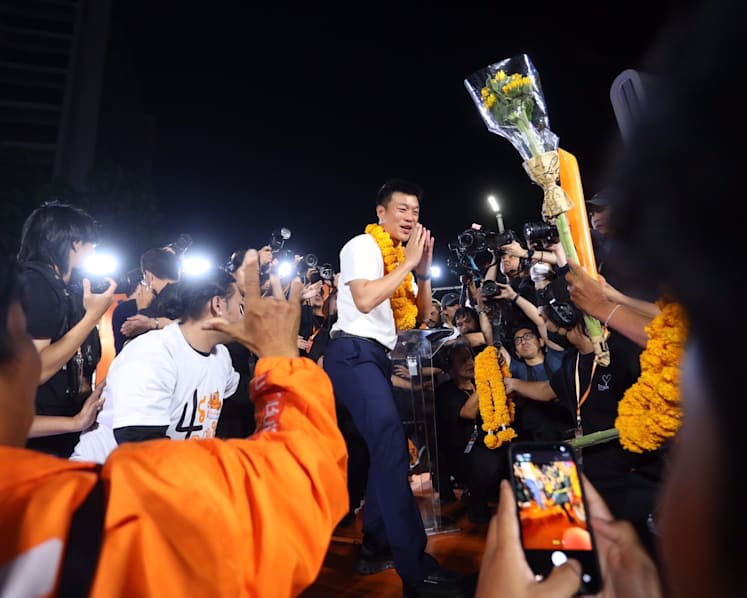
REFORMIST DNA
The People’s Party has entered this period of campaigning as a more moderate force in “mood and tone”, according to deputy leader Sirikanya Tansakun.
It has softened its stance on reforming royal insult law, according to party leaders, and on the role of the military in national affairs to broaden its support across the country.
Its major policies in the 2026 election fall under the “3 Thai” vision, focused on transparency, equality and modern governance. It wants to overhaul the justice system and anti-corruption mechanisms, expand social security and improve public transport.
Sirijkanya said the party’s reformist DNA has not changed.
“Maybe there’s a feeling that we have become less progressive. But I think our values since 2018, since we founded the Future Forward Party, are still there. As the time passed, we have become more mature,” she told CNA.
The party wants to prove it can turn the idealism of the past eight years into reality, she said.
“In 2019 it was about reclaiming democracy, and people were fed up with the coup and its legacies. And for 2023 it's a little bit changed to anger and anxiety about the whole regime, and they want change. And this time, they know they want change, but they are wondering ‘how’.
“So that's why we have to position ourselves to make sure that we have the competence, we have the capability to deliver the change,” she said.
Rangsiman Rome, another deputy leader at the People’s Party, said that expectations for change among voters, especially young people, was high at the last election, especially when the party won the popular vote.
But the reality of Thai politics had been a sobering experience and forced a readjustment to the party’s approach. “Even if you won the election, it doesn't mean that you can be prime minister,” he told CNA.
Now, there is a strong focus on youth - the party’s solid support base - to be “a bridge to every generation”, Rangsiman said.
“We want to make sure that Thailand will be the country for everyone, not just for the old, not just for the working class, but for everyone,” he said.
The party has nominated three prime ministerial candidates this time around: Natthaphong, Sirikanya and Veerayooth Kanthuchat, another party deputy leader with a background as a political economist.
But none of them has the charisma and appeal of previous candidates, Pita or banned party co-founder Thanathorn Juangroongruangkit, making broader appeal “a tough job”, according to Stithorn.
And without a galvanising issue, like removing elements of the military junta from power, mobilising enough voters could prove difficult, the analyst said.
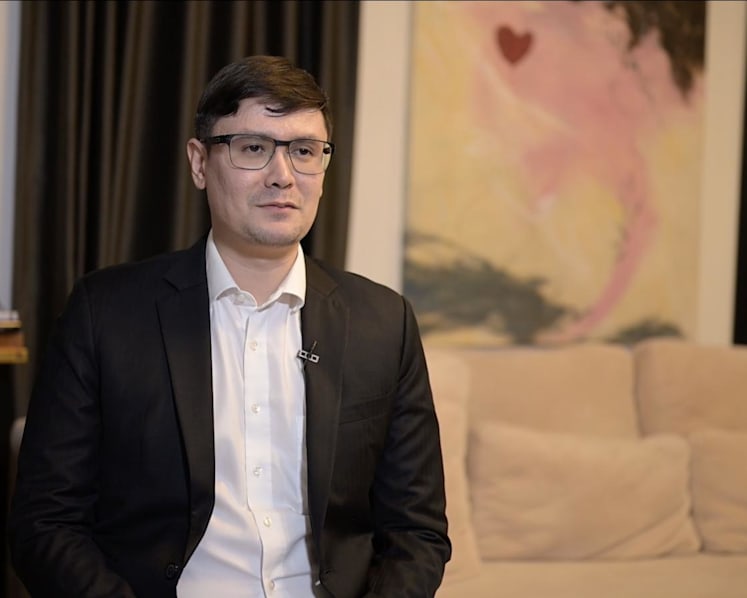
YOUNG PEOPLE STILL ENGAGED
First time voters told CNA that while their generation feels bound by structural stasis, they have not lost interest in core democratic issues. But they are keenly aware that they are entering a changed political environment.
The mass street demonstrations, particularly through 2020 and 2021 following the dissolution of the opposition Future Forward Party, have faded.
The energy of past years that had been largely driven by young people, often through protest, is less visible now.
“Many activists feel tired and discouraged. For ordinary people, fatigue often comes from feeling that nothing changes, and that feeling is understandable,” said Laponpat Wangpaisit, a former student leader and activist.
Laponpat, 23, who was the face of the Bad Student movement - which among other goals pushed for educational reforms - said he has turned to other methods like online media, exhibitions and theatre to communicate about issues and be tools for change.
Despite appearing to be less organised and mobilised, he said he was surprised by the quiet but high levels of political engagement among young people.
“Just because they don’t talk about politics openly doesn’t mean they’re unaware,” said Laponpat.
A trio of first-time voters, all university students, sat down with CNA to discuss their hopes, fears ahead of the election and for the next chapter of Thai politics.
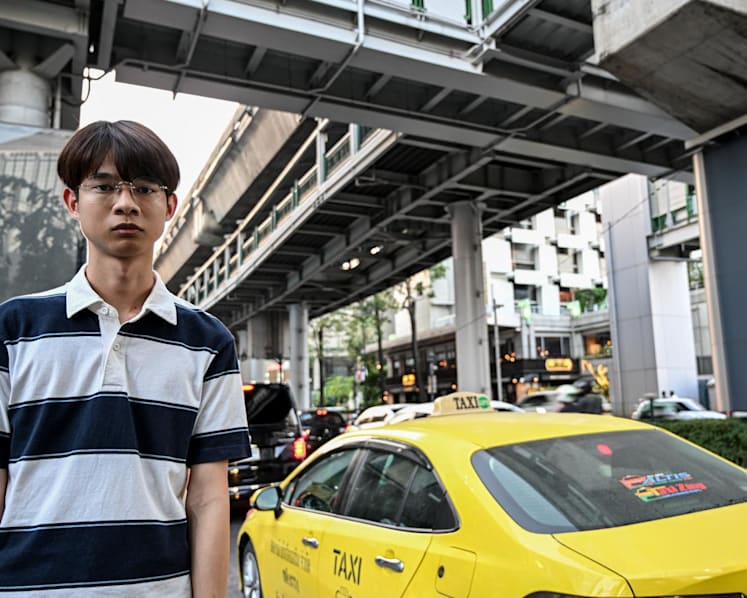
Economic anxiety, trust in politics and future prospects weigh heavily on all of them, as they spoke of the emerging challenges of transactional coalition politics and the difficulty of reforming institutions.
These are views broadly held by many of their peers. Opinion polls show broad disillusionment with political parties and politicians across the population, including among younger voters.
“I understand the perspective of people who have voted before. They have more experience than us, yet they still don’t feel real change,” said Neennara Nonchayawit, 19.
“This may be because social and political structures do not allow alternative voices to truly create change. That’s why we shouldn’t vote for parties with the same old ideas if we want real change to happen,” she said.
“It feels like the momentum has slowed down, but that doesn’t mean the spirit has disappeared. It’s just waiting for the right moment to rise again, especially if something happens that people feel is unjust,” she added.
Kasidis Klapwongsa acknowledged that many of their contemporaries see little hope in change these days and say some would leave Thailand if they could.
“This is my homeland, this is home. So I don’t feel strongly drawn to leave, but I understand and agree with those who do,” he said.
He said he had observed “reduced intensity” in the approach by the national opposition. While it could have eroded support among some youth, he was more forgiving.
“Some supporters who agreed with the original approach may have stepped away,” he said.
“But we also need to be fair - the party has been constrained by state power and capable leaders with strong ideas and ideology have been removed from the political arena.”
For Palika Rojprachanart, her ask of politicians was more simple. “I want them to keep their promises, and I hope this election won’t further destroy people’s faith,” she said.

IMITATION AS FLATTERY
Analysts told CNA that youth politics is increasingly shaping party behaviour across the field.
More parties are running fresh-faced candidates or professionals in constituencies that were once the sole domain of career politicians or incumbents.
In December, Bhumjaithai revealed a roster of prospective parliamentary candidates in Bangkok, younger faces and professionals alongside more established local figures, reflecting the party’s effort to broaden its appeal in the capital.
Pheu Thai has also actively introduced “new blood”, substantial batches of new and younger candidates from multiple provinces, said Suriya Jungrungruangkit, the party’s director of election campaigning, in October.
In January, it also announced a team of technocrats aimed at instilling confidence in the party’s ability to govern. Around the same time, the People’s Party unveiled a team of experts and professionals as potential cabinet ministers, part of an ongoing effort to produce detailed policy.
“They hope that they will reassure the voters that they can do the job. So I think it's a good trend,” said Suranand Vejjajiva, secretary-general to the prime minister during the Yingluck government and now a political analyst.
And there is pressure on politicians to propose long-term ideas and be seen to be open to reform and change, he added.
“Other parties have to field potential candidates from the new generation to fight in terms of ideas. So they (the People’s Party) have changed the Thai political scene.”
That shift is also playing out on the campaign trail.
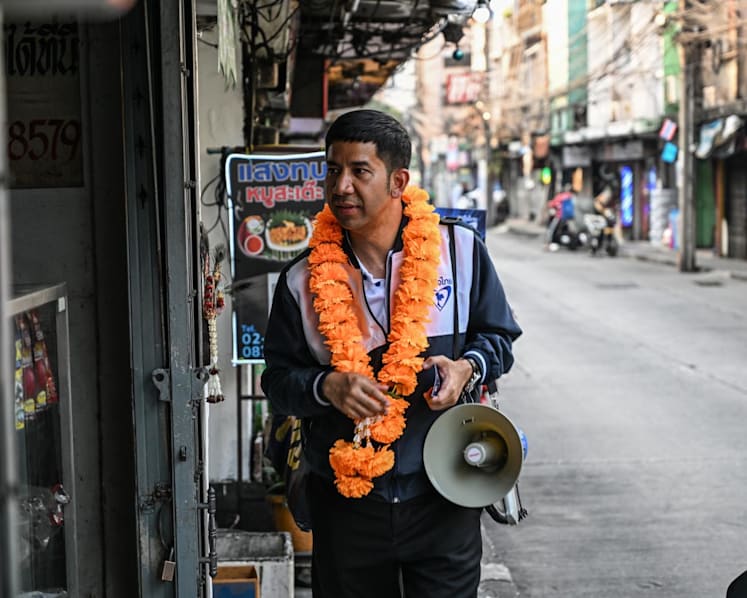
In this election, Norasedth Thienprasiddhi is running for the second time as a Bhumjaithai candidate in Bangkok.
The 43-year-old school teacher said he has taken into account the youth-focused policies raised by his opponents in the past, to help craft his political messages to win over new supporters, after failing to be elected in 2023.
“I wouldn't say copy, but I would like to say study and to understand more their actions, the way they engage young people," he said.
Policy ideas like education reform and modernisation, broader social welfare, opportunity for small businesses and entrepreneurs and increased avenues for public participation in governance have all been proposed in the past by the People’s Party.
For Sirikanya, imitation is flattery. “Good policies are the policies that stick, right? If they want to copy us, it means that we have campaigned successfully.
“It means that we have laid down some legacies that people have to follow, and that become mainstream ideas that every party has to campaign on,” she said.
As election day looms, Thailand’s young voters are still watching closely. They are no longer expecting politics to deliver sudden change but they have not stopped trying to shape it.
“I don’t place my hope in any one person or party,” said Laponpat, the former student leader.
“As long as we continue speaking out, these problems won’t be forgotten.”
Additional reporting by Jarupat Karunyaprasit and Saksith Saiyasombut.