Commentary: Why US tech firms are investing billions in India
American firms have an early advantage in shaping how Indian consumers use AI tools, says Amit Joshi of IMD Business School.
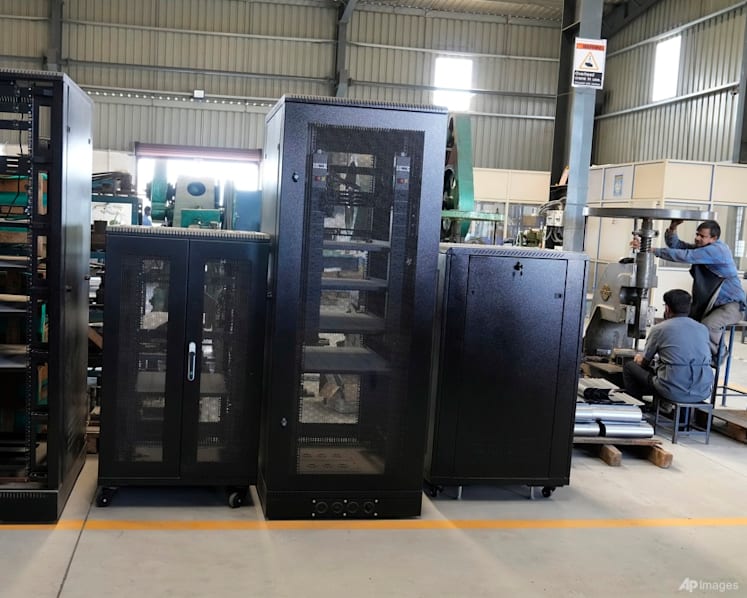
Large steel chassis made for data centres are ready for shipment at a factory in a suburb of Bengaluru, India, Feb 27, 2025. (AP Photo/Aijaz Rahi)

This audio is generated by an AI tool.


LAUSANNE, Switzerland: As US tech giants accelerate their spending on artificial intelligence, India is emerging as a big beneficiary.
Microsoft is committing US$17.5 billion to India, its largest investment in Asia, to expand data centres and AI infrastructure over the next four years. Google has pledged US$15 billion for a new data centre hub in Andhra Pradesh, while Amazon plans to invest US$35 billion through 2030. The e-commerce giant has already put about US$40 billion into India since 2010.
Why is Silicon Valley betting big on India, and why now?
Access to data is a key reason. Generative AI models need to be trained on reams of user data, and investing in India gives American firms access to the world’s biggest population of about 1.46 billion people.





According to a Deloitte survey, India has the highest generative AI adoption rate in the Asia Pacific, with 90 per cent of students and 80 per cent of employees actively using the technology. This has fuelled the growth of AI infrastructure in India – data centre capacity is set to more than triple to about 4.5 gigawatts by 2030.
Another reason that US firms are investing in India is its huge base of tech talent. AI engineers are now in hot demand, and about 1.8 million people work in India’s back-office sector. The country decades ago became a hub for basic IT support but is moving up the value chain as multinational companies adopt AI tools.
India offers US AI providers a large and accessible market with few local rivals. No Indian large language model (LLM) ranks among the top worldwide. India is the fastest-growing market for ChatGPT, and is possibly already its largest user base.
Meanwhile, Google’s Gemini is easy to access in India because Android phones – which come with Google’s services built in – make up almost the entire smartphone market.
Together, these factors give US firms an early advantage in shaping how Indian consumers use generative AI tools, with such services acting as entry points into their wider tech ecosystems.


GEOPOLITICS IS SECONDARY
Geopolitics is secondary to the commercial case. The US-China tech rivalry sets the backdrop to American AI investment in India, but the real drivers of investment are India’s market size, digital adoption and talent. Supply-chain shifts away from China offer a relatively minor boost to the build-out of AI infrastructure in India.
Another political factor that has facilitated US tech investment into India is Delhi’s and Washington’s increased alignment in their digital trade policies. Both governments prefer to keep tight control over how data moves and is stored, avoiding rules that would constrain their own policy space.
But the risks are real. Data centres that power AI require vast amounts of water and energy, adding to the strain on local supplies in fast-growing Indian cities. The water footprint of India’s data centres is projected to more than double, from 150 billion litres in 2025 to 358 billion litres in 2030. This will exacerbate India’s existing challenge of water scarcity.
Also, India’s data centre boom may bring about limited job gains for the local population in the long run. Though building a data centre may create jobs for thousands of construction workers, once construction ends, only a few dozens of technicians are needed to keep the facility up and running.


WHAT WILL INDIA DO NEXT?
The bigger question is what India does next. In my view, its task now is to make sure this wave of investment strengthens its own digital capabilities.
Building domestic versions of frontier models like ChatGPT or Gemini is beyond reach for now, given the cost, computing power and specialised talent required. India produces vast numbers of engineers, but relatively few focus on advanced AI research, and many of those who do eventually move to the US.
But creating applications that sit on top of LLMs and serve specific industries is far more achievable for India. The country already has a strong startup ecosystem, and local firms such as Observe.ai, which builds AI tools for call centres, and Arya.ai, which develops AI systems for healthcare and finance, are beginning to make a mark in this space.
Moreover, while India’s protectionist digital trade policies are no longer a barrier to US investment, they are still too broad to ensure the country captures enough of the value created. The rules do not spell out which types of data are strategically important, which activities should stay onshore, or how foreign firms should share the gains from using Indian data.
As a result, valuable economic activity – such as data processing, analytics and the development of AI models – can still happen outside India, even when the data originates within the country. To strengthen its position, India will need clearer, more targeted rules on how data leaves the country.
In the short term, the main benefit for India is the promise of new jobs, even if the longer-term numbers prove to be modest. Over time, the bigger gains are access to technologies that can make advanced AI tools available to more consumers, a chance to democratise intelligence by lowering barriers to expertise, and boosting productivity for the world’s fourth-largest economy.
If India can turn this investment surge into stronger digital capacity, it will prove that Silicon Valley made a good bet.
Amit Joshi is Professor of AI, Analytics and Marketing Strategy at IMD Business School.