Commentary: Sluggish Indonesia market clouds aviation outlook for Southeast Asia
A large contraction in domestic air travel within Indonesia will impact the regional outlook in Southeast Asia, says aviation analyst Brendan Sobie.

This audio is generated by an AI tool.


SINGAPORE: Anticipated growth of Southeast Asia’s air transport market and the resulting opportunities for suppliers were major themes at the recent Singapore Airshow.
Several major industry players predicted at the show that Southeast Asia would be the fastest-growing region over the next two decades, with high single-digit annual passenger growth.
The long-term potential of Southeast Asia’s aviation sector is undeniable, given the rapid growth of its middle class and a geography that results in limited options for other types of transport, such as rail.
However, Southeast Asia has been the slowest region to recover following the COVID-19 pandemic, resulting in a low base that distorts any forecast. The short-term outlook for traffic growth is also rather bleak, making forecasts that the market will triple in size by 2044 or 2045 somewhat questionable.





INDONESIA’S SLUGGISH DOMESTIC MARKET
In 2025, Southeast Asia seat capacity was about 8 per cent below 2019 levels, based on OAG data. Indonesia’s domestic market accounts for more than half of the gap – approximately 31 million of the 54 million seat reduction.
Last year, Indonesia’s domestic market was 19 per cent below 2019 levels, based on airport passenger traffic data from BPS-Statistics Indonesia. Compared to 2018, Indonesia’s domestic market in 2025 was down by 34 per cent.
The peak year for air travel within Indonesia was 2018, when it became the fifth country to reach 100 million domestic passengers, joining the United States, China, India and Japan.
However, Indonesia’s domestic market contracted in 2019 to about 80 million, and so far in the post-pandemic era has fallen short of 70 million every year.
Indonesia’s domestic market has the fundamentals to get back on the growth curve. Its population of 288 million represents 41 per cent of the Southeast Asian total and has an archipelago geography stretching over 5,000km east to west.
However, both the demand and supply pictures are concerning.
On the demand side, Indonesia’s middle class and consumer spending have been shrinking in recent years. Consumer confidence further weakened in 2025 as unemployment rates surged, contributing to another decline in domestic airport passenger traffic of 3 per cent.
The economic outlook for 2026 is even worse. The Indonesian rupiah hit an all-time low against the US dollar in January, leading to market uncertainty and investor unease.
Indonesian airlines are concerned as demand so far this year has been weak while costs, which already increased significantly post-COVID, have skyrocketed due to the rupiah depreciation.

FLEET CONSTRAINTS AND LACK OF COMPETITION
The current challenges in filling up aircraft are particularly troublesome given how much capacity has already been removed from the market.
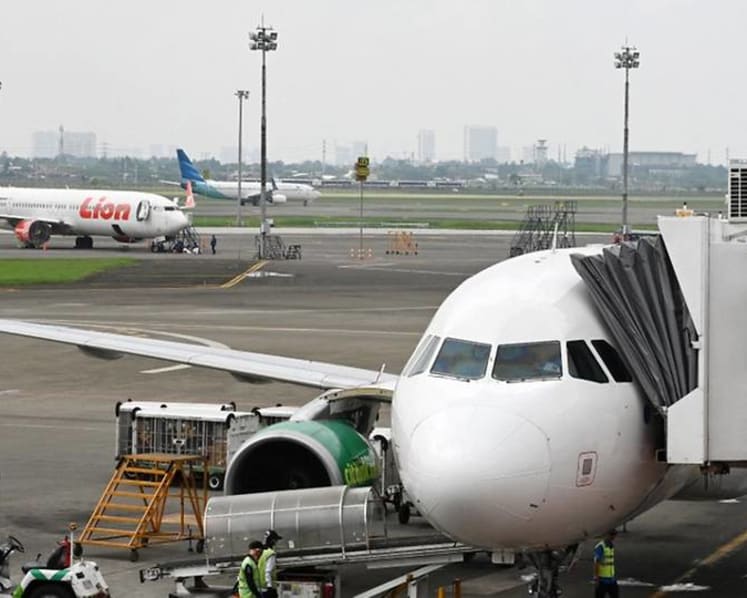
Fleet constraints – grounded aircraft due to financial issues and a lack of new deliveries – have received the brunt of the blame for the contraction in Indonesia’s domestic market. Indeed, Indonesia’s commercial aircraft fleet has shrunk by about 30 per cent compared to pre-pandemic levels. There are currently about 170 inactive or grounded aircraft, and there are only two Airbus or Boeing aircraft that are less than five years old, according to data by ch-aviation.
A lack of competition also has been blamed as two airline groups now control about 90 per cent of the market, including nearly 70 per cent for Lion Group.
Returning aircraft to service and rebuilding the fleet through new deliveries has been painfully slow. One could argue Lion is not incentivised to bring back aircraft given its powerful position in the market.
However, the reality of the current situation is demand being insufficient. Fewer Indonesians can afford to fly or have the discretionary income to take frequent trips.
Slashing fares to stimulate demand is not a viable option. Air fares are now much higher compared to 2018 levels. However, airlines would not be able to survive if they reverted to those prices, given that they were all unprofitable in 2018 and costs have since increased significantly.
This is the paradox with the bullish traffic forecasts for Indonesia. For example, the International Air Transport Association (IATA) expects Indonesia to reach 390 million total passengers, domestic and international, by 2037.
The total market this year will likely be only about 105 million passengers, including about 43 million international. It could be at least a few more years and perhaps several years before the domestic market again reaches 100 million, and the overall market reaches 150 million.

NO RETURN TO PRE-COVID GROWTH RATES
Without a stronger contribution from Indonesia, it will be virtually impossible for Southeast Asia to achieve the overall forecasted figures.
A few of the region’s other markets face similar issues, albeit not as pronounced. Most Southeast Asian countries have growing middle-income populations but are similarly price-sensitive, which is an issue because fares need to be significantly higher in the post-pandemic era to cover higher costs.
Airlines in the region need to be profitable to resume expansion, but the low fares that helped stimulate growth prior to the pandemic are now untenable.
Southeast Asia’s air transport market more than doubled in size from 2009 (after the global financial crisis) to 2018, from about 200 million to 500 million passengers. During this period, Indonesia’s domestic market also more than doubled from 44 million to 102 million passengers.
This was a honeymoon period with favourable market conditions and lots of low-hanging fruit, particularly for low-cost carriers. No one should assume a return of this kind of growth for Indonesia and Southeast Asia overall.
Brendan Sobie is the founder of Singapore-based independent aviation consulting and analysis firm Sobie Aviation.