Commentary: The quantum era crept up while you were watching AI
The sheer pace of quantum activity from tech firms in 2025 would have been unthinkable even five years ago, says Catherine Thorbecke for Bloomberg Opinion.
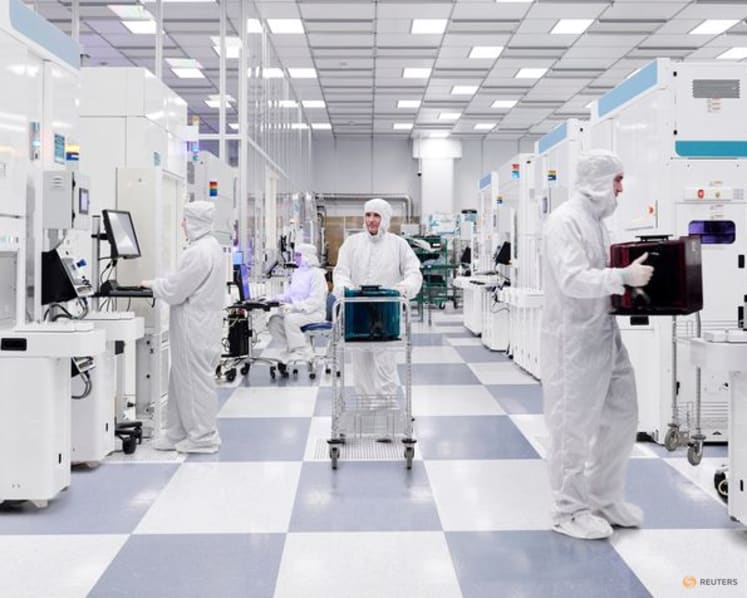
People work at a cleanroom that manufactures 300mm silicon wafers containing quantum computing chips at the Albany NanoTech Complex in Albany, New York, US, in this handout image released on Nov 10, 2025. (Photo: IBM/Handout via Reuters)
TOKYO: Step aside, artificial intelligence. Another transformative technology with the potential to reshape industries and reorder geopolitical power is finally moving out of the lab: quantum.
The United Nations dubbed 2025 the International Year of Quantum Science and Technology. It’s been marked by a flurry of announcements – and a mountain of hype – around a mind-boggling field of science long dismissed as perpetually a decade away from usefulness. But that’s how people talked about AI, too, before ChatGPT spurred the current global arms race and investor euphoria.
Quantum technology taps the odd mechanics of quantum physics – how particles behave at the atomic level – to create computers, sensors and communications gear that are exponentially more powerful than today’s. Classic computers process information in bits, which can be represented as “0” or “1”. Quantum computers use qubits, which – bear with me for a moment – can exist in a superposition of both states at the same time. That allows them to evaluate a vast number of possibilities at extraordinary speed.
As mystifying as it seems, quantum technology has the potential to transform sectors from medicine to finance. McKinsey & Co estimates it could generate up to US $97 billion in revenue worldwide by 2035. Bain & Co, looking at the broader ecosystem, says it could unlock as much as US$250 billion in market value.





AI soaked up most of the attention this year. But if you weren’t watching closely, here’s what you may have missed in quantum, and what I’m watching out for next.
“CUSP OF A QUANTUM AGE”
The year began with something rare in the field: a viral moment. In February, Microsoft unveiled its first quantum computing chip, touting a path to fitting a million qubits on a single processor. A sleek YouTube video broke down some of the jargon usually associated with the science and culminated with the declaration: “We’re at the cusp of a quantum age.”
Some researchers later questioned if the PR hype machine was going too far, perhaps overselling the underlying science.
But Microsoft’s splashy announcement followed Alphabet’s Google late-2024 unveiling of its own quantum-computing chip, dubbed Willow. And that was quickly followed by Amazon’s cloud unit teasing its Ocelot chip, which it claimed can reduce the costs of quantum error correction by up to 90 per cent compared to previous approaches. Reducing error rates is one of the biggest challenges given how sensitive qubits are to even the smallest changes in their environment.
By June, IBM, a pioneer in the sector, unveiled an impressively detailed framework for launching a fault-tolerant (that is, less error-prone) quantum computer by 2029. And in October, Google said that it ran a “verifiable” algorithm on its Willow chip – meaning one that can be repeated on another quantum system. The algorithm, dubbed “Quantum Echoes”, ran 13,000 times faster on Willow than what’s possible on the world’s most powerful supercomputer, according to Google.
MOMENTUM UNLIKELY TO EBB IN 2026
The sheer pace of quantum activity from Big Tech and startups in 2025 would have been unthinkable even five years ago. Investors are taking notice and capital is flowing. The momentum is unlikely to ebb in 2026.
The US still leads, but China is rapidly narrowing the gap. I recently wrote about this, looking at a surge of patent filings – the same kind of data that analysts previously used to anticipate the nation’s leadership in other sectors, such as electric vehicles. John Martinis, one of this year’s winners of the Nobel Prize in Physics, warned earlier this month that China is mere “nanoseconds” behind.
A new geopolitical race is underway. Beijing has earmarked US$15.3 billion in public funds for quantum computing, more than eight times the US$1.9 billion the US has pledged. The West was largely caught flat-footed by China’s rapid advances in AI. It cannot afford a repeat. The stakes in quantum are arguably higher, but there is no excuse to be surprised by new breakthroughs coming from there in the new year.
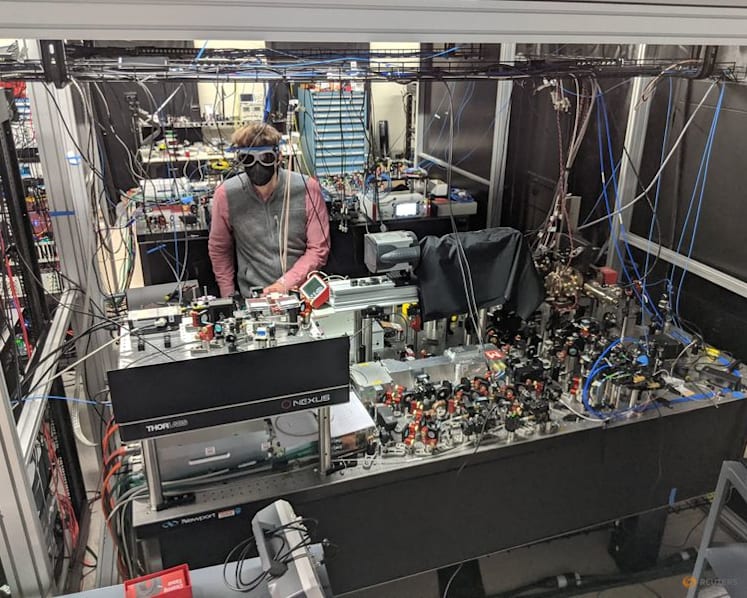
LIMITS OF TODAY’S MACHINES
Still, for all the excitement, the limits of today’s machines are just as real.
At the start of the year, Nvidia CEO Jensen Huang predicted that we’re about 15 to 30 years away from quantum computers being very useful. He later said he was wrong, and by June declared the tech could be applied to “solve some interesting problems in the coming years”.
But he’s not alone in hedging. Amazon Web Service’s head of quantum hardware had a similar 15 to 30 year timeline in August. Even some of the most aggressive projections inside the industry put meaningful utility at least five years away. The spread in forecasts underscores how hard it remains to stabilise qubits and suppress error rates at scale.
Yet that uncertainty is precisely why business leaders should pay attention now.
One of the most immediate risks stems from one of quantum’s most famous algorithms. In theory, Shor’s algorithm could allow a sufficiently powerful quantum computer to break much of the commonly used encryption by banks and governments on today’s internet. New “post-quantum” cryptographic standards are being developed, but the question of existing systems becoming obsolete is increasingly a “when”, not an “if”.
A Bain survey this year found that 73 per cent of IT security professionals expect this to be a “material risk” within the next five years, and 32 per cent within the next three years. Yet only 9 per cent said they have a plan to address it.
This disconnect is the real story of quantum going into 2026. Timelines have compressed, money is pouring in and a global race is underway – but preparedness is lagging. Now is the time for companies and policymakers to build new quantum strategies and talent pipelines, beginning with a serious plan for post-quantum security.
The hype is getting louder; the quiet story is how unprepared we are.