China’s courts grapple with copyright issues in the age of AI-generated art
Chinese courts now expect a higher threshold of human creativity as AI tools become more powerful and easier to use.
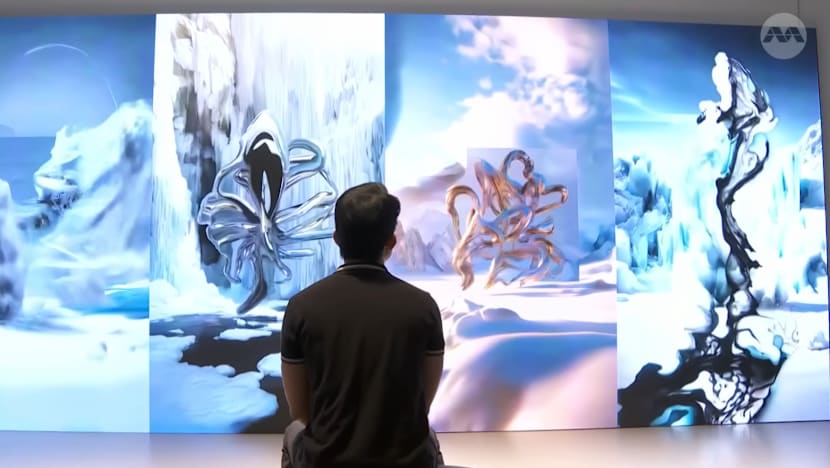
Artwork on display at PromptoScape, an art exhibition featuring AI art that was held at the Shanghai Minsheng Art Museum in 2025.

This audio is generated by an AI tool.



SHANGHAI/BEIJING: At an art exhibition held in Shanghai, visitors were able to get a taste of what creativity looks like in an age where artificial intelligence is both a tool and a collaborator.
Many of the artists featured in the exhibition, titled PromptoScape, were not human but machines.
While the event – which took place from July to September last year – has ended its run in the Chinese megacity, court cases over AI-assisted creations are only just beginning.
Legal battles over such creations are brewing in courtrooms across China, as judges and lawyers race to keep pace with rapidly evolving technology.
Chinese AI models have been making global headlines for rivalling the best in the world, with many Chinese creative professionals adopting such technology amid government promotion of AI integration.
A study by Shanghai Jiao Tong University, published two years ago, found that 87 per cent of about 110 visual artists who were surveyed use AI in at least one stage of creation.
This has planted the seeds for a new legal conundrum: Does AI artwork generated by artists warrant copyright protection, especially when they are created using models trained on vast datasets of existing creative works?
A LEGAL WIN AT A COST
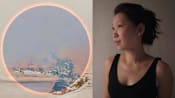
One artist caught at the centre of this legal grey zone is Lin Chen, known professionally as Tudou Man.
In 2024, he found himself at the forefront of a landmark lawsuit involving AI-assisted art.
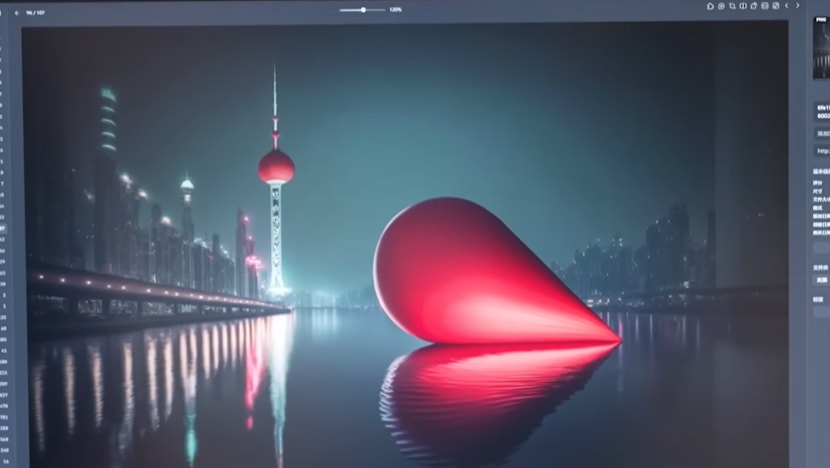
He had used a generative AI tool called Midjourney to “do an early round of generation” of an image.
“After a few hours of back-and-forth, a heart finally appeared lying on the surface of Shanghai’s Huangpu River. I then edited it in Photoshop, turning it into half a heart on water,” he told CNA.
“This brings out the idea: when the two halves meet, it’s a complete heart.”
But Lin later saw a video online showing a 3D installation of his artwork, displayed on a lake in neighbouring Jiangsu province.
“It was extremely infuriating,” Lin recalled.
At first, Lin tried to reach out to the real estate company, but they did not respond.
Then he decided to contact the balloon installation company – which, besides creating the 3D balloon installation, also used an image similar to his artwork for their online advertisement.
The company responded but was adamant they did nothing wrong.
“They said they had created many half-suns and half-moons on the water before, so why would half a heart be an infringement? They didn’t believe using my work constituted an infringement,” Lin said.
“That’s why I filed the lawsuit.”
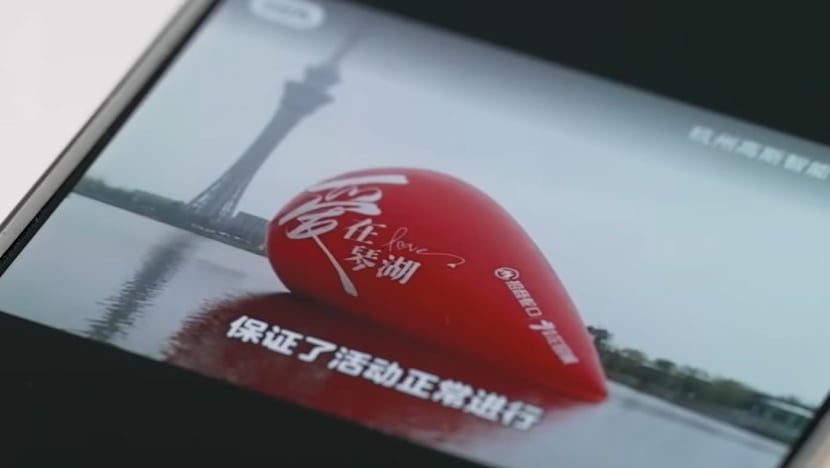
Lin ultimately won his case, but with an unexpected twist.
In a 27-page ruling – an unusually lengthy one for a civil case – the Changshu Court in Jiangsu decided that the 2D image used in the balloon company’s advertisement infringed Lin’s copyright.
The court found that even though Lin created the image using an AI tool, he demonstrated originality due to his creative control in the composition of elements like colour, environment and light.
However, the court ruled that the 3D installation on the lake was not a copyright infringement.
In its ruling, the court stated that copyright protects concrete artistic expression rather than abstract creative ideas, and the heart-shaped balloon installation represented a common and simple design concept that lacked sufficient originality.
The also court pointed out that Lin’s copyright registration only covered the 2D artwork itself.
Lin was awarded 10,000 yuan (US$1,400) in damages for the illegal reproduction of his 2D artwork. But he had spent more than seven times that amount on legal fees alone.
He said it was a learning experience for him in how to register his artwork for copyright protection. He registered it as a single, flat two-dimensional image, but noted he should have applied for an appearance patent to copyright it from multiple angles.
“If it had been registered as a 3D piece or in other sculptural forms, it wouldn’t have left loopholes for the other party – or anyone else – to exploit,” he lamented.
CHANGE IN LEGAL THRESHOLD
Meanwhile, in the Chinese capital Beijing, lawyer Deng Yile is defending the copyrights of another AI-assisted artwork.
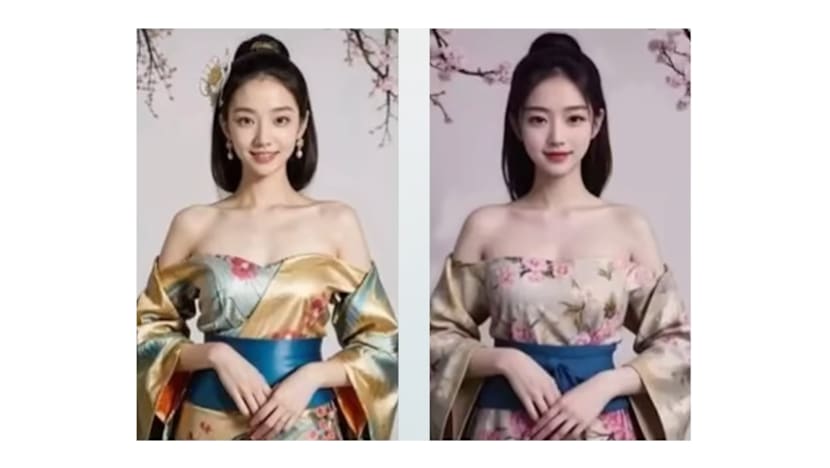
Her client, who created the piece with the help of AI, has accused a Chinese cybersecurity firm of using a marketing image that bears a striking resemblance to his creation.
The case has, however, taken a turn – Deng’s client found himself being sued for defamation instead.
Deng and her legal team had to debate what course of action to take, after Chinese courts ruled last year that a creator who enters AI prompts or adjusts parameters will not secure copyright protection for their AI-generated image.
This was a reversal of the courts’ decision in 2023 and reflects how judicial rules are responding to tech development, said Deng.
Her legal team began exploring a new strategy - to frame AI-assisted artworks as unique datasets protected under recently revised civil provisions issued by China’s Supreme People’s Court.
Those provisions set out several new courses of action to protect the intellectual property of data.
Deng’s team is arguing that by using data without permission to generate their own artwork, the defendants have infringed on her client’s rights.
But this has raised a larger, unresolved issue.
AI models themselves are trained on enormous datasets of creative works, often without compensation, under the principle of fair use.
Still, Deng said she feels the fair use principle is worth re-examining in the current AI age.
“If we cannot draw a clear line for what counts as ‘fair use’, that lack of clarity will also affect (AI) development,” she pointed out.
“We can see there are a large number of works in the public domain. But if AI companies ‘learn’ from them, or even conduct style-based learning, has that already gone beyond what is necessary for (fair) use?”
The principle of fair use was also mainly to regulate personal use for learning purposes, noted Deng, but AI platforms or large learning models use data for primarily commercial purposes.
NO EASY ANSWERS
Globally, the debate is intensifying.
In 2024, more than 10,000 actors, musicians and authors around the world signed a public statement warning that unlicensed use of their work to train generative AI poses a “major, unjust threat” to their livelihoods.
The number of signatories later grew to 50,000, including novelist Kazuo Ishiguro, actress Julianne Moore and singer-songwriter Kate Bush.
While their demand to stop unlicensed AI training altogether appears unlikely to gain traction, amid the international race for AI dominance, others have suggested people should treat creative knowledge as a public good and collectively fund it like public broadcasting or infrastructure.
For Lin the artist, his experience has reshaped how he works.
Rather than rejecting AI, he had embraced it early, believing the technology had to be mastered, not feared.
Now a practising designer and university lecturer, he has watched entire courses disappear as AI replaced once-essential technical skills.
Today, he is known for AI-generated digital art that remixes modern consumer culture with Chinese aesthetics – hyper-realistic, imaginative works that sometimes resemble fan art of major brands.
Some of those brands have even approached him directly, paying to use his artwork for their marketing materials or to generate more conceptual artwork for them.
After his lawsuit, fellow creatives have begun seeking his advice on how to protect their own work.
As China pushes ahead with AI as a national strategy and millions of AI-generated creations flood the market, the rulings emerging from its courts may offer an early glimpse into how ownership, originality and creativity could be redefined – not just in China, but around the world.