No Dong Jun, but plenty of China at Shangri-La Dialogue
China’s defence minister may not have attended this year’s Shangri-La Dialogue but the country still loomed large and remained at the centre of discussion.
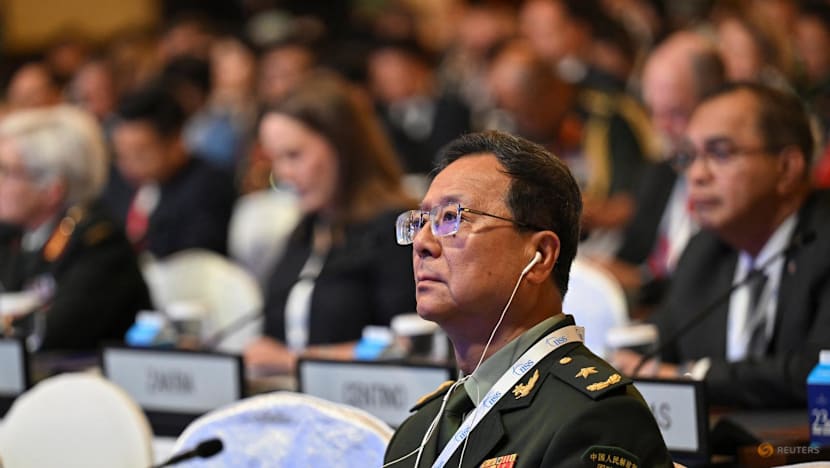
Major General Meng Xiangqing, of the People’s Liberation Army (PLA), listens at a plenary session at the Shangri-La Dialogue security summit in Singapore on May 31, 2026. (Photo: Reuters/Caroline Chia)

This audio is generated by an AI tool.


SINGAPORE: Chinese Defence Minister Dong Jun may have skipped the Shangri-La Dialogue for the second year in a row - but China still loomed large, featuring prominently in regional security discussions, including a maritime dispute involving a Dutch warship from earlier in the week and sharp exchanges over what Beijing described as “new militarism” by Tokyo.
More than 550 delegates, including military leaders and senior officials, from more than 40 countries attended the three-day forum at Shangri-La Hotel - which concluded on Sunday (May 31).
Led by Major General Meng Xiangqing, this year’s Chinese delegation from the People's Liberation Army National Defence University drew heated questions from delegates.
“NEW MILITARISM” AND OLD GRIEVANCES
At a panel on Sunday, Japanese Defence Minister Shinjiro Koizumi hit back at China’s accusations of “new militarism” - reiterating that Tokyo has “consistently respected international law”, alongside efforts to maintain and strengthen a “free and open international order”.





“Japan’s past as a peace-loving nation has been valued by the region and by the international community,” Koizumi said, adding that Japan’s door to dialogue is “always open”.
“This fact will not be shaken by false claims, because it is a fact.”
He also criticised Beijing for “continuing to increase its defence spending”.
“China is rapidly expanding its military capabilities across a wide range of areas without sufficient transparency,” Koizumi said, adding that these are matters of “serious concern” for Japan and the international community.
“There is a country that has a huge arsenal of nuclear weapons and strategic bombers. Japan has neither such weapons, and yet Japan is labelled new militarism. Isn't it strange?”
Recalling a “frank and fruitful discussion” with Chinese counterpart Dong Jun last year at the ASEAN Defence Ministers’ Meeting Plus talks in Kuala Lumpur, Koizumi reiterated that Japan believes it is essential to have “persistent, candid dialogue and communication” without turning away from difficult issues.
Koizumi added that the Japanese defence ministry would continue to use “every available opportunity to communicate firmly with the Chinese side”.
“Please give my best regards to my counterpart Dong Jun,” he said, addressing Chinese delegates in the audience.
At the summit a day earlier, Major General Meng criticised Japan's efforts to revise its "pacifist constitution" and the three non-nuclear principles, as well as its pursuit of the deployment of allied nuclear weapons on Japanese territory.
“Today, some forces continue to openly glorify war crimes, promote distorted narratives of WW II history, attempt to challenge the verdicts of the Tokyo Trial, and seek to whitewash the history of aggression,” Meng said.
“Some have even taken concrete steps to break through the constraints of the post-war peace framework,” he added.
He also questioned if a country that has “never fully eradicated the remnants of militarism” can claim the moral authority to lecture others about defence cooperation on the international stage.
“Can it earn the trust of the international community, especially the Asian countries that once suffered under its aggression? I have serious doubts," Meng said.
ILLEGAL INTRUSION AND FREEDOM OF NAVIGATION
At the session, Dutch Defence Minister Dilan Yeşilgöz-Zegerius addressed an incident earlier this week involving Dutch frigate De Ruyter, which Beijing had accused of “illegally intruding” into the Paracel Islands in the contested South China Sea.
Beijing claims sovereignty over most of the resource-rich South China Sea, while Southeast Asian countries including Vietnam, Malaysia, Brunei and the Philippines have competing claims.
The Netherlands said the HNLMS De Ruyter was sailing through the South China Sea for diplomatic, security and economic reasons.
Yeşilgöz-Zegerius reiterated that the ship had followed its planned route in “full accordance with international law - operating in waters where freedom of navigation applies and without entering territorial waters”.

Chinese representative Liu Wanxia said Dutch navy helicopters had “illegally intruded into China’s territorial airspace”.
“The Dutch side talks a lot about respecting sovereignty and rules, but it uses so-called freedom of navigation as a pretext to severely violate China's sovereignty rights and interests and maritime and air security,” Liu said.
Responding, Yeşilgöz-Zegerius emphasised that the Netherlands was “not here to seek conflict”.
“We are here to seek cooperation with our frigates and we did more or less the same two years ago in good cooperation with China - and I hope the next time we are here in the area we will have a better encounter.”
HISTORIC RIGHTS AND INTERNATIONAL LAW
Beyond the dispute involving the Dutch warship, the South China Sea remained a recurring theme at the summit.
Addressing attendees during the final panel, Philippines Secretary of National Defense Gilberto Teodoro Jr noted that 2026 marked the 10th anniversary of an arbitral tribunal ruling in favour of the Philippines in its case against China concerning the South China Sea.
“This landmark ruling affirmed the fundamental principle that maritime entitlements are derived not from ‘historic rights’ but from international law,” Teodoro said, also accusing Beijing of not “honouring their obligations”.
Speaking to Reuters on the sidelines, Teodoro said Manila remained under “severe threat” from Beijing - territorially and politically, despite a recent thaw in US-China tensions following a summit between Presidents Donald Trump and Xi Jinping this month.
“We have no choice but really to be resilient and to stand up against Chinese aggression,” he added.
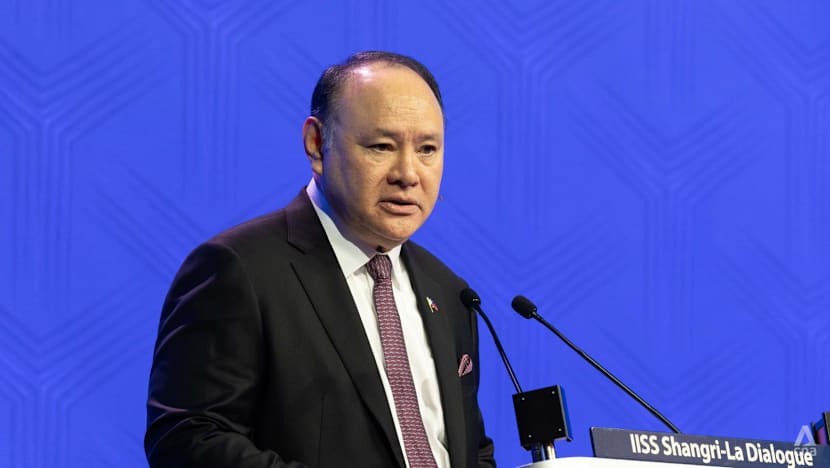
In response to Teodoro’s remarks, the Chinese Embassy in Singapore accused the Philippines defence chief of “groundlessly attacking and smearing China” by referencing the “so-called South China Sea Arbitration Award”.
In a statement posted on its official Facebook page, the embassy called the ruling “nothing but a piece of waste paper that is illegal, null and void, and non-binding”.
“China neither accepts nor recognises the award, and will never accept any claim or action based on it,” the embassy said.
It added that the ruling violates “basic principles of international law”, as the Philippines unilaterally initiated an arbitration without exchanging views with China in advance.
The statement added that China is committed to working together with ASEAN countries to conclude a Code of Conduct as early as possible, to provide “robust institutional safeguards for peace and stability in the South China Sea”.