







Ageing but arming: Why East Asia’s greying societies are spending more on defence
Despite falling birth rates and shrinking armies, East Asian powers are boosting military spending, driven by threat perceptions and technological advances.
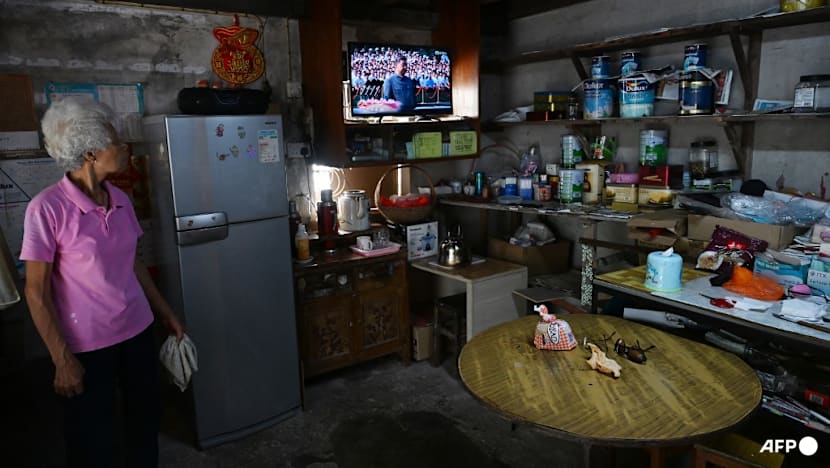
An elderly woman watches her television in her small shop in Hong Kong as China's President Xi Jinping starts his inspection of the troops during a military parade marking the 80th anniversary of victory over Japan and the end of World War II, in Beijing's Tiananmen Square, on Sept 3, 2025. (Photo: AFP/Peter Parks)

This audio is generated by an AI tool.








East Asia’s population is ageing fast – yet, instead of turning inward or becoming more pacifist, countries in the region are racing to modernise their militaries.
Fertility rates across Japan, South Korea and China are below replacement level, while life expectancy continues to rise.
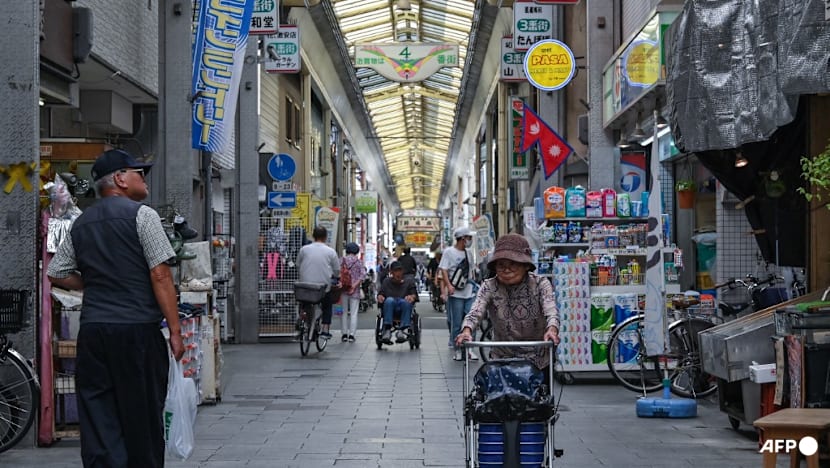
In Japan, nearly one in three people is now aged 65 and above, the highest proportion globally.
South Korea recorded the world’s lowest fertility rate at 0.74 in 2024, prompting then-president Yoon Suk Yeol to declare a national demographic emergency.
Meanwhile, China reported its first population decline in 2022. Its transition from an “ageing” to an “aged” society – where 14 per cent of the population is 65 and above – has taken just 36 years.
Despite these demographic headwinds, defence spending is climbing – and is expected to continue growing.
AGEING, BUT NOT PACIFIST
At first glance, ageing societies might be expected to adopt more pacifist attitudes.
Traditional demographic theory suggests that societies with fewer young people – and higher welfare and pension costs – would be less willing to invest in military confrontation.
“Generally speaking, (an) expanding population has been associated with expansionary behaviour of states,” said Jaehan Park, an assistant professor at the Rajaratnam School of International Studies.
“If you look at the shrinking population, it is not unrealistic to assume or anticipate that (this) will lead to a less aggressive policy.”
Yet that expectation has not borne out in the region, said defence analyst Ridzwan Rahmat.
Instead, countries like China, Japan and South Korea are “turning up the rhetoric on military action, modernising their respective military branches and most of all increasing their defence budgets”.
EXPANDING DEFENCE BUDGETS
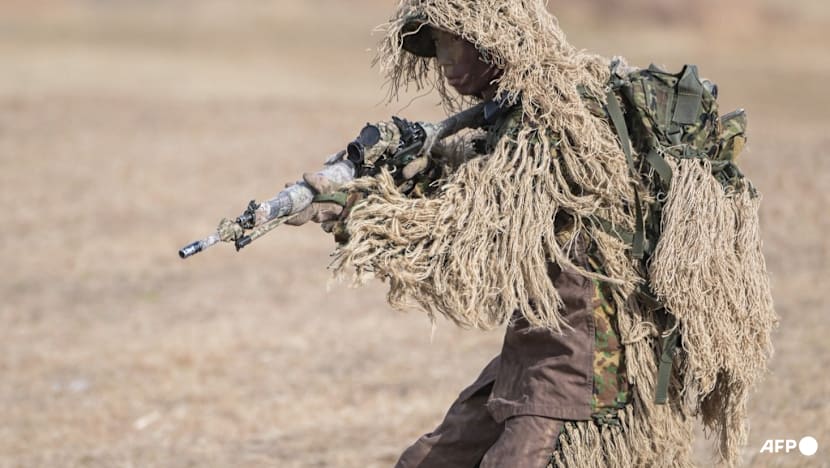
Japan has set a goal of raising defence spending to 2 per cent of its gross domestic product (GDP), abandoning a longstanding unofficial cap of around 1 per cent of GDP.
Tokyo’s defence budget for the fiscal year starting April 2026 is a record 9 trillion yen (US$58 billion) as it faces intensifying tensions with China.
This comes amid mounting manpower constraints at home. For years, the country’s Self-Defense Forces (SDF) have consistently failed to meet recruitment targets.
The SDF has a total strength of about 247,000 personnel, and in fiscal year 2023 more than 6,200 service members quit — the highest number in 15 years.
With conscription barred under its pacifist Constitution, the government has raised wages and improved benefits to attract and retain personnel while turning to technology as a solution.
South Korea’s defence ministry says its military has shrunk by about 20 per cent over the past six years, to about 450,000 troops.
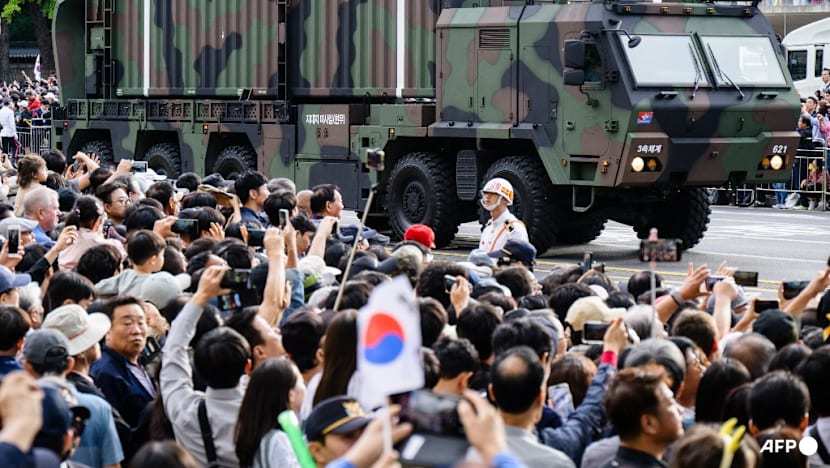
The country’s 2026 defence bill is expected to hit a record 65.9 trillion won (US$45 billion) as Seoul aims to introduce high-tech weapons and raise military wages.
China’s defence budget ballooned to 1.78 trillion yuan (US$255 billion) in 2025, more than doubling since 2013.
Analysts note that while China has long leveraged its vast population to build military strength, the People’s Liberation Army is now pivoting toward high-tech capabilities, seeking to lock in strategic gains even as its demographic edge fades.
Taiwan, meanwhile, aims to raise defence spending to around 5 per cent of GDP by 2030, up from about 3 per cent today, to strengthen deterrence amid growing military pressure from Beijing.


THREAT PERCEPTIONS
Public opinion, analysts say, plays a more complicated role than simply acting as a brake on military action.
Kei Koga, associate professor at Nanyang Technological University’s School of Social Sciences, said younger generations in the region are not necessarily pro-war, but they are increasingly aware that conflict is no longer unthinkable.
“They are not actually considering real war, but they are trying to think about the possibility for that,” he said, referring to how young people view rising tensions around flashpoints such as Taiwan and the Korean Peninsula.
“I don’t think (anyone) wants to actually see war in Northeast Asia because the cost is too high,” Koga told CNA’s East Asia Tonight.
But advances in technology and shifts in military capability have complicated those calculations.
“As technology advances and the demographic changes, people would think that there might be some kind of chance to win the war or conflicts to some extent – and that creates a big debate over the possibility of the conflict,” he added.


TECHNOLOGY BOOST
Analysts say rising defence budgets are also driven by efforts to automate operations and build smarter militaries to compensate for shrinking manpower pools.
“There is a bit of a dynamic where countries are taking advantage of this particular window where they are able to automate as much of their processes as possible,” Ridzwan said.
“With technology, with automation, with AI (artificial intelligence), to seize some kind of advantage that they might have over their adversaries when the time comes that … population shrinkage or demographic challenges are too big to overcome.”
Ridzwan added: “Twenty years ago, military modernisation tended to focus on the tonnage of equipment produced - how many tanks, how many warships.
“But today we are seeing a lot more focus on automation – how much data can be collected by this particular platform, how much data can be processed in the battlefield and how I'm able to fuse the data … to give an outcome that is more desirable with my security objectives.”
Among East Asian countries, China is leading this shift, he said.
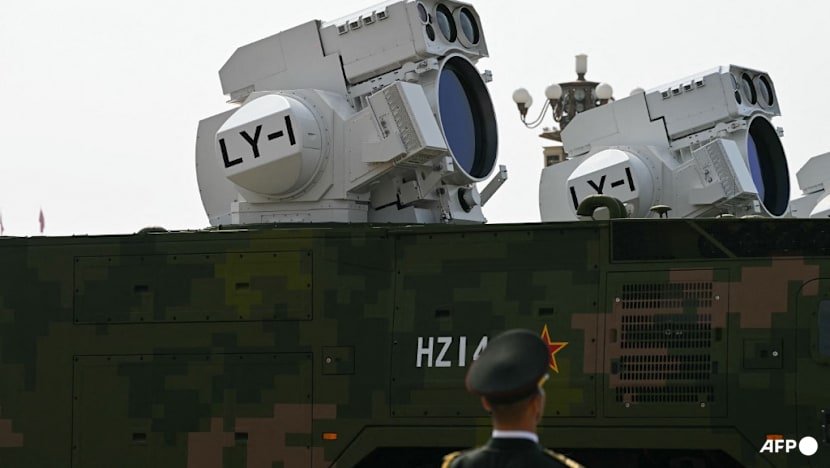
That technological lead was on display during its military parade in Beijing last September, where the People’s Liberation Army unveiled a range of advanced weapons systems.
These included unmanned equipment, hypersonic missiles, directed-energy weapons, and electronic jamming systems.
China’s advances have not gone unnoticed. Analysts say Japan and South Korea are increasingly integrating AI-based solutions into their own military platforms.

SHIFTING POWER BALANCES
Looking ahead, demographic change could reshape the regional balance of power.
Koga said Japan faces one of the toughest long-term outlooks, with a shrinking economy, a rapidly ageing population and an increasingly challenging security environment.
“In that sense, we could actually say that Japan is a gradually declining power,” he said.
But “if they actually invest a lot in AI or defence technology, then they could actually become an economic and also military power", he added.
As for South Korea, he noted that Seoul is under pressure from multiple directions – the North Korea threat, China’s growing influence and intensifying United States-China rivalry.
Of the different scenarios that could happen to South Korea's foreign policy if Japan's influence wanes, Koga said South Korea is more likely to hedge against the risk of being too reliant on any single power.
“South Korea is not going to push too much to China or the United States,” he said.
It may also find ways to improve its ties with Japan, he added, viewing Tokyo as a declining but still important partner.

GREY FUTURES, HARDER CHOICES
While automation and intelligent machines may help plug manpower gaps, they bring new risks of their own.
One concern is how much decision-making is delegated to machines on the battlefield.
Some analysts caution that automation could paradoxically make conflict more likely.
“If you are able to substitute humans doing the fighting with AI, with robotics, with automation … then, ironically, because humans are not involved, you may be more willing to take risks, especially if you think that you can control escalation,” noted Chong Ja Ian, an associate professor of political science at the National University of Singapore.
“If the risk profile changes because of automation and AI, it may mean that even with a diminished population, states may decide that they have a greater appetite for risky behaviour.”





