







Fundamental assumptions about law need to be rethought amid AI disruption: PM Wong
Singapore's legal frameworks were not designed for AI to make consequential decisions, said Prime Minister Lawrence Wong.
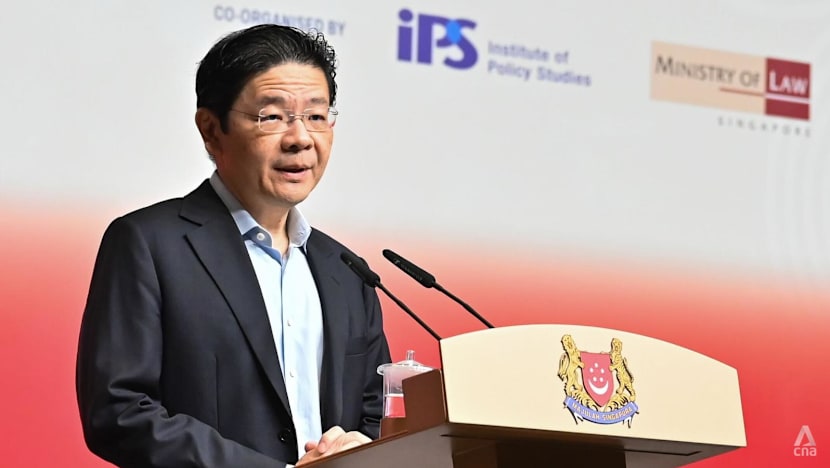
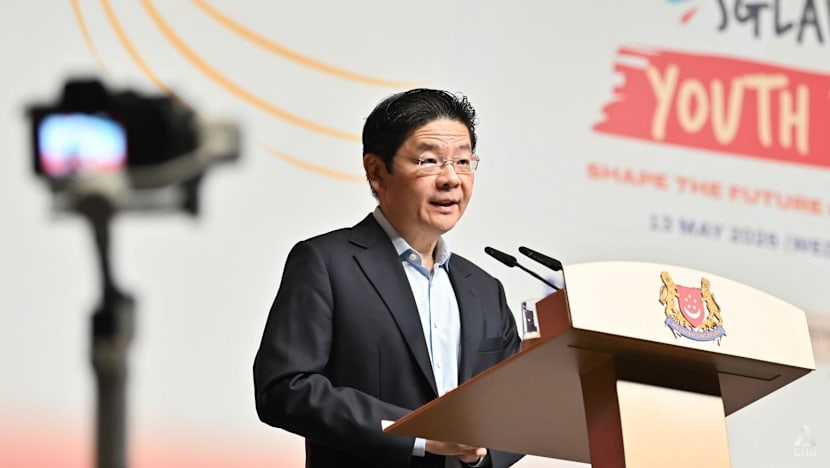
Prime Minister Lawrence Wong at the SGLaw200 Youth Forum on May 13, 2026. (Photo: CNA/Alyssa Tan)

This audio is generated by an AI tool.


SINGAPORE: Existing legal frameworks were not designed for a world where artificial intelligence allows machines to make “consequential decisions”, Prime Minister Lawrence Wong said on Wednesday (May 13).
This reality requires a rethink of fundamental assumptions about responsibility, liability and accountability, he added.
Acknowledging that this will not be easy, Mr Wong pointed out the tension between moving too slowly and letting the law fall behind, versus moving too quickly and stifling innovation.
“We must strike the right balance – between safety and progress, between control and creativity,” he said.





Mr Wong was speaking about the rule of law in his opening address at the SGLaw200 Youth Forum, part of commemorations for the bicentennial of Singapore’s modern legal and judicial system.
He said AI was advancing faster than legal systems can keep up, giving examples of more sophisticated scams, deepfakes and misinformation as a consequence of the technology's use.
Harder questions of who should be held accountable lay ahead, he said, as he sketched out scenarios of AI giving a wrong medical diagnosis or a fatal accident with a self-driving car.
“Even as we harness technology, we must be clear that the law ultimately rests on human judgment,” said Mr Wong.
“Machines can assist, analyse and recommend. But questions of responsibility, fairness and justice cannot be delegated entirely to algorithms.
“These are human questions, which humans must decide – and that must always remain so.”

Access to justice is another challenge the current legal system faces, said Mr Wong, who is also finance minister.
Even the best legal system in the world means little if it is out of reach for ordinary citizens, he said.
“A system only works if everyday Singaporeans can use it to find justice and enforce their rights,” he added.
Mr Wong said Singapore made important progress in this area by establishing the state-funded Public Defender’s Office in 2022.
It provides criminal defence aid to Singaporeans and permanent residents facing non-capital charges who cannot afford a lawyer.
Access to justice is not just about access to lawyers and the courts, but legal awareness, he added.
“People must know their rights — and understand how to exercise them. Otherwise, the protections of the law exist only on paper,” he said.
Gaps remain for vulnerable groups who may not know how to navigate the legal system, said Mr Wong.
He said this was why the Ministry of Law had set up a task force for a more inclusive justice system.
Mr Wong said laws must ultimately deliver “real outcomes for ordinary people”.
“A legal theory that reads beautifully in a textbook, or a system that works well in a larger or more homogeneous society, may not work well for Singapore.”

RULE OF LAW IN DAILY LIFE
Pragmatism alone is not enough, added the prime minister, because the rule of law is a “living social compact” that depends on people believing in it and upholding it.
He emphasised the importance of public trust in this regard.
“Our key institutions – the police, the Attorney-General’s Chambers, the judiciary – must uphold the highest standards and act with integrity and in the public interest,” he said.
“The moment people think that power is being used for private gain, trust begins to erode. And once trust is lost, it is very hard to rebuild.”
This is why Singapore sets high standards and applies them to everyone, he said.
“Any breach – however isolated, however senior or junior the person involved – will be dealt with firmly. And that is how we keep our system clean, fair and worthy of the trust Singaporeans place in it.”
With this trust in place, Mr Wong spoke at length about how the rule of law is experienced by people in daily life by using three examples of how Singapore takes a different approach in certain offences.
He pointed to corruption, which he said is tolerated in some countries as part of the cost of doing business.
Singapore’s zero-tolerance approach to corruption is not just about maintaining a good business environment, he said.
“It reflects a basic principle of fairness — that opportunities in Singapore are based on merit, not on connections or privilege,” he said.

Another example is Singapore’s laws on drug trafficking.
When drugs are found in someone’s possession, in many other legal systems, the prosecution must prove beyond reasonable doubt that the accused knew he or she was carrying drugs, he said.
“But proving what someone knew is often extremely difficult,” said Mr Wong, as people can claim ignorance.
“That makes enforcement extremely difficult, and drug traffickers know how to exploit this,” he said.
Mr Wong said this is why Singapore takes a different approach.
“If drugs are found in your possession, the law in Singapore presumes you knew they were there. The burden shifts to you to prove otherwise. This reflects a practical reality: you are best placed to account for what is in your possession.”
He also stressed the safeguards that exist alongside this statutory presumption.
“Every case goes through a full investigation and trial before an independent judge. The accused has the right to legal representation – and in capital cases, the state appoints a lawyer for the defence at no cost. Every death penalty verdict is automatically reviewed by the Court of Appeal, even if the accused does not appeal.”
This makes the system firm but fair, said Mr Wong.
His third example was speech and the online space.
“In some countries, even offensive speech is protected in the name of free expression. You can insult someone’s race or religion. You can publish falsehoods online. The belief is that bad speech can be countered with more speech – not legal restriction,” said Mr Wong.
Singapore takes a different view, because speech that demeans race or religion can polarise society, normalise hatred and lead to violence, he said.
Singapore cannot take such risks lightly because of its diverse society, he said.
“So we have laws against speech that incites racial or religious hatred, and laws to counter the spread of online falsehoods.
“Some have criticised this approach as overly restrictive. But today, even societies that once took a more permissive approach are tightening their laws – because they are confronting the same challenges and realities," said Mr Wong.
What once seemed overly cautious is increasingly seen as necessary, he added.
While people may differ in what they think the rule of law is, a deeper point lies beneath that, said the prime minister.
“As a French philosopher once put it: ‘Justice without force is powerless; force without justice is tyranny’,” he said, adding that this was not abstract philosophy, but real life.
Law enforcement must work within a framework of laws, otherwise it risks being abused, said Mr Wong.
“But constrain that power within a framework too tightly, and criminals will exploit the gaps, and the guilty walk free, and the ordinary people pay the price.
“So the real challenge is navigating the space in between – where principle meets practice, and difficult trade-offs have to be made.”
He said that every country must find its own balance in this.
“The rule of law is also not just about order or efficiency. It is about legitimacy as well.
“People must believe that the system is fair — that it treats them with dignity, and that justice is not only done, but seen to be done. Without that belief, even the strongest laws will not hold,” he said.

Turning to the rule of law internationally, Mr Wong said this is under growing strain, with more countries “acting unilaterally and with impunity”.
Smaller and more vulnerable countries feel the impact first, he said, adding that this is why Singapore makes its voice heard internationally.
For example, if principles like the law of the sea are weakened, this will affect Singapore directly as a trading nation, said Mr Wong.
“When fundamental principles are tested, we state our positions clearly and consistently,” he said.
“So this is not just a matter of idealism. It is a matter of national interest. And for a small country like Singapore, a strong and functional system of international rules is vital.”




