Parliament unanimously backs motion affirming that Singapore must not have jobless growth amid AI transition
A total of 24 Members of Parliament, including seven from the Workers’ Party, spoke for over seven hours on the impact of the AI transition on jobs and livelihoods.
A view of Parliament House in Singapore on May 24, 2018. (File photo: Reuters/Edgar Su)

This audio is generated by an AI tool.






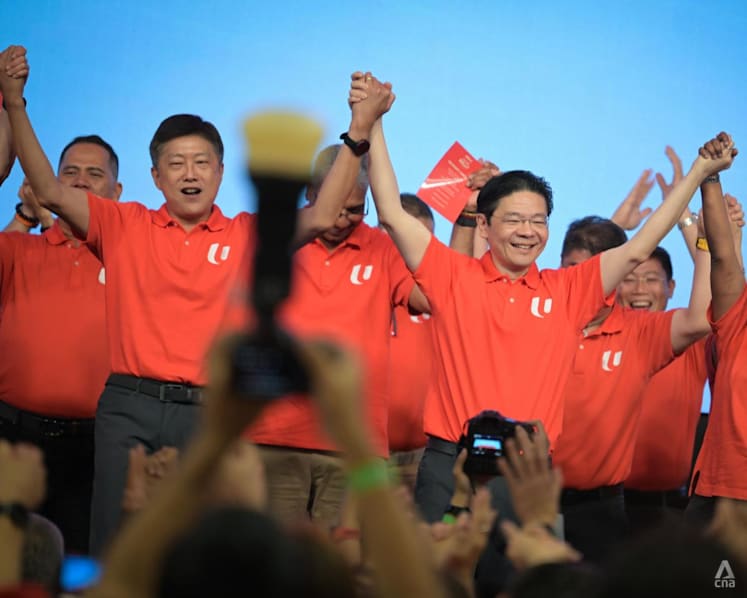
SINGAPORE: Parliament unanimously passed a motion on Wednesday (May 6) affirming that Singapore must not have jobless growth amid the artificial intelligence transition, with labour chief Ng Chee Meng hailing a "clear consensus" that the impact on workers must be collectively managed.
“All members recognise that AI adoption is not optional. If Singapore is to stay competitive, both enterprises and workers need to use AI fluency to seize new opportunities,” said the National Trades Union Congress (NTUC) secretary-general.
The private member's motion called on the House to recognise the transformative power of new technologies, emphasise that Singapore's approach should be fair and affirm that economic progress must be inclusive.
It was moved by Mr Ng (PAP-Jalan Kayu) on Tuesday, together with Mr Saktiandi Supaat (PAP-Bishan-Toa Payoh), Ms Yeo Wan Ling (PAP-Punggol) and Nominated Member of Parliament Mark Lee. This was the first motion tabled by the labour movement in more than a decade.





It passed after two days of debate spanning more than seven hours, with speeches from 24 Members of Parliament (MPs), including seven from the Workers' Party (WP) and two political office holders, Manpower Minister Tan See Leng and Minister of State for Digital Development and Information and Education Jasmin Lau.
In his speech rounding up the debate, Mr Ng reiterated what Dr Tan and Ms Lau said on the need for collective action. “Left to market, AI growth may not automatically benefit workers,” said Mr Ng.
He also noted that other MPs warned about an outcome in which some workers gain, but others risk falling behind.
“I am therefore glad that through this motion, the government has affirmed that it will not leave outcomes to chance but will shape the direction of AI growth deliberately,” said Mr Ng, adding that he is looking forward to the government’s Economic Strategy Review (ESR) report.
“With this House standing united, I’m fully confident that we can strengthen our plans and responses at this stage of AI-enabled growth.
“Together with enabled enterprises, we will forge tripartism in the AI era for win-win outcomes, as we have done before in Singapore for Singaporeans.”
WORKERS’ PARTY PROPOSES 'SOCIAL DIVIDEND', REDUNDANCY INSURANCE
The seven WP MPs who spoke during the debate put forth several proposals to support workers through the AI transition. All of them ultimately said they supported the motion.
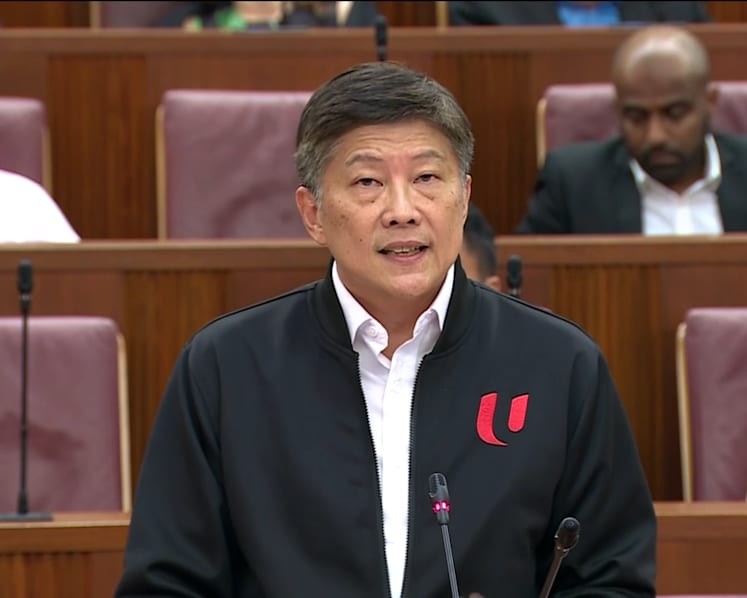
In his speech, Mr Gerald Giam (WP-Aljunied) suggested setting up a national “AI equity fund”, with part of the fund going to a “social dividend”. He said the revenue would be distributed as a direct payout to every adult Singapore citizen.
The source of the fund’s contributions could be from corporate taxes and Singapore’s net investment returns, he said.
The purpose of the dividend is to provide an additional cushion for families and allow Singapore to reap the benefits of AI without “overly exacerbating” social inequality, said Mr Giam.
He proposed an initial dividend of S$500 per adult.
Mr Giam then added that the remaining portion of the fund could be dedicated to a “mastery fund”, which will be an employer-led on-the-job training model that provides the apprentice a wage, covering 50 per cent of the gross salary capped at the median wage for six months for any Singapore citizen entering or transitioning into an AI-augmented role.
“This rewards the workers’ effort in adapting, while lowering the barrier for firms to hire, train and retain talent in this volatile market,” he said.
The mastery fund would also finance a pool of expert on-the-job consultants, which will help small and medium enterprises fill a talent gap, he added.
In another speech, Non-Constituency MP Andre Low also proposed changes to the Jobseeker Support Scheme (JSS) to better protect workers displaced by AI.
Currently, the JSS pays up to S$6,000 over six months tapering in monthly installments and is only available to workers who earned S$5,000 or less.
“A payment that starts high and slowly reduces is not a flaw. It is a countdown, and a countdown pushes a worker to take the first offer, not the right one,” he said.
Instead of the JSS, the WP has proposed a redundancy insurance scheme, where retrenched workers will receive a payout of 40 per cent of their last drawn salary, with no income ceiling and no tapering mechanism.
This will be funded by employer-employee contributions in the same model as the Central Provident Fund (CPF), and it covers every worker who pays in, he said.
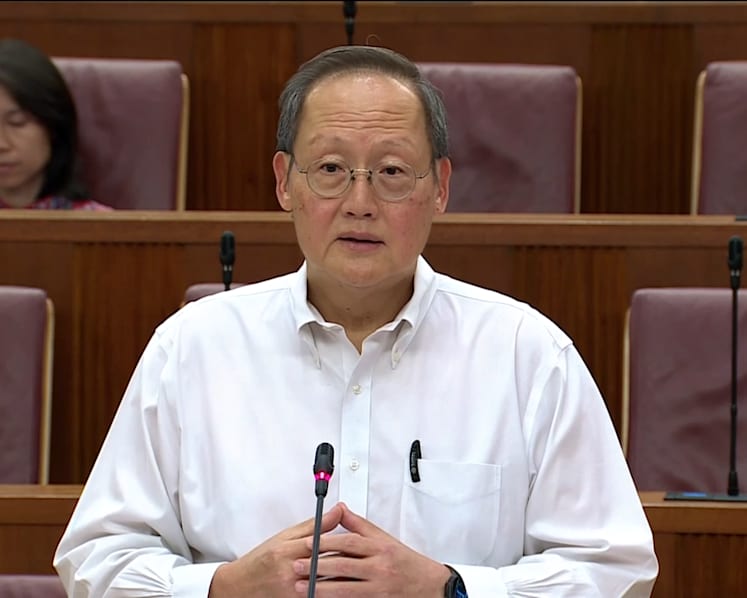
In response, Dr Tan said that both Mr Giam and Mr Low's proposals rest on a more “pessimistic premise” that Singaporeans are “essentially passive passengers in the AI transition” and without agency to seize opportunities.
“I cannot hold on, and I would not hold on to such a premise,” said the manpower minister, adding that both proposals are not a form of empowerment.
“To me, it is a settlement resigned to the fact that mass displacement is inevitable and that the best we can do is soften the blow.
“We should have more confidence in the tenacity and the adaptability of our fellow Singaporeans,” he said, adding that the convention is to invest in people rather than to “compensate them for their circumstances”.
Dr Tan also took aim at a suggestion by Mr Kenneth Tiong (WP-Aljunied) to universalise the six months’ free access to premium AI tools, which is currently given out to those taking selected AI courses.
Dr Tan said not all Singaporeans require frontier AI tools and that free versions suffice.
“By tying subsidies to training, we are better able to target those who are more serious about leveling up their use of AI, and we help them to make optimal and responsible use of such powerful tools,” he said.
AI INEQUALITY
Several MPs, such as Mr Saktiandi, also flagged concerns that AI could worsen inequality.
Noting that many of the more capable AI tools require ongoing subscriptions, Mr Saktiandi said that despite six months of free access to premium AI tools provided by the government, a divide could emerge between those who can afford to continue using these tools and those who cannot.
“If left unaddressed, we risk creating a new form of inequality between the AI haves and have-nots,” said Mr Saktiandi.
Access to these tools directly affects productivity, learning and income potential, so unequal access will lead to unequal outcomes, he said.
In this light, he suggested providing a baseline level of subsidised access, or group-based pricing with industry partners. There could also be shared access through community centres, libraries and training hubs, or access for workers through their employers, he said.
“If AI is to be a force for inclusive growth, access cannot be a privilege, it must be broadly shared,” he said.
NTUC deputy secretary-general Desmond Tan also highlighted seniors as one group that lacks access to AI tools and training, as well as the confidence to use AI.
He said many of them “have lived through repeated cycles of change and transformation and may feel fatigued, uncertain or even question the relevance of more training”.
“We must make training more accessible for them at a suitable pace, through practical and bite-sized modules, and make AI more relevant to their job skills,” he said.
Ms He Ting Ru (WP-Sengkang) said some people face “systemic barriers” as Singapore moves toward an AI-ready future.
She pointed to persons with disabilities, women, lower-income Singaporeans and young graduates as possible groups.
Unequal access to AI tools and training could also entrench existing disadvantages, she said.
“Those without the resources or home environments conducive to learning new skills may find themselves falling further behind,” said Ms He, adding that that would risk “hardening inequality” across generations.
The government’s response to such concerns is to “raise the floor and to widen the door”, said Ms Lau.
The co-chair of the ESR’s technology and innovation committee said this will involve building AI literacy in schools so that all students, regardless of economic background, can learn about the technology safely.
Institutes of Higher Learning will offer selected AI-related courses at discounts for their alumni for a period of one year from the second half of 2026, she said, reiterating that Singaporean workers who complete selected AI training courses will get six months’ complimentary access to AI tools.
“Every Singaporean, regardless of starting point, should have the chance to experiment with AI tools and build fluency,” said Ms Lau.
SUPPORTING DISPLACED WORKERS
Several MPs also highlighted the need to support workers who are at risk of being displaced by AI, especially those in professional, managerial, executive and technical (PMET) roles.
This group of workers are highly exposed to artificial intelligence, NTUC assistant secretary-general Patrick Tay (PAP-Pioneer) noted.
Unlike earlier waves of automation that mostly impacted rank and file workers, many of the middle-income workers are “expected to perform like the top, but are less protected than the bottom”, he said.
“We perceive PMEs as privileged and adaptable who have resources and can take individual responsibility to upskill and also to cope with setbacks. This assumption no longer holds true,” he said.
Nominated MP Mark Lee said workers who are displaced, whether due to AI or industry consolidation, need stronger support during their transition.
“If another company is prepared to take in a displaced worker, even if the fit is not immediate, we should support that transition directly,” he said, adding that this can be done by providing temporary wage support to the employer.
Doing so would shorten the period of uncertainty for workers, while giving the firms the confidence to take in and develop new talent, he said.
NTUC assistant secretary-general Yeo Wan Ling (PAP-Punggol) said transition support must be timely, and AI grants should be tied to mandatory job redesign requirements and productivity gains linked to workers’ outcomes.
If enterprises are unable to retain workers, they should be required to notify the government early, so displaced workers can be assisted by the newly formed Tripartite Jobs Council, she said.
In her speech, Ms Lau said the ESR will identify sectors with sustained labour demand and lower AI displacement risk, and work with unions and employers in those sectors to create supported entry points for workers making a transition.
"We must make these pathways walkable, and not just visible," she said.
She gave an example of a mid-career worker in an administrative role who is worried about being displaced by AI. The worker could explore similar roles in healthcare administration, which is seeing robust labour demand.
This requires more than courses, she said. Various parties such as training providers, unions and employers must work closely together so that workers do not fall through the cracks, said Ms Lau, adding that no government has all the answers.
"What we in Singapore can commit to is this, we will not wait for perfect solutions before acting. We are starting now, and we will adjust our efforts along the way," she said.