







Economic strategy review looking to 'intensify' career conversion programmes to save jobs amid restructuring
This would involve working with companies that have business changes planned, to proactively upgrade the skills of their employees before they retrench any workers, says Economic Strategy Review committee co-chair Desmond Choo.
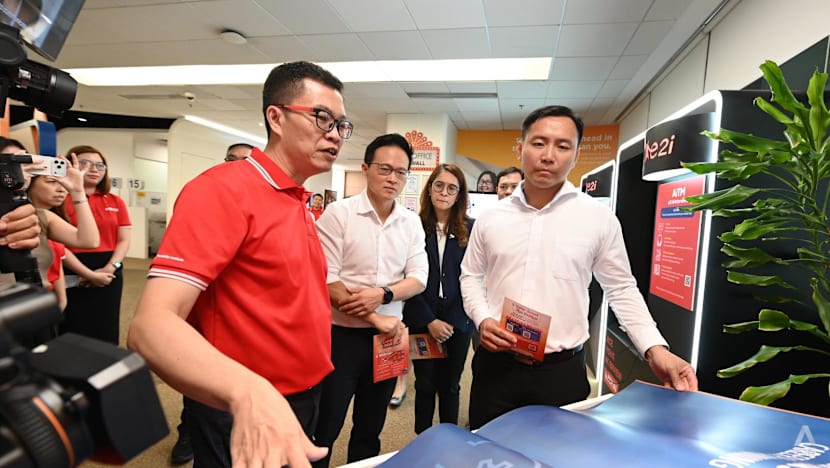
Minister of State for Home Affairs Goh Pei Ming and NTUC deputy secretary-general Desmond Choo at NTUC's e2i centre on Feb 9, 2026. (Photo: CNA/Justin Tan)

This audio is generated by an AI tool.


SINGAPORE: An Economic Strategy Review committee tasked with exploring ways to manage the impact of restructuring is looking to "intensify" career conversion programmes in order to save jobs.
This would involve working with companies that have business changes planned, to proactively upgrade the skills of their employees before they retrench any workers, said committee co-chair Desmond Choo on Monday (Feb 9).
"I think that can help people from falling out of the workforce," he told reporters.
The committee is co-chaired by Mr Choo, who is also Minister of State for Defence and deputy secretary-general of the National Trades Union Congress (NTUC); and Mr Goh Pei Ming, who is Minister of State for Home Affairs and Social and Family Development.
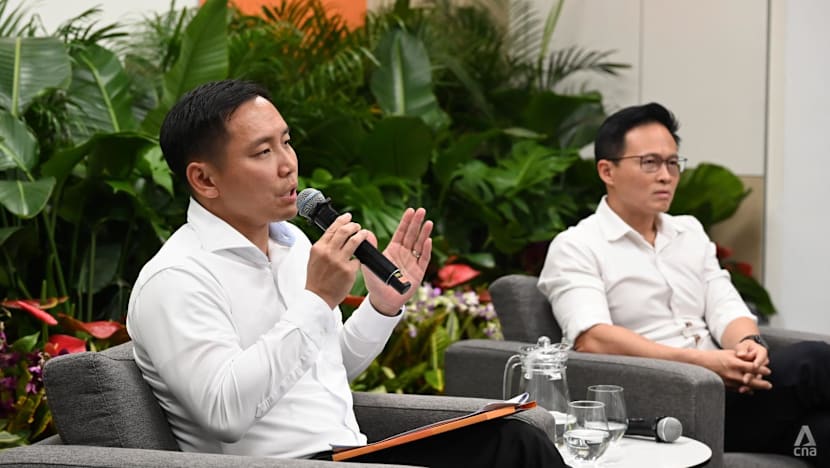
They were giving a midterm update on the work of the committee, which is one of five committees charting an economic blueprint for Singapore.
The committees announced seven key recommendations in January, after gathering feedback from businesses and workers.
Mr Choo said that career conversion programmes, which are administered by Workforce Singapore, have shown very good results in the past years.
"We can double down on some of this work, working closely with (trade associations and chambers) and companies to identify more opportunities for career conversion programmes," he told reporters.
The committee is also looking at "career bridges" as a solution to the "resistance and inertia" that workers may feel towards acquiring new skills and changing industries, said Mr Choo.
Career bridges assume that "not all your skills are irrelevant" and that workers might already have a significant percentage of the skills required for another role, he added.
Mr Choo said this would involve building a bridge for workers in industries that are more impacted by artificial intelligence, such as administrative work, to move to more resilient sectors that offer other career trajectories, like healthcare.


RETRENCHMENTS ARE "INEVITABLE"
The co-chairs also addressed how to better support retrenched workers. Mr Choo noted that retrenchment is "part of normal economic change" and inevitable when companies restructure.
He said there was scope to work with the tripartite partners to bring mandatory retrenchment notifications earlier, so that affected workers can receive support faster and earlier.
Currently, companies with at least 10 employees must notify the Ministry of Manpower if they retrench an employee within five working days after the employee is informed.
Earlier on Monday, NTUC said that at the Budget debates, labour chief Ng Chee Meng will call for mandatory advance retrenchment notifications.
"Our workers should know over time, that even though there will be variances, up and down structural changes, you'll always be taken care of," said Mr Choo.
He also stressed the importance of supporting workers' career health.
"When a person is deeply involved in the job and working just to make sure they fulfil the job requirements, oftentimes they neglect the skills upgrade," he said.
"We want to make sure that we strengthen our career health, making sure that every worker has a chance to be able to go through (a) diagnosis of their current status and what they need to improve."
NO SUNSET INDUSTRIES
On the committee's suggestions for businesses, Mr Goh described three archetypes of companies that they hope to support through restructuring.
The first type of company seeks to grow, such as by venturing deeper and becoming more specialised, by taking advantage of technology, or by repositioning its product across bigger markets.
The second type of company may be open to reviewing its business approach and to consolidate to its more core and profitable sectors.
"There are no sunset industries here, but factors will change. Factors such as market sentiments, demand shifts or even technology may render some parts of their business offering less relevant," he said.
"From time to time, companies will need to make this assessment in terms of what aspects they continue to invest on, they continue to place emphasis, and what are the parts they want to step back from."
Mr Goh said that such businesses have expressed the need for support through these transitions, and that the committee will "lean forward" to explore how they can get more guidance.
The third type of company is open to exploring overseas expansion.
Mr Goh said that the committee is looking at a range of solutions that include enhancing support schemes for companies to embrace technology and facilitate regional expansion.
The committee is also looking at connecting them with partners for business transition, and providing advisory and consultation on business health and to share broader industry trajectories.





