







Singapore attracted S$14.2 billion of investments in 2025; about 15,700 new jobs expected in next five years: EDB
The expected number of jobs created is the lowest in at least 20 years amid a more cautious business outlook and growing automation.
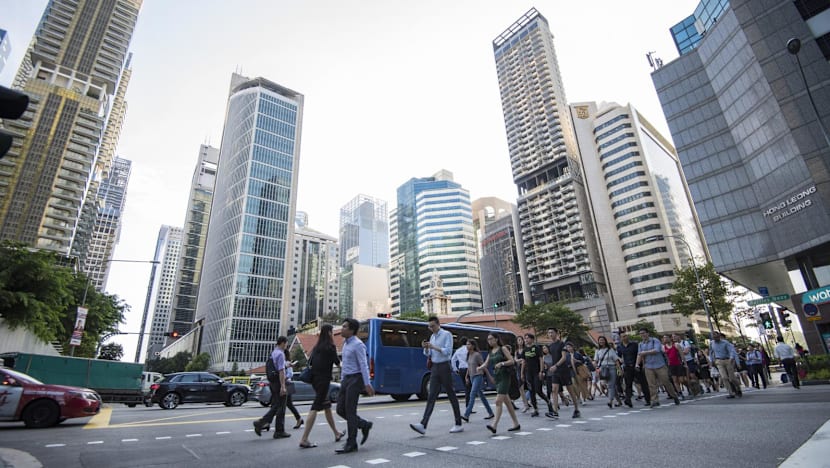
Office workers in the central business district of Singapore. (File photo: iStock)

This audio is generated by an AI tool.


SINGAPORE: Singapore attracted S$14.2 billion (US$11.1 billion) of investments in 2025, creating an expected 15,700 jobs over the next five years, the Economic Development Board (EDB) said on Monday (Feb 9).
The S$14.2 billion fixed asset investment, which refers to spending on long-term assets such as facilities, equipment, and machinery, is a slight increase from the S$13.5 billion investment in 2024.
Total business expenditure, which refers to companies’ incremental operating costs including wages and rent, edged up to S$8.9 billion in 2025 from S$8.4 billion the year before.
The investment commitments are on par with recent years, despite a volatile global environment, EDB said in its annual year-in-review report.





In 2025, companies had to grapple with multiple uncertainties, from the implementation of the global minimum effective tax rate, to US President Donald Trump’s “Liberation Day” and tariffs, said EDB chairman Png Cheong Boon.
“Fortunately, Singapore remains a top-of-mind destination for business leaders. This is because of our excellent track record of being a stable, reliable, connected and trusted location. As well as our consistent and pro-business policies and good infrastructure,” he said.


EXPECTED JOBS CREATED
The results from 2025 show that investment commitments are not expected to translate into the same level of value added or new jobs created, Mr Png said.
Job creation refers to the number of new jobs tied to the investment when it is fully realised, and value added measures the direct contribution a company makes to Singapore’s gross domestic product, excluding multiplier effects.
The expected 15,700 new jobs created over the next five years is the lowest since at least 2005, based on the earliest available data.
In 2024, about 18,700 new jobs were expected to be created over five years.
The drop in expected job creation comes amid a more cautious outlook and the growing use of automation and artificial intelligence in business operations, Mr Png said.
“Nevertheless, the percentage of good jobs to be created from investments secured in 2025 remains high,” he added.
“Over two-thirds of the new jobs committed are expected to have a gross monthly salary above S$5,000.
“These will create opportunities for both fresh graduates and mid-career hires. They will offer meaningful career pathways for our workers, especially those who have the necessary expertise and have done well; they will also offer opportunities to learn new skills and to take on new roles.”
The job creations are in services (40 per cent), manufacturing (37 per cent), and research and development and innovation (23 per cent). The majority of these roles are professional, manager, executive and technician (PMET) roles, EDB said.
Managing director of EDB Jermaine Loy added that as industries transform, they are increasingly seeing job roles evolve.
“More than ever, they require strong digital capabilities, and some require new and specialised skillsets,” he said.
In 2025, investments were expected to value-add S$18 billion – a decrease from S$23.5 billion in 2024.
The lower figure is the result of companies’ cautious business outlook that moderated their demand projections, and revenue and profit forecasts, Mr Png said.

INVESTMENTS IN MANUFACTURING
By industry, electronics and biomedical manufacturing were the top two sources of investments committed last year, accounting for 33 per cent and 30.8 per cent respectively.
This is a different picture from 2024, when investments in electronics dominated at 57 per cent.
Of the S$14.2 billion fixed asset investment commitment in 2025, about S$12.1 billion came from manufacturing-related projects, EDB said.
Mr Loy said this reflects Singapore’s continued strengths as a hub for advanced manufacturing.
“We also saw strong global demand for AI-related activities – chips, servers, server-related products – and these were all key drivers of investments in the semiconductor industry,” he added.
“At the same time, we also saw biomedical manufacturers investing to meet demand for high-value biopharma and medtech products, and chemical manufacturers investing in specialty chemicals and sustainable materials.”
In terms of total business expenditure commitments, the majority came from investments in headquarters, professional services and R&D.
Similar to last year, tech companies were the largest contributor to HQ investments, reflecting a strong demand for digital solutions and services in the region, Mr Loy said.
“And we also saw many companies investing in R&D through new centres of excellence, and by locating their product roadmaps and commercialisation functions here in Singapore,” he said.
Additionally, EDB made further progress in growth areas such as AI, precision medicine, green and bio-based economy and next-generation hardware and mobility.
EDB secured new projects in data centre hardware and infrastructure, and nascent areas like quantum hardware-related testing.
In mobility, new projects in autonomous vehicles and electrification technologies created new jobs in automation, software, and hardware development.
Precision medicine is an approach that uses molecular and health data to enable more accurate and personalised healthcare treatment.
The sector is emerging as a growth area for Singapore, as rising healthcare needs and wellness trends are increasing demand for data-driven equipment, Mr Loy said.

CHINA’S GROWING SHARE
By region, the bulk of fixed asset investment commitments came from Europe, China and the US.
The US’ investment commitment fell sharply from 55.5 per cent in 2024 to 17.3 per cent in 2025, while China’s share grew from 2.5 per cent to 20.6 per cent in the same period.
This is the first time that China has recorded a higher fixed asset investment commitment than the US.
In terms of total business expenditure commitments, China emerged with the largest share of the pie at 50.7 per cent, compared with 15 per cent in 2024.
“Singapore has always been an open economy. Foreign companies with substantive business activities are welcome to set up here as long as they abide by our laws and regulations,” Mr Png said.
Many Chinese companies are seeking to expand internationally in response to slower growth domestically. Over the last few years, China-headquartered companies from a range of sectors have expanded their footprint in Singapore, he added.
Some examples include e-commerce and games brands such as Bytedance and Mihoyo.
Singapore has a “good track record” of hosting multinational corporations from the US, Europe, Japan, India, China, and other Southeast Asian countries, he said.
“We continue to look towards the US and Europe to be key sources of investment commitments in terms of stock and flow,” he added.
Mr Png said that MNCs in 2025 generally adopted a “wait-and-see” approach to figure out how to respond to the evolving geopolitical environment.
“This year, business leaders have told us that while they expect volatility and uncertainties to remain, with the global economy remaining fragmented, they are ready to make calculated moves to grow or transform,” he added.


OUTLOOK AND PRIORITIES
Mr Png noted that more global businesses are looking outside traditional markets and operating bases for growth opportunities and stronger supply chain resilience.
Southeast Asia, in particular, has shown “brighter growth prospects”, and Singapore is “well positioned” to support companies that want to expand into the region, he added.
But the EDB chairman said that Singapore should be “clear-eyed” that they are operating in a different context from before.
Looking ahead, EDB said it expects continued intense global competition for investments. With structural shifts to the global business landscape, job creation will become more challenging.
To create the same number of jobs, EDB will have to bring in even more new projects, Mr Png said. This means engaging more companies across more sectors and regions, and of different company sizes and growth stages.
“To remain competitive and secure more investments, we must double down on sectors where Singapore has built-up strong capabilities, established global leadership positions and therefore has a competitive advantage,” he said.
He gave the example of Singapore’s aerospace sector, one of the country’s strongest growth sectors.
“We have built up a sizeable aerospace maintenance, repair and overhaul industry over the years, with global leadership position in aircraft engine component repairs,” he added.
In its report, the EDB also highlighted areas to work on, in line with the focus of the Economic Strategy Review Committee.
This includes strengthening Singapore’s leadership in growth sectors, such as AI, to position Singapore as a leading AI hub and an AI-empowered economy.
The EDB will also pursue emerging opportunities to create new growth engines, as well as identify, attract and anchor high-growth companies with potential to become future industry leaders.
“We will also continue our partnerships with companies to train and upskill our local workforce to ensure they have a strong talent pipeline with future-ready skills to fuel future growth,” Mr Png said.





