







60-storey flats in first BTO project at Pearl's Hill in over 40 years, as government intensifies land use
A new Build-to-Order project will also be launched next to Caldecott MRT station in October.
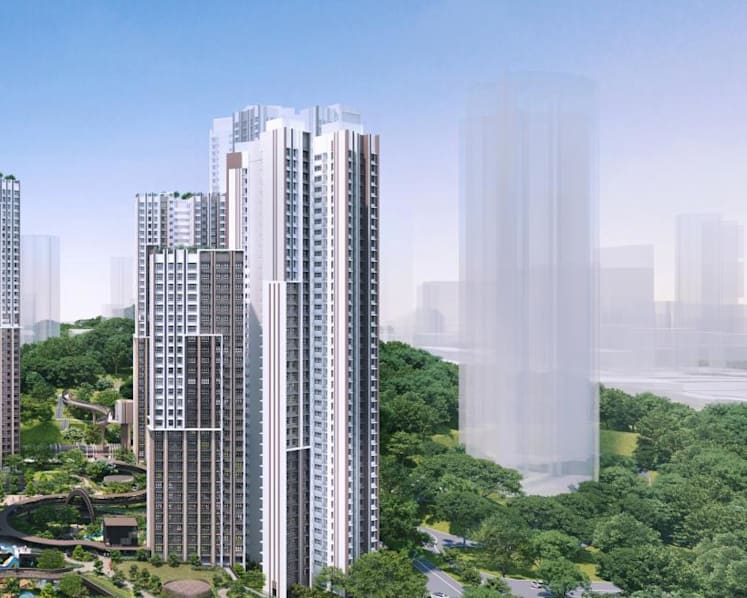
An artist's impression of the BTO project in Pearl's Hill. (Image: Ministry of National Development, Housing and Development Board)

This audio is generated by an AI tool.


SINGAPORE: Singapore’s tallest public housing project will be launched at Pearl’s Hill within the next few years, marking the first Build-to-Order (BTO) project in the area in over four decades.
The new project was announced by National Development Minister Chee Hong Tat in parliament on Wednesday (Mar 4) during the debate on his ministry's spending plans.
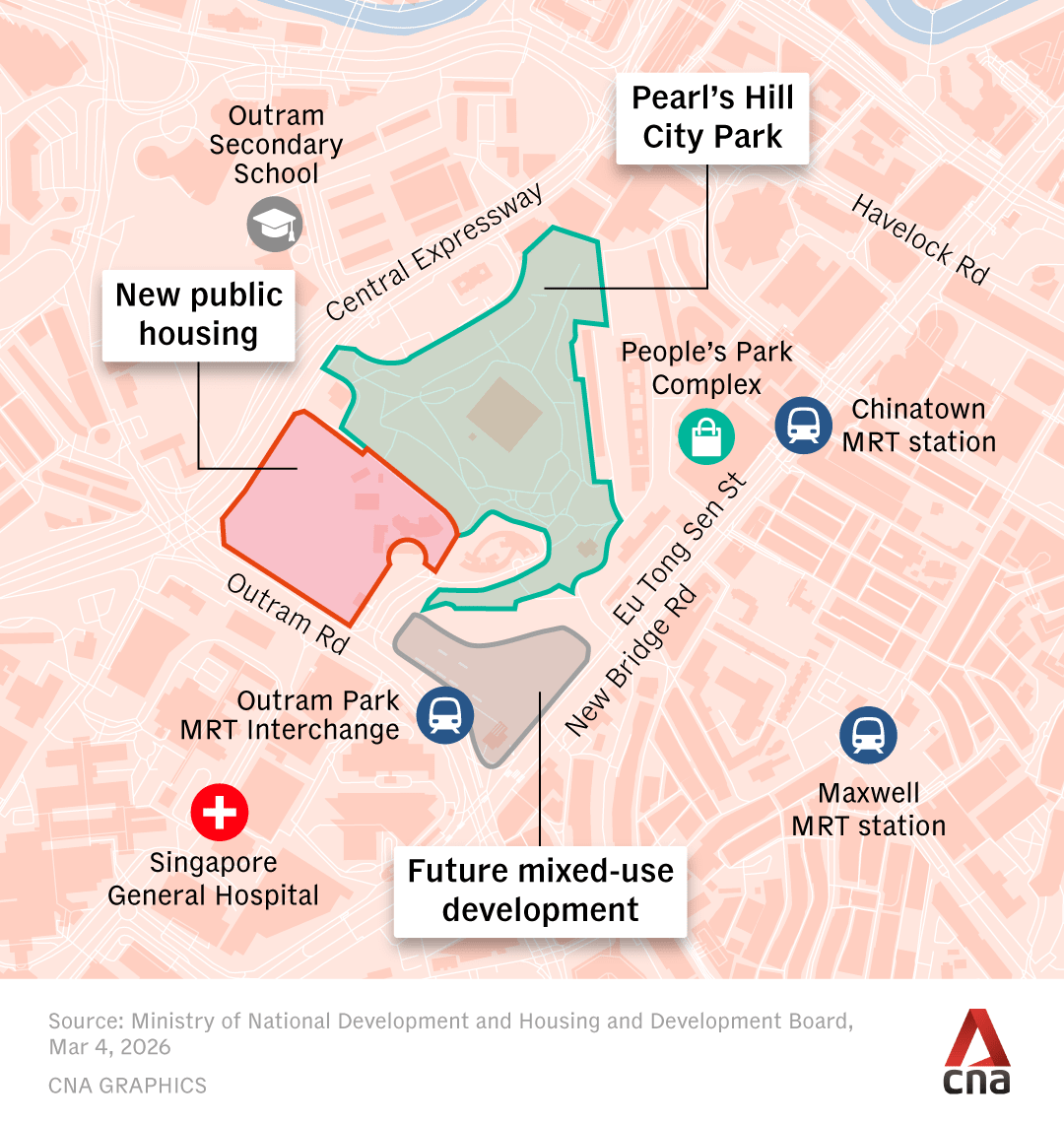
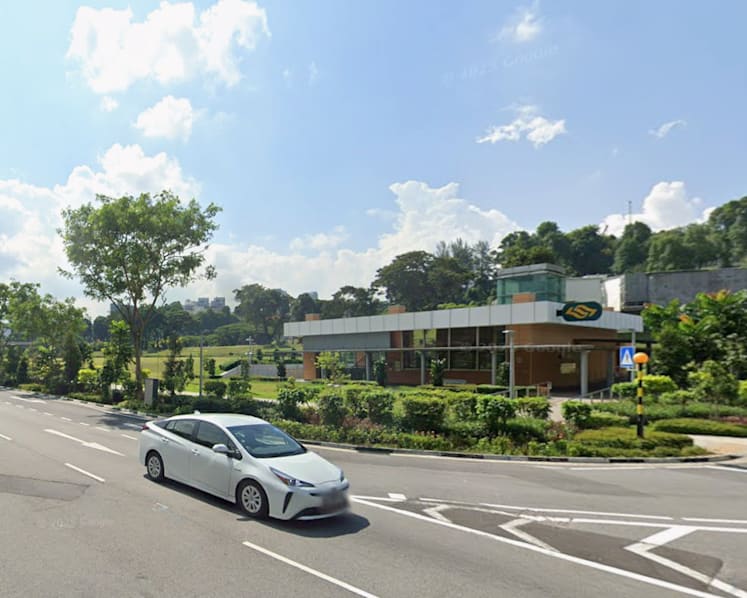
The Housing and Development Board (HDB) flats will sit on the site of the former Outram Park Complex, at the base of Pearl’s Hill City Park. It will be next to Outram Park MRT station.
The project will comprise about 1,700 two-room flexi, three-room and four-room flats, as well as over 140 public rental flats, HDB and the Ministry of National Development (MND) said in a joint release.





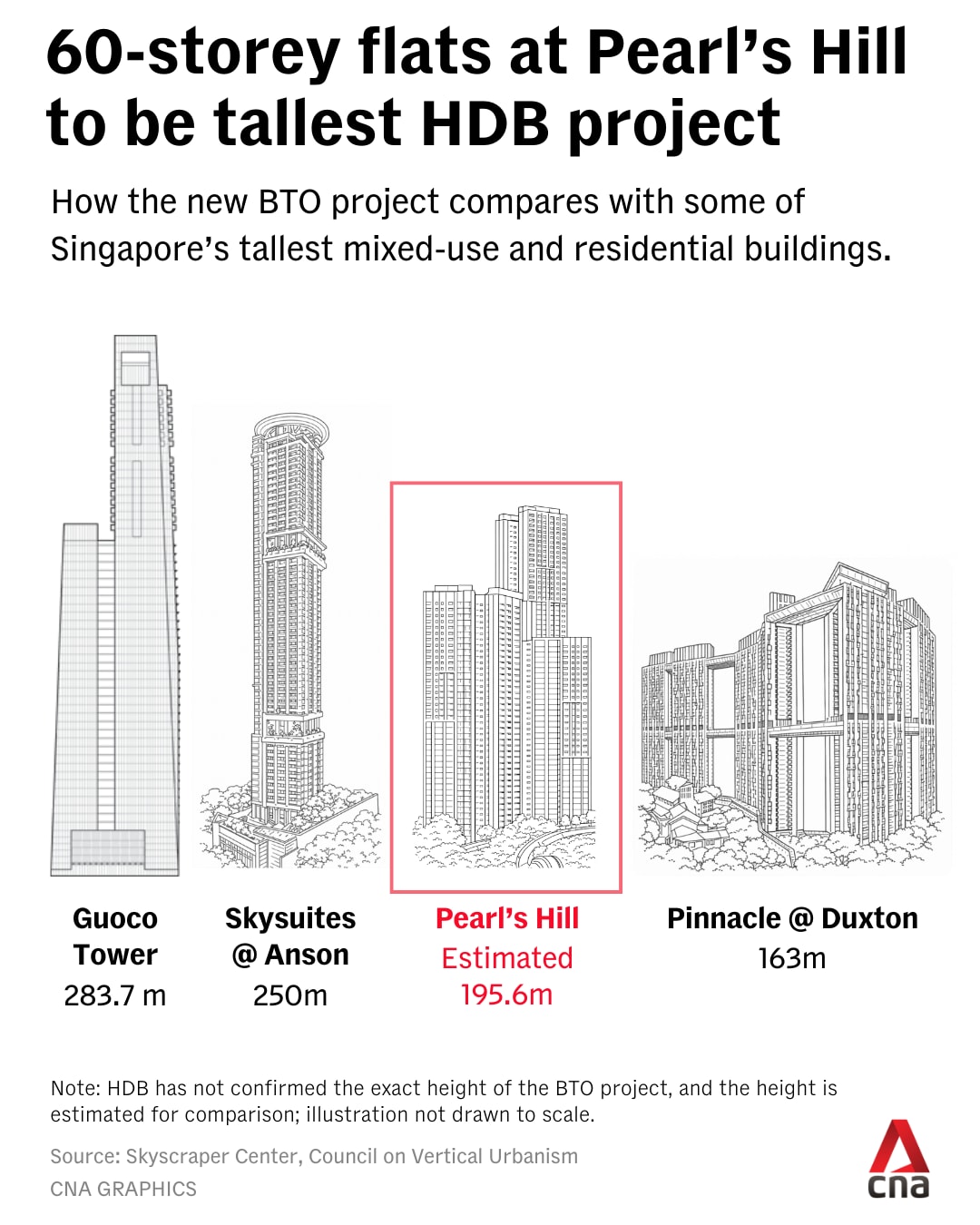
At over 60 storeys, the development will be Singapore’s tallest housing project. The blocks will be of varying heights, said Mr Chee.
To date, the Pinnacle@Duxton is the tallest HDB project at 50 storeys.
“This is part of our efforts to find ways to build more public housing, by intensifying land usage and building taller where possible,” Mr Chee said.
He added that a 60-storey block can provide 50 per cent more flats compared to a 40-storey block, the height of most of the tallest HDB blocks today.
In response to CNA’s queries, HDB said it is able to build taller blocks in the Pearl’s Hill area as there are less stringent height limits there.
The agency added that it will consider building higher, where site conditions permit, to optimise the use of limited land.
Mr Chee said: “We will proceed carefully and sensitively, building taller only when conditions allow. We will also pay close attention to design and liveability.”
In response to Member of Parliament (MP) Ang Wei Neng’s question on which HDB towns could realistically support such high-rise developments, Mr Chee said that, besides Pearl’s Hill, it is too early to pinpoint other towns.
He reiterated that the authorities would like to do so where possible.
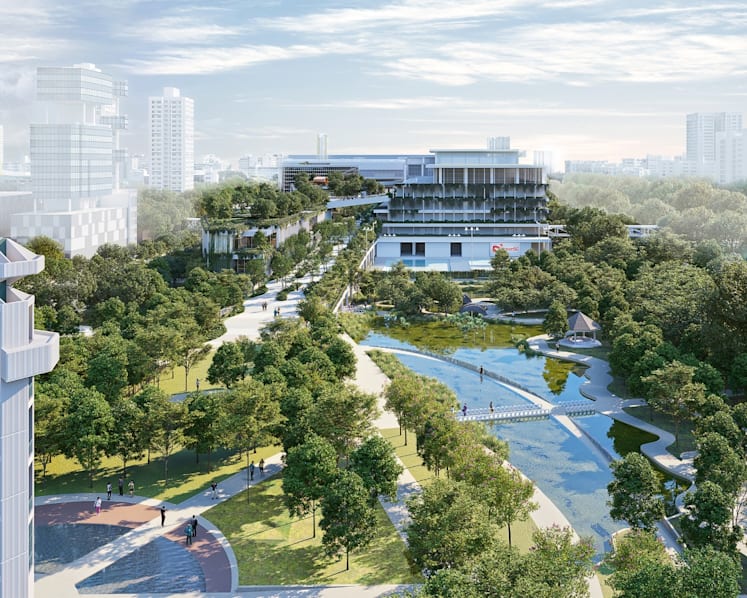
The new BTO project will draw inspiration from the nearby Chinatown heritage and will incorporate green and landscaped spaces in its design, HDB and MND said.
Residents will also benefit from enhanced connectivity to existing green spaces, as the development will connect Pearl’s Hill City Park to Outram Park MRT, the authorities added.
The Urban Redevelopment Authority (URA) first announced in November 2023 that 6,000 homes would be progressively built in Pearl’s Hill over 10 years.
The new homes will comprise a mix of BTO flats, rental flats, and private homes, URA said then.
Future residents can look forward to a variety of amenities within a proposed mixed-use development to be integrated with Outram Park MRT Station and around the neighbourhood to meet their daily needs, the authority said at the time.
More details of the BTO project in Pearl’s Hill will be announced when it is launched within the next few years, HDB said.
DEVELOPMENTS IN TOA PAYOH WEST
In his speech, Mr Chee also announced the launch of a new BTO project in Toa Payoh West, which will be part of the October sales exercise.
Located next to Caldecott MRT, the project will comprise about 1,600 units across five blocks. It will include 590 two-room flexi flats, 580 four-room flats, and about 230 public rental flats.
There will also be 240 Community Care Apartments for seniors – a first for Toa Payoh – and an Active Ageing Centre.
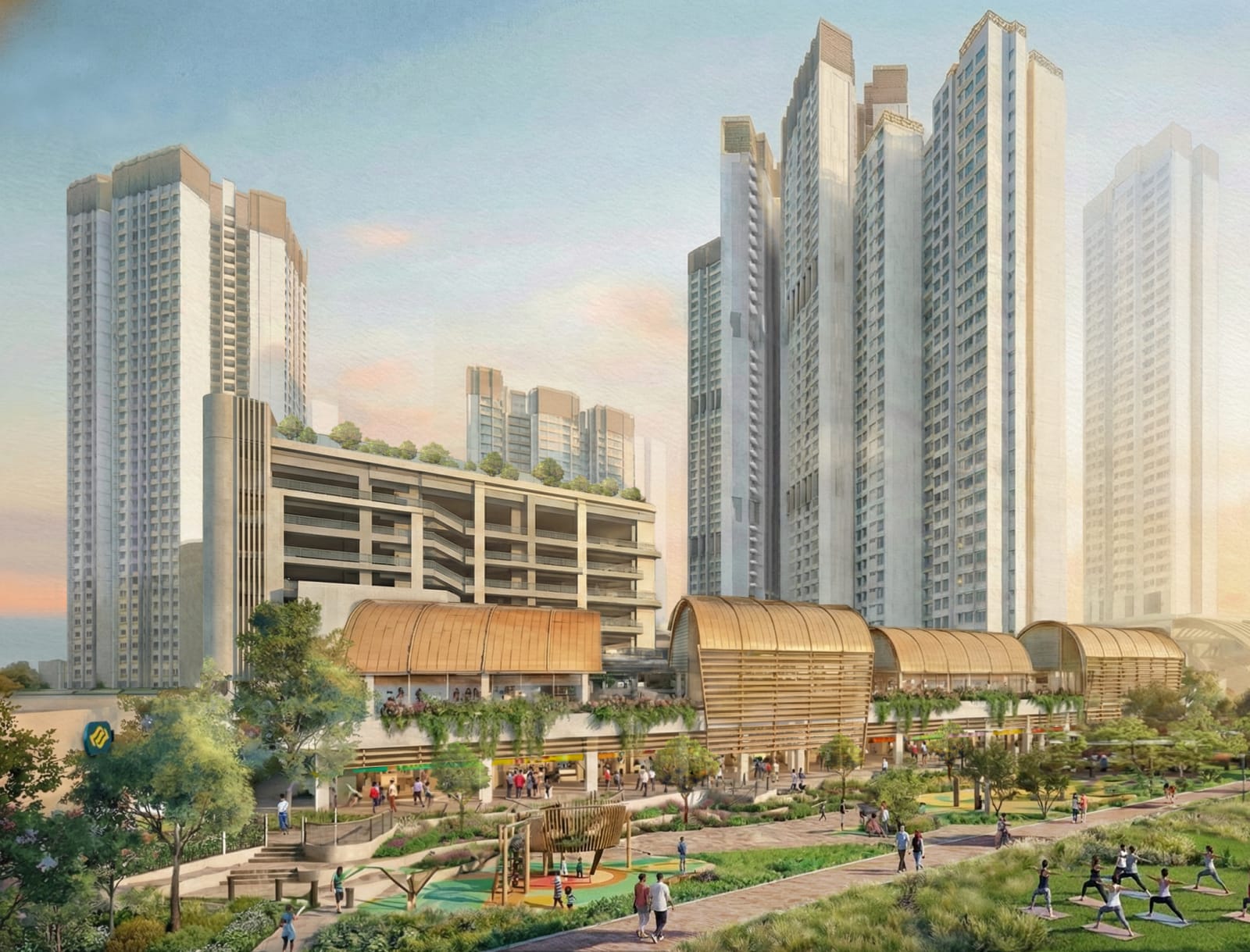
Other amenities include a food court, fast food restaurant, supermarket, childcare centres and shops, HDB and MND said.
MND and HDB said in a media release that the project will feature a “distinctive terracing skyline” that reflects its hillside character.
The authorities will also develop a new 1.1ha neighbourhood park fronting the project.
More details, including the BTO project classification, will be announced during the October sales exercise.
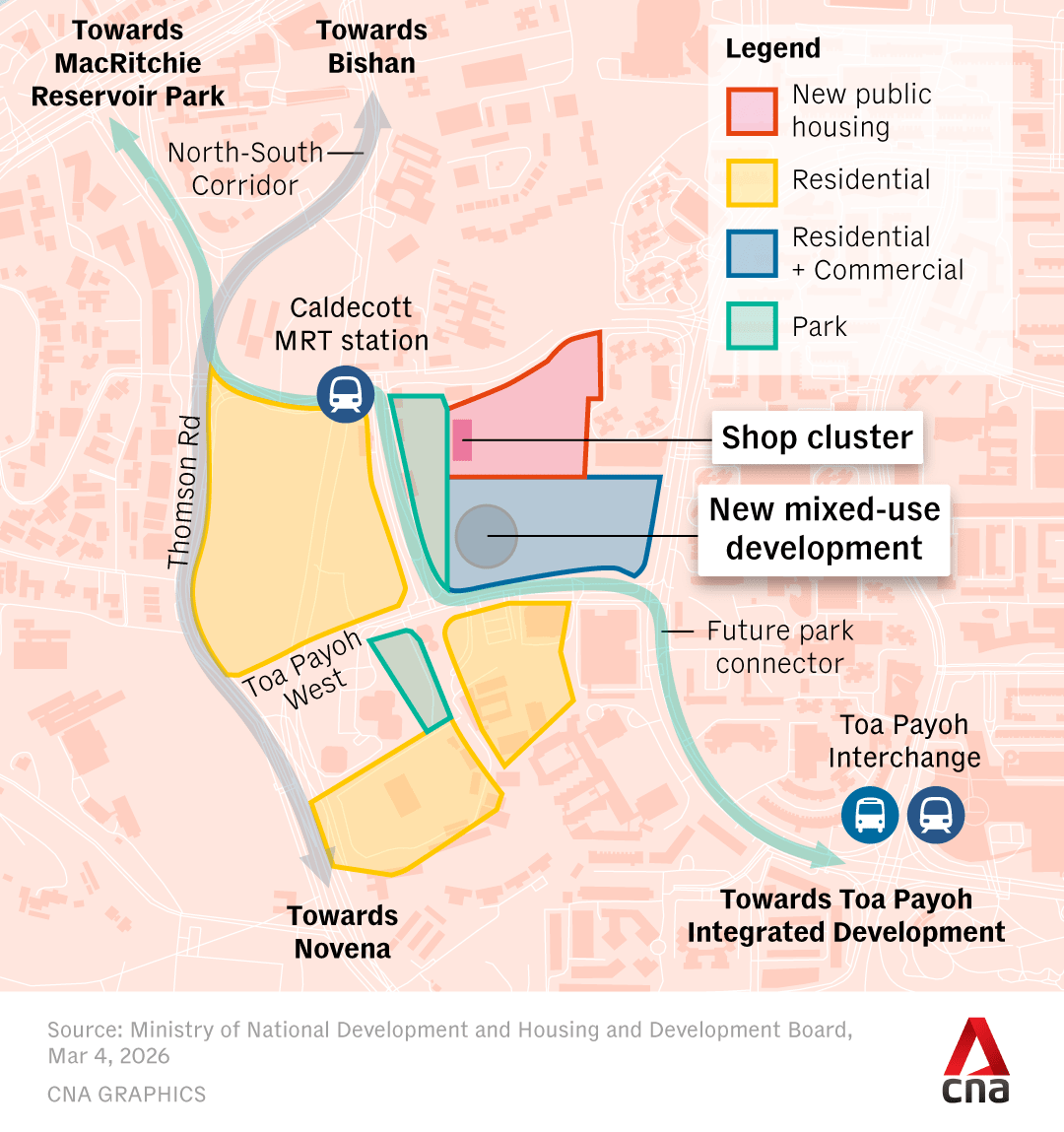
Plans are also underway for a new mixed-use development in the area that includes private residential units and a shopping centre.
The shopping centre will provide residents with retail and dining options, and will be similar in scale to Woodleigh Mall in Bidadari, Mr Chee said.
In response to CNA’s queries, HDB said the mixed-use development is part of the new commercial node around Caldecott MRT station.
It will be implemented in phases and not in tandem with the upcoming Toa Payoh West BTO launch.
“This will ensure that infrastructure improvements in the area, including road enhancements and utility upgrades, are in place to adequately support the upcoming developments,” HDB added.
As residents move in a few years later, other major developments in the vicinity will be completed, Mr Chee said.
This includes the North-South Corridor underground works, which will strengthen connections between Toa Payoh West and its surrounding areas, and wider footpaths across Thomson Road and Lornie Road.
Residents will also be able to access the rest of Toa Payoh, including the upcoming Toa Payoh Integrated Development, a sports and lifestyle hub that is expected to be completed by 2030, he added.
Mr Chee said that more than 10,000 additional homes will be launched across Toa Payoh West and Mount Pleasant over the next decade.
These will mostly be public housing, as well as some condominiums, including mixed-used developments, he added.
“In Toa Payoh West, these homes will be integrated into the lush, hilly terrain, some with views of MacRitchie Reservoir,” he said.
In his speech, Mr Chee also reiterated that the ministry is looking at increasing the BTO income ceiling and lowering the eligibility age for singles to buy HDB flats.
“But to do more for our singles and also for other groups of flat buyers, HDB will need to build more flats to ensure supply is adequate to meet higher demand,” he said.
Workers’ Party chief Pritam Singh had asked if HDB would consider allowing first-timer couples who exceed the income eligibility threshold to have the option of purchasing a BTO flat.
These buyers could face additional restrictions, such as requiring an age cap of either spouse or a longer minimum occupation period, he said.
The current income ceiling to buy an HDB flat is S$14,000 for families. Mr Chee noted that this covers around eight in 10 Singaporean households.
Mr Chee said removing the income ceiling would have trade-offs, as there would be additional competition. He said this was something that the government would need to study carefully.
"In order to ensure that we are able to meet this higher demand, supply is key. And that's why I hope to have the support of all members of this House that we have to build more and build faster," he added.
On the Voluntary Early Redevelopment Scheme (VERS), Mr Chee said that the plan is to start with a few sites in the first half of the next decade, before scaling up the programme from the late 2030s.
He added that the government will aim to “flesh out” as much of the VERS policy framework as possible in this term of the government, and will engage Singaporeans to take in feedback before the policy is firmed up.
He added that flat owners can look forward to a second round of upgrading works via the Home Improvement Programme II (HIP II) when their flats reach the 60 to 70-year mark.
HIP II will be more extensive and make use of new technologies like microwave scanning, which helps detect and trace sources of water seepage in more complex cases.
On resale flats, Mr Chee noted that as at mid-February, HDB resale prices for 2026 have shown a slight decline of 0.1 per cent.
HDB flat resale prices rose by 2.9 per cent in 2025, compared with 9.7 per cent in 2024, marking the slowest price growth since 2019.
Mr Chee said this follows the "strong pipeline of BTO flats" and cooling measures rolled out over the last few years.
"We are watching the market closely, and stand ready to adjust our measures, bearing in mind that more flats will reach their MOP (minimum occupation period) in the next few years, thereby increasing the supply of resale flats," he said.
Over the last few years, the application rates for singles and seniors for two-room flexi flats were higher. The minister announced that the government will increase the two-room flexi supply by almost 50 per cent from 2026 to 2028 to meet this growing demand.
PRIORITY FOR LARGER FAMILIES
In addition, HDB will increase the allocation quota under the Third Child Priority Scheme (TCPS) from the June 2026 BTO exercise, Senior Minister of State for National Development Sun Xueling said in parliament.
Under the scheme, eligible families with three or more children receive priority flat allocation.
Currently, up to 5 per cent of flats offered in BTO and Sale of Balance (SBF) exercises are set aside for eligible first- and second-timer families.
From June, the allocation quota will be increased to up to 10 per cent.
The eligibility criteria will also be expanded to allow families to apply for a flat under the scheme from the time the mother is expecting her third child, Ms Sun said.
HDB and MND said over 2,800 BTO applicants benefited from the scheme from 2020 to 2024.
“Furthermore, to support larger families, we will work towards increasing the supply of bigger flats in the longer term. This is part of our strategy to sustain a robust supply of HDB flats,” Ms Sun said.
On housing support for vulnerable households, Senior Parliamentary Secretary for National Development Syed Harun noted that in 2025, more than 2,000 existing rental households have booked a flat and are awaiting completion.
While most rental households are families, about 40 per cent are singles, he noted.
The authorities have received positive feedback from the Single Room Shared Facilities (SRSF) pilot and the Joint Singles Scheme Operator Run (JSS-OR), he said.
Both typologies will be scaled up in the coming years, and more details will be shared when ready, he said.




