







IN FOCUS: 1 in 3 new lawyers want out – can the industry fix the burnout before it’s too late?
After the Chief Justice's wake-up call about the attrition of junior lawyers, CNA talks to young associates about the difficulties of sustaining a legal career.
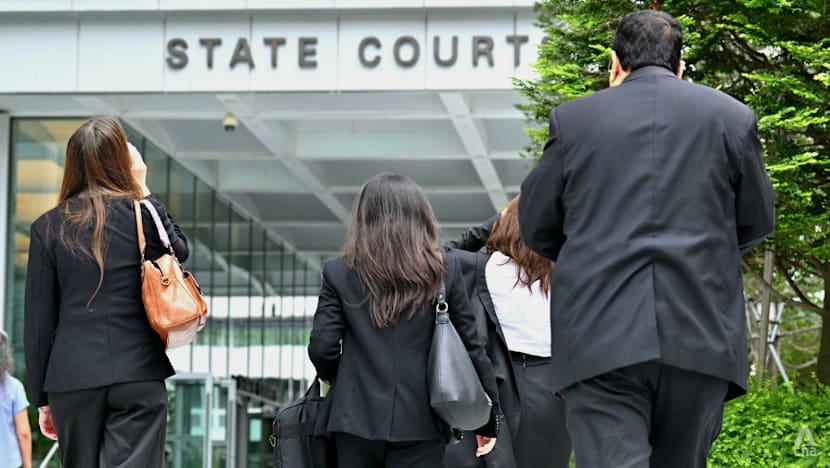
Lawyers outside the State Courts of Singapore on May 12, 2026. (Photo: CNA/Raydza Rahman)

This audio is generated by an AI tool.


SINGAPORE: In her second year on the job, lawyer Johanna suffered her first panic attack when the stress from work became too much to bear.
“I thought my life was over,” the now 30-year-old, who asked not to use her real name in order to be candid about her former work environment, told CNA.
She would come home from work crying after dealing with a particularly unreasonable client she had at the time, while handling multiple files on her own with no help.
This happened because without Johanna’s consent, managers and support staff at her firm had openly discussed her salary – which was pegged to her previous income at a larger, more prestigious law firm.





After the seniors at her new firm found out her junior associate pay was close to their own, she said she faced a situation where they were unwilling to give her mentoring guidance.
“I sometimes had very basic questions, like I’ve never been to court before, what am I supposed to say? Do I say ‘good morning, Your Honour’? Am I supposed to introduce my opposing counsel? These are questions you can’t find in any textbook,” she said.
But her seniors offered only minimal help, and even then, reluctantly.
Johanna was hospitalised after the panic attack. She received counselling and started looking for another job as a way out of the legal industry.
Only a timely interview set up by a legal recruiter, which led to an offer in another firm, kept her in the industry. She is now a mid-level associate, paying it forward by mentoring trainees and juniors herself.
While Johanna came back from the brink, other junior lawyers are poised to leave the profession, according to a survey cited by Chief Justice Sundaresh Menon at this year’s mass call in April.
One in three new lawyers said they were likely to leave law in the next three years. The key reasons they cited were excessive workload, poor workplace culture and a lack of mentorship, according to the Chief Justice.
The issue of lawyer attrition has been present for some time now, with the late Law Society of Singapore president Adrian Tan warning in 2022 – amid the “great resignation” during the COVID-19 pandemic – of large numbers of new lawyers leaving the industry.

With the recent wake-up call from Chief Justice Menon, members of the legal fraternity warned that, if left unchecked, the departures of young lawyers could spell trouble not just for the profession but for society as a whole.
“This may price lawyers beyond the man on the street and it becomes an access to justice issue,” said Mr Thio Shen Yi, joint managing partner of TSMP Law Corporation, who has noticed higher attrition among younger lawyers.
“So building a pro bono culture into our collective DNA is critical,” added the board member of Pro Bono SG and former Law Society president.
High attrition could mean the “hollowing out” of well-trained legal professionals. Another consequence may be the decline of competence and professional standards in the justice system and in legal transactions, said Mr Ronald JJ Wong, deputy managing director of Covenant Chambers.
Replying to CNA’s queries on its response to the reportedly high attrition of young lawyers, the Ministry of Law referred to a May 6 parliamentary reply by Law Minister Edwin Tong.
In the reply, Mr Tong said the survey cited by the Chief Justice was a poll of 289 newly qualified lawyers about their future career plans, of which one of the options was leaving the legal profession entirely.
A total of 85 respondents chose that as one of their options – among others like going in-house or into academia – but only eight of them selected it as their sole option, he said.
Mr Tong said that lawyer attrition has “remained stable” in the last decade. Between 2015 and 2024, about six in 10 lawyers were still practising in law firms after five years, and four in 10 after 10 years.
Over the same period, the number of Singapore lawyers in practice grew by 26 per cent, while the number of locally qualified in-house counsel more than doubled.
As of 2025, there were 6,434 private practitioners in Singapore, according to the Law Society’s data.
“Lawyers leave the profession for a variety of reasons, not all of which can be addressed systemically. We will consider the sustainability of legal practice, particularly through the lens of the young legal practitioner,” said Mr Tong.
For now, the number of new lawyers who qualify to practise law each year has been largely stable, with 569 admitted to the Bar from September 2022 to August 2023, and 593 from September 2023 to August 2024.
Between January and November 2025, 155 applicants were admitted to the Bar. This was after the duration of the practice traineeship that aspiring lawyers must pass was doubled to 12 months from 2025.
“SHE WAS ANSWERING CALLS IN THE HOSPITAL BED”
To highlight the attrition issue, Chief Justice Menon said in 2024 that most junior lawyers intending to leave the profession appeared to be motivated by “push” rather than “pull” factors.
On top of this, there are also fresh anxieties about the impact of artificial intelligence on the job prospects of fresh law graduates and junior lawyers.

Speaking to CNA, junior lawyers described a culture where working on weekends, on holiday and even through medical events is still the norm.
Johanna recalled what she learnt as a trainee: “One of the partners told us that she was working until the point that she went into labour, and that is how it should be … She was answering calls while she was in the hospital bed.”
She also brought up the commercial realities of practising law, with firms setting billing targets that are pegged to three times of a lawyer’s salary.
What made it harder to meet this target was the fact that partners would assign pro bono files to the junior associates, as well as offer goodwill discounts to paying clients.
“Save for when I am literally in the middle of drafting submissions for court, it is always at the front of my mind,” she said of these business pressures.
While every profession has its pressures, these young lawyers point to a generational divide in how they weigh the demands of the job against its rewards. For them, the traditional trade-off no longer adds up.
One 28-year-old lawyer left in his second year of practice to become a consultant at a legal startup and is now waiting to start an in-house position in another company.
“People left very quickly because there was a lack of progression, they were dissatisfied, the work is difficult, hours are long,” he said of one of his former law firms.
Late nights at work were “like a bad dream”. On one occasion in 2025, he found himself alone in the office at 10.30pm, manually indexing a bundle of documents for court while sweaty, tired and hungry.
“What am I doing with my life?” was the thought that ran through his head.
“It sounds very silly, because I had a very high-paying job. It was the most money I was earning my whole life,” said the 28-year-old, adding that many junior lawyers would “kill” to have been in his position.
But he felt “wretched” and like he had made the wrong choice. It became the turning point for him to leave practice.
“You just think, I have sacrificed so much to get here, and now I am holding this poisoned chalice, and I don’t want to drink from it anymore,” he said.
He added that he felt a disconnect between the daily grind and his desire to contribute to something greater.
“My main motivating factor was to gain experience, but I had neglected all of the other things that make a job something that you want to do,” he said. “So for example, do you find the work interesting? Do you feel that you are contributing?
“When I was working in a law firm, I was contributing to nothing bigger than my clients’ bottom lines,” he said.

He acknowledged that things felt this way because even though practising law is a “sacred calling” for some lawyers, it was not for him.
“When your expectations don’t match with your reality, that is when the frustration sets in … and I wish that those more senior would understand this, but I don’t know how many of them really do,” he said.
Another junior associate in a major law firm similarly saw a gap between how she and her seniors set boundaries around lawyering.
“My mindset, as with many Gen Zs, is that work is work. Maybe to some people, or maybe to the seniors, they say it’s a profession, it’s a calling. But for me, it is just a job,” said the 25-year-old, who asked not to be named as she still works at her firm.
“And my job is for me to be able to fund the lifestyle that I want, because I’m here exchanging my skills for my salary.”
She felt “really bitter” about working after hours, and said it felt like her seniors were disrespecting her time because often, the work was not actually urgent, but they simply had not got to it earlier.
“It also really depends on the bosses, how respectful they are of your time and how they manage their own timelines,” she said. “They do have the power to make the call to the clients and adjust timelines, or not just say okay to unreasonable timelines.”
DRAWN TO ALTERNATIVES
One undeniable draw of the profession is the substantial starting pay for junior lawyers.
In a 2025 Manpower Ministry survey of recent university graduates, law was one of only two fields where new hires made more than they expected.
Law graduates aged 22 to 28 earned a median salary of S$7,500 against an expected salary of S$6,500.
This was the highest median salary in the survey – which included fields like information technology, engineering and business, but not some others like medicine.
Education was the only other profession where the median salary exceeded the expectations of graduates in the field.
Having in-demand skills also means young lawyers can be drawn out of private practice to good opportunities elsewhere.
Mr Thio, the former Law Society president, pointed out that some young lawyers leave local practice because they have great options in international law firms and in-house or industry roles.
“It’s not necessarily bad for the legal industry because fewer domestic lawyers and more work means the ability to gravitate towards higher margin work,” he said.
He saw attrition as “self-selection”, pointing out that some junior lawyers always planned to use law as a springboard to roles more aligned with their interests.
Many of the young lawyers who spoke to CNA have become or considered becoming in-house counsel. This was one of two “tried and tested” paths they described – the other being to endure in practice until they become a partner at their firm.
The Law Society’s spokesperson said it does not track the numbers of practising lawyers who have moved in-house, as lawyers do not need to give reasons when they do not renew their practising certificate (which is not needed for in-house counsel).
Legal recruiters agreed there are abundant in-house opportunities for young lawyers, although they said the common perception that the hours are more manageable than private practice is an illusion, since this varies by industry and company.
In recent years, Mr Benedict Joseph, Singapore director at recruitment firm JLegal, has seen in-house opportunities flourish in fintech companies that arrive flush with money.
He also pointed to new in-house roles that have emerged with AI, such as “legal ops”, which helps companies to streamline workflows and make legal teams more efficient.
Still, in-house work has its own pull apart from the hours and money.
“When (lawyers) advise their clients from the law firm perspective, they only get to see that one side of the jigsaw puzzle,” said Mr Joseph.
“But if they move in-house, they get that advice from a law firm, and then get to implement it. They get to see it through all the way down to the end. That’s exciting to young lawyers, they want to see what’s going on.”
Ms Nicole Chan, principal consultant at legal recruitment firm Taylor Root, said that in the search for more meaning and purpose, she has seen lawyers take pay cuts to move out of practice, including to in-house roles.
A former lawyer herself, the 32-year-old also stressed that younger lawyers have a lower appetite for poor workplace culture and “toxic bosses”.
“They won’t tolerate what previous generations used to tolerate,” she said.

HOW THE INDUSTRY IS REACTING
To address the problem, Law Minister Tong and Chief Justice Menon now oversee a committee on the “future of the legal profession”, set up in December 2025, aimed at making recommendations to help ensure the long-term sustainability of the legal sector.
The industry as a whole is also taking action.
In late 2025, the Law Society, which represents all lawyers in Singapore, implemented a guidance note on the prevention of workplace harassment and bullying, which stresses a zero-tolerance approach.
This year, Law Society president Tan Cheng Han announced a dedicated task force to foster a more sustainable and fulfilling environment for younger lawyers.
A spokesperson for the society said it shares the concerns the Chief Justice articulated about the sustainability of the profession, and hopes to support sustainability across all levels – junior, middle and senior.
This is to ensure “the perspectives and needs of all segments of the Bar are taken into account”, the spokesperson told CNA.
For lawyers who stick it out, the payoff does eventually arrive, justifying the initial sacrifices once they earn the autonomy to set their own pace.
Some senior lawyers also cite the importance of mentors who helped them weather the early years.
Mr Rohit Singh, a 33-year-old associate at Regal Law, questioned if the profession was truly for him early on after he was called to the Bar in 2023.
“The low point came when I felt time flying by and not having the capacity to spend time with loved ones. I asked myself is this what my life is meant to be from now,” he said.
On the advice of his supervising solicitor, Mr Rohit started exploring different areas of the law and found a good fit in criminal litigation.
“I remain in practice because the work is meaningful. Every day is different, and there is a certain excitement in not knowing who is going to walk through the door and what problem you will be called upon to solve.”
He has also learnt to draw better boundaries – making it a point to leave the office on time where possible, and to keep work to the weekdays.

When lawyer Benaiah Lim welcomed his first child at the age of 32, he took the opportunity to go in-house after two years in practice, as he believed it would give him more stability and time with his family.
Now 35, he has returned to practice as a counsel at Covenant Chambers.
“What I came to realise was that private practice, despite its demands, offers quite a high level of control over how you build your career and how you manage your matters. And I found that difficult to replicate elsewhere,” he said.
As a junior associate, Mr Lim said he felt like he was being pulled in multiple directions, as he was working on each senior’s and each partner’s schedule.
“At my seniority, I have a level of control,” said Mr Lim of his position now. “I have control over my own schedule. I have control over how I want to arrange court timelines, internal deadlines.”
Mr Thio agreed that the work becomes more satisfying with seniority, when it goes “beyond the less interesting (but no less important) task of precision drafting”.
“A senior disputes lawyer gets more advocacy air time, and gets to develop case strategy directly. A senior corporate lawyer gets more embedded in their clients’ business structure and (to) negotiate deals,” he said.
“It gets better, not because things are easier, but because the work becomes more satisfying.”
While time and experience naturally alleviate some of these early struggles, some firms said they are also taking concerted steps to help junior lawyers build sustainable long-term careers.
“The management of junior associate workloads boils down to intentional culture, efficient productivity processes and optimal project management,” said Mr Wong, Covenant Chambers’ deputy managing director.
This involves regularly checking in on each lawyer’s capacity and proactively redeploying senior and junior team members to share the load as needs arise.
He said the firm protects boundaries by not rushing non-urgent work unnecessarily and by seeking to arrange reasonable timelines, although this partly depends on other stakeholders in the legal system or in the transaction.
“In any event, we seek to manage timelines internally with the view to ensure that there is sufficient buffer for our teams to produce quality work efficiently and have space for personal time and rest,” he said.
The firm is also structured such that junior lawyers can easily consult team leads without going through several layers, he added.
The mid-sized firm, which has more than 20 lawyers, also intentionally exposes younger lawyers to opportunities in court advocacy and transactional negotiations early in their careers.
“This gives junior lawyers a greater sense of achievement and impetus in their professional development,” said Mr Wong.
For counsel Mr Lim, what made a difference was realising that “sustainability isn’t about avoiding long hours or hard work”, but about managing these demands.
On the advice of a senior, he makes an effort to find small and consistent pockets of time to decompress – such as a full day off every quarter for a day out in Singapore with his wife, on top of any overseas holidays they might take.
“Long holidays are rare. But shorter pauses actually help you in sustaining practice, tremendously. A good dinner, a quiet evening, or even just a short weekend break.”




