







Singapore to inject S$70 million over five years to boost local farm output
New measures include an expanded national breeding programme and fresh hatchery support for the aquaculture sector.
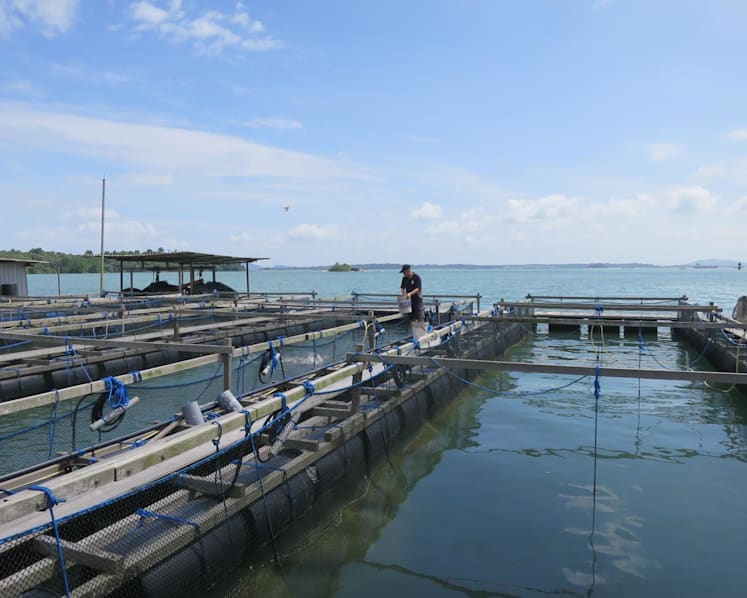
A floating fish farm in the waters off Singapore. (Photo: The Fish Farmer)

This audio is generated by an AI tool.


SINGAPORE: Singapore will inject S$70 million (US$55 million) over the next five years to help local farms expand production capacity and build capabilities, as the country steps up efforts to strengthen food resilience amid growing global uncertainties.
The new funding tranche under the Agri-Food Cluster Transformation (ACT) Fund was announced by Senior Minister of State for Sustainability and the Environment Zaqy Mohamad on Wednesday (Mar 4), as he laid out his ministry's spending plans this year.
Introduced in April 2021, the ACT Fund helps local farmers upgrade their operations, such as purchasing equipment and adopting technologies that improve productivity. With the extension, the scheme will be renamed ACT Fund 2.
The measure is part of the Singapore Food Story 2 strategy, unveiled in November last year, which aims to bolster food resilience through four pillars: diversifying imports, growing local, stockpiling and forging global partnerships.
Singapore currently imports more than 90 per cent of its food. That heavy reliance leaves the country exposed to supply chain disruptions caused by climate change, disease outbreaks and geopolitical tensions – making stronger local production a priority.
“We have learnt many lessons from our 30 by 30 initiative. While it had successfully catalysed local production growth, mainly focusing on one pillar – grow local – left us vulnerable to the very disruptions that we sought to address,” Mr Zaqy said.
“A single-pillar approach, no matter how ambitious, cannot provide the food supply resilience that Singapore needs.”
However, growing local produce remains an important pillar of our food resilience strategy, he added.
“Local farms can provide us with a regenerative source of food, of fresh food in fact, that is maintained even during prolonged disruptions. More of our farms are moving towards controlled environments which makes them more climate-resilient and land-efficient.”
Under new local production targets, Singapore will focus on fibre and protein types that are feasible to be produced at scale efficiently.






S$70 MILLION IN CO-FUNDING
Administered by the Singapore Food Agency (SFA), ACT Fund 2 provides co-funding support for farms to adopt advanced technologies, improve productivity and enhance climate resilience. It is Singapore's largest industry scheme for supporting local agriculture capabilities to date, Mr Zaqy said.
The first tranche of the ACT Fund was launched in 2021, with S$55 million awarded to 150 projects across 60 firms.
In response to a follow-up question by MP Nadia Ahmad Samdin, who asked for details of unsuccessful projects that had received funding, Mr Zaqy said that about two of the 60 companies had folded, representing a 3 per cent failure rate.
SFA has refined the scheme over the years based on industry feedback, expanding coverage to include marketing and branding expenses, as well as standalone pre- and post-harvest production facilities.
A new funding component - the Industry Partnerships for Capability Transformation Grant - will also be introduced. It is designed to support collaborations between farms and industry partners to develop shared, sector-wide solutions.
"This new funding component is introduced in response to feedback from the industry on the need for collaborative approaches to tackle common challenges, such as limited economies of scale and supply chain inefficiencies," SFA said in a joint factsheet with the Ministry of Sustainability and the Environment.
Farmers can apply for support over a five-year period starting from April 2026. Further details on the application process will be released later.
SUPPORT FOR AQUACULTURE
Beyond direct co-funding, SFA will step up support for technology adoption in aquaculture through demonstration projects.
These projects aim to test overseas farming technologies in real operating conditions similar to Singapore's small-scale, tropical marine environment before farms commit significant investments. Solutions that prove viable will be supported under ACT Fund 2.
The national breeding programme will be expanded to include red snappers, and the supply of whiteleg shrimp larvae and grouper fingerlings will be increased through industry collaboration.
SFA will also facilitate partnerships between local hatcheries and overseas breeders to bring in selected parent stock, breed them locally and supply farms with reliable post-larvae and fingerlings.
BOOSTING DEMAND FOR LOCAL PRODUCE
Recognising that commercial viability depends on sustained demand, SFA is also working to increase offtake of locally farmed produce.
The Singapore Agro-Food Enterprises Federation (SAFEF), which connects farmers, traders and food processing companies through commercial contracts, will expand its product selection under brands such as SG Farmers' Market to include more vegetable varieties and manufactured goods such as sauces and canned items.
It will also introduce new ready-to-eat marine tilapia products under The Straits Fish brand in collaboration with TheSeafoodCompany, and partner more food and beverage players to feature SG Farmers' Market products on their menus.
Meanwhile, the Farm-to-Table Recognition Programme – which recognises food operators that source at least 15 per cent of their produce from local farms in selected food categories – continues to grow. As of December 2025, 119 food businesses have joined the programme.




