







New massage parlour rules welcomed amid heartland concerns, but businesses worry about increased costs
Open-concept massage parlours will soon have to apply for a licence under tightened regulations for such businesses.
A person getting a massage. (File photo: iStock)

This audio is generated by an AI tool.


SINGAPORE: A move to tighten the licensing regime for massage parlours has been welcomed by those concerned about issues like heartland vice, but such businesses are worried about how they might be impacted.
Jalan Besar MP Denise Phua called the measures a "long-awaited response to the growing unhappiness among residents about such activities taking place at their doorstep".
She said agencies currently lack coordination and a “lack of teeth” to tackle the problem proactively – something she called "regrettable", as some tenants are legitimate businesses that can be distinguished from problematic ones through proper registration and checks.
“It is good that there will now be proper registration and audits, although that will require a fair amount of resources,” said Ms Phua, adding that residents and community groups will have to chip in.
The police announced on Tuesday (Apr 21) that open-concept massage establishments, which have been exempted from licensing since 2018, will no longer be exempted from the second half of this year.
Currently, such places only have to comply with conditions such as registering with the police and ensuring that there are no rooms, partitions or cubicles in their premises that would allow massage services to be administered in private.
Massage establishments are currently grouped into two licence categories. Category 1 includes those operating in HDB shophouses, shopping centres and hotels, while Category 2 covers shops located away from residential areas, schools and places of worship.
Open-concept massage parlours will be required to be licensed under a new Category 3 and subject to more stringent requirements, such as obtaining the relevant land-use approval from the Housing and Development Board (HDB) or Urban Redevelopment Authority.
Existing open-concept massage parlours will get a grace period to apply for and obtain a licence after the changes are implemented.





Mr Foo Cexiang, MP for Tanjong Pagar, said the changes address a longstanding frustration that when an establishment is shut down for illegal activity, another quickly takes its place.
“What we had observed previously was that after the police enforced against a tenant that was caught doing illegal activities and shut down, very quickly the shop is let out to another tenant who conducts similar activities,” he said.
Jurong East-Bukit Batok MP David Hoe, whose Clementi ward has a number of open-concept massage operators, welcomed the change.
“I'm glad that now there are higher barriers to entry, and there are certain compliances that they are supposed to accommodate and follow,” he said.
BUSINESSES WORRIED
Open-concept massage establishments told CNA they are worried the new rules will cost them business.
A masseuse at Eternal Health Center TCM in Clementi Avenue 2 said the shop's location already puts some customers off, as it is next to an eatery.
“Sometimes the queue stretches all the way until our shopfront. Some people may not want to get a massage here as diners are looking in while waiting for their food,” she said.
Another masseuse at a nearby shop, who declined to be named, was concerned about losing business with the tighter regulations.
Curtains in her premises are sometimes left closed at a customer's request, she said, as most customers are topless during a massage.
“If you have to lie here exposed to people passing by right outside, will you still want to get a massage here?” she asked.
An employee at Vigour Spa in the same estate said they would apply for a licence accordingly under the new regime and welcomed the implementation of a grace period.
“If they (the authorities) want us to change anything, we can do so without being immediately penalised.”
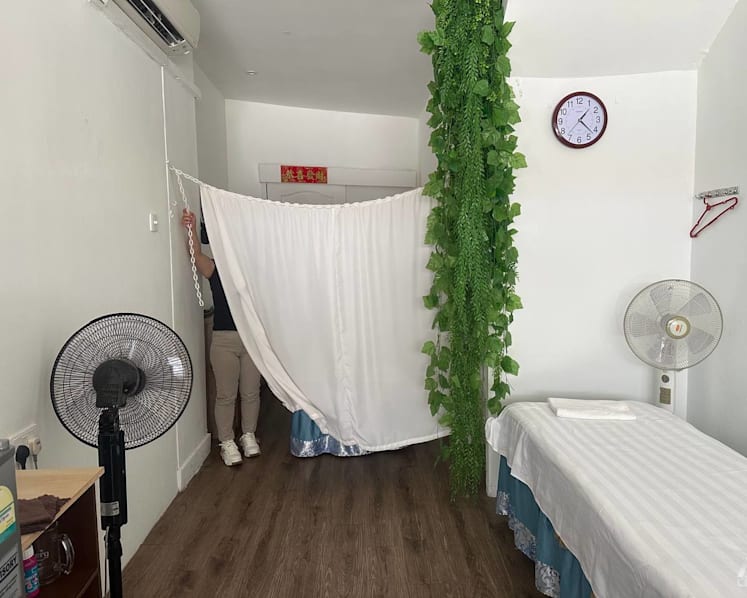
While there is a curtain in the shop which can be closed to block a massage bed at the back of the premises, the employee said it is typically just for customers to change.
“There are customers who say, ‘If you don’t close it, then I don’t want to do a massage anymore’. In such cases, we will just give them a refund and tell them to leave,” she said.
An owner of 10 massage establishments across the country, all with Category 1 licences, said the new Category 3 tier would hurt legitimate businesses.
“Those legitimate foot reflexology shops, for example, sometimes their staff will hop across various outlets to beef up manpower when needed,” said the industry veteran, who only wanted to be known as Mr Ang.
If the new licence tier works the same as the current regime’s requirements, each masseuse will only be allowed to work in one venue, said Mr Ang, who has been in the sector for 15 years.
The person will also have to go for an official massage course to get certified, which costs around S$1,000 each, he said.
Businesses may also incur renovation costs as there are other criteria to be fulfilled for the premises, such as fire safety requirements, he added.
CHANGING THE TENANT MIX
Some MPs are calling for more to be done to ultimately adjust the tenant mix in affected estates, beyond the massage establishments.
“At the end of the day, I think it's the tenant mix in an entire area that has residents feeling some level of discomfort,” said Mr Hoe.
As of January this year, about 8,500 HDB shops were privately owned, accounting for more than half of the roughly 15,600 HDB shops in Singapore.
The rest are directly rented out by HDB, with a majority being retail, food and beverage and services that support residents’ daily needs, such as coffee shops, laundromats, and household goods.
About 13 per cent of the HDB rental shops are beauty and wellness establishments, which include massage establishments, hair salons, beauty salons, and traditional Chinese medicine facilities.
But owners of privately owned shops do not have to inform HDB when renting them out.
Mr Hoe questioned whether free market allocation brings the most desirable outcome.
“Evicting them doesn't solve the problem because someone else comes in with the same nature of services. For the people living there, it affects their perception of safety, quality of life and livability,” he said.
He hopes that the Ministry of National Development can play the role of town planner in older estates like his, just as it does in newer Build-to-Order estates.
Another point he hoped would be considered for new operators’ applications is whether there is an overconcentration of any particular type of service in the area, and if there are other basic needs or services lacking for residents.
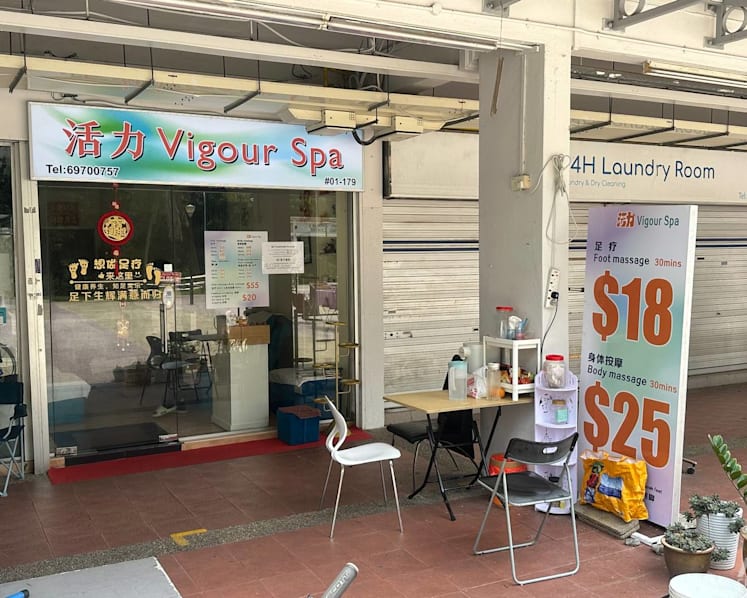
The police have seen an increase in vice-related activities and infringements of exemption conditions in open-concept massage establishments.
Because his ward is located near the city centre, Mr Foo said he faces the issue of people travelling there specifically for vice activity.
“From our perspective, first and foremost, it shouldn't be happening right in the middle of the heartlands where young families are residing,” he said.
“As to greater awareness against the harms or risks associated with such vices, I think that is an important part of overall public education as well. I'm also mindful that within a modern city like Singapore, it's very difficult to completely weed out such activities.”
Ms Phua said that residents have raised concerns about the growing number of massage establishments in their estates, notably over the past two years.
“During my house visits, residents shared that visible solicitation activities outside some of these establishments made walking home or walking by these shops feel uncomfortable,” she said.
Residents have also asked for other businesses, like childcare centres, senior activity centres or gyms, which they feel better support “a family-friendly living environment”, said Ms Phua.
THE RIGHT LICENCE
Mr Hoe noted that massage operators should choose the licence that suits their operations, such as whether to have an open-concept venue or one with private spaces.
“You choose a licence, and it permits you to provide certain services. People who then choose to purchase that service, must definitely know what they are buying. If you want a curtain or a room, then you pay a premium so that you have your level of security and privacy,” he said.
“If this licence caters to this particular profile of consumers and you want something else, then change your licence to the one that serves that purpose. We shouldn't breach the licence just because the consumer wants something else. That’s fundamentally wrong.”
He also called for a greater level of clarity in the new licence to avoid any grey areas.
Mr Foo refuted sentiments that the new licensing regime would prevent open-concept massage establishments from doing business as per normal.
“What it basically means is not that you're not allowed to do it, it's just that you need a licence from the police. So actually this concern is a red herring.”
Another way to make the new legislation effective is the punishment, said industry veteran Mr Ang.
“The punishment has to be high enough to be a deterrent,” he said. “If, let’s say, the punishment is a mandatory jail term, then it will more likely eradicate the problem.”




