







New 15% US tariff likely to apply to Singapore, says DPM Gan Kim Yong
Singapore is seeking clarity from Washington on implementation details, including whether processes for tariff refunds will be put in place.
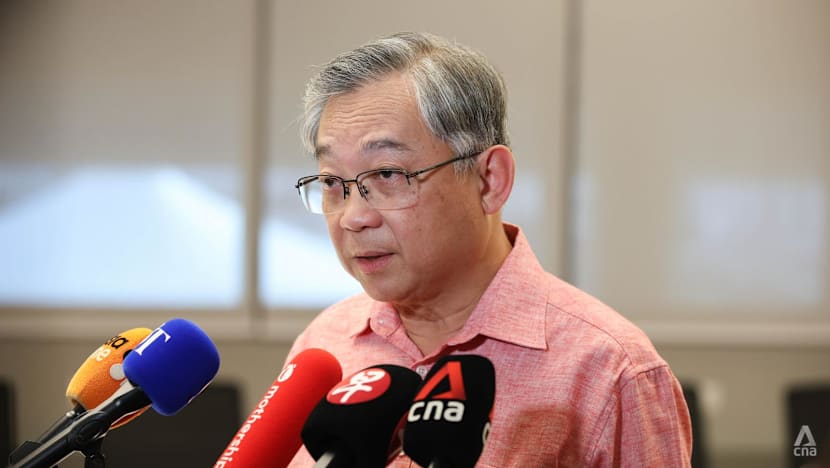
Deputy Prime Minister Gan Kim Yong speaks to the media at One Punggol on Feb 22, 2026. (Photo: CNA/Ili Mansor)

This audio is generated by an AI tool.


SINGAPORE: Singapore is likely to fall under a new United States tariff of 15 per cent on all imports, Deputy Prime Minister Gan Kim Yong said on Sunday (Feb 22), urging the country to prepare for a fundamentally changed global trade environment.
Mr Gan's comments came after US President Donald Trump announced the rate increase from an earlier 10 per cent. Details of how the new tariff will be implemented have yet to be released by Washington.
"It is important for us to continue to remind ourselves ... we need to prepare for the long term, and this is the new world that we are facing," Mr Gan told reporters during a media interview at One Punggol Community Centre.
"Our economic strategy review plays a very important part in charting the path forward to strengthen our competitiveness and deepen our resilience, and this is an important part of the work," said Mr Gan, who is also Trade and Industry Minister.
On Friday, the US Supreme Court struck down the president's "Liberation Day" tariffs, ruling that the International Emergency Economic Powers Act did not grant him the authority to impose them.





The White House responded by invoking Section 122 of the Trade Act of 1974, ordering a 10 per cent global tariff for 150 days from Feb 24 – before Mr Trump announced on his Truth Social platform the rate would be lifted further to 15 per cent.
Section 122 permits the US president to impose temporary import tariffs or quotas to address serious balance-of-payments deficits, at rates not exceeding 15 per cent, for a maximum of 150 days.
Certain products are exempted from the new tariffs, including energy products, pharmaceuticals and active pharmaceutical ingredients, some electronics and aerospace items, as well as metals used in currency and bullion. Semiconductors and pharmaceuticals are excluded as they may fall under separate Section 232 tariffs, which have not yet been implemented.
The Ministry of Trade and Industry said it is monitoring developments and will seek clarity from US authorities on implementation details, including whether processes for tariff refunds will be put in place.
The ministry noted that according to US Census Bureau data, the US ran a goods trade surplus of US$3.6 billion with Singapore in 2025, higher than the surplus of US$1.9 billion in 2024.
IMPACT OF TARIFFS
Asked for his assessment of the new tariff's impact, Mr Gan said this depended on details of how it was implemented and how the rest of the world will react.
"But I would say that if the tariffs applied across the board, then it doesn't affect the relative competitiveness, and therefore, I think (there will still be) opportunities for Singapore to be able to continue to do business with the US.
"But at the end of the day, tariffs also mean higher costs globally, and with higher costs, it will slow down economic investments. It will slow down trade ... and therefore, I think there will be headwinds going ahead. So this is something that we have to always bear in mind."
What is more critical is the uncertainty arising from the tariffs, Mr Gan said, noting Section 122's 150-day time limit and possible changes during this period.
Responding to a question on whether Singapore might fall outside the legal grounds for tariffs, Mr Gan discouraged Singaporeans from thinking that way, pointing to how the US administration had been able to maintain its tariff structure through various approaches.
"It may not be exactly what it looks like today, may be some other shapes or forms, but I think it will be unproductive for us to assume that we are going to get out of this tariff structure anytime soon ... better for us to accept the fact that we are going to have to live with this uncertain world going forward," he added.

Asked about Singapore's likely reaction if 15 per cent tariffs were implemented, Mr Gan said this would depend on whether the levy was applied across the board. If so, it would be very difficult to negotiate for an exemption, he added.
"So it is also important for us to think about what are our alternatives, how we can look for new markets, how we can go for higher value-added products, or whether we can focus on some of the sectors that the US will need and would ... give exemption on this tariff."
He added that the situation was fluid and required Singapore to be nimble, flexible and adaptable.
The Ministry of Trade and Industry (MTI) said that the government will work with tripartite and industry partners through the Singapore Economic Resilience Taskforce to provide timely information to businesses and workers, and gather feedback on how they are affected.
MTI and Mr Gan also referred to the series of measures rolled out during Budget 2026 to support companies and other entities. These include a corporate income tax rebate to help manage costs, and enhanced support for companies to expand overseas.
Mr Gan said these measures will be sufficient to weather the immediate impact of tariffs, but added that it was important to continue to help firms navigate through the uncertainty and volatility.
On whether the latest move by the US will affect the GDP growth forecast, Mr Gan said the government will relook and revise the forecast if necessary and share it with Singaporeans in time to come.
Singapore's economy is expected to grow by 2 per cent to 4 per cent this year, up from the previous forecast of 1 per cent to 3 per cent.




