







Nearly 1 in 5 workers in Singapore 'overqualified' for their jobs; rate below average of high-income nations: MOM
The vast majority of overqualified roles in Singapore appear to be voluntary, according to two studies by MOM and NTUC.
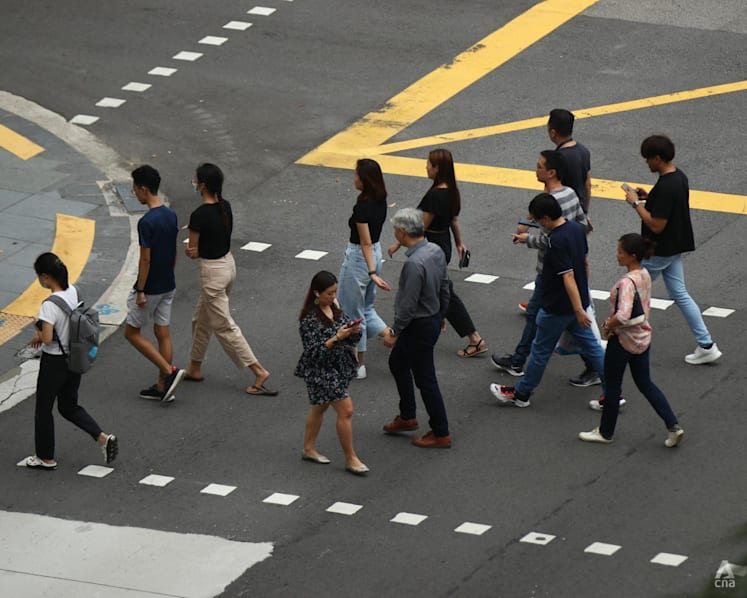
File photo of people crossing the street at the central business district (CBD) in Singapore. (Photo: CNA/Syamil Sapari)

This audio is generated by an AI tool.


SINGAPORE: Nearly one in five Singapore workers was overqualified in 2025, though this rate remains lower than in other high-income economies, according to a study by the Manpower Ministry (MOM) that was released on Tuesday (Apr 14).
A "vast majority" of these cases on overqualification were voluntary "due to workers choosing roles that better align with their aspirations, work preferences or life circumstances", said MOM and the National Trades Union Congress (NTUC) in a joint statement.
Involuntarily overqualified workers make up just 1.7 per cent of the resident workforce here, the statement said. This means they were unable to find jobs that matched their qualifications.
MOM's study is part of a report on overqualification, which refers to a worker holding an academic qualification that is higher than what is required for the job. NTUC also released a second study on overqualification, which had similar findings to MOM's report.





According to the joint release, 19.4 per cent of Singapore’s resident workforce were overqualified in 2025 - below the average of 21.6 per cent across high-income countries such as the United States, Finland, the United Kingdom and Switzerland.
This is despite Singapore having a more highly educated workforce, with 64 per cent holding tertiary qualifications, compared with an average of 41.2 per cent in other high-income economies.
MOM’s study used an internationally comparable measure developed with the International Labour Organization, which assesses whether a worker’s highest qualification exceeds the level typically required for their occupation.
The findings are based on data from the Comprehensive Labour Force Survey, which covered about 33,000 households in Singapore.
NTUC’s study, conducted with about 1,100 Singapore citizens and permanent residents in October 2025, complemented this with survey-based and self-assessed indicators such as skills, qualification and field-of-study mismatches to provide a broader picture of underemployment.
The statement said the pair of studies shed light on where there may be "under-utilisation of human capital", but also need to be seen in the context of "a fast-changing world with shortening half-lives of skills".
"The skills and knowledge acquired in tertiary education must be refreshed by new skills and experiences, including those acquired in workplaces," said the statement.
DRIVEN BY CHOICE
Among overqualified workers, about nine in 10 – or 17.7 per cent of the workforce – were in roles below their qualification levels, often due to preferences such as work-life balance, flexibility or career transitions.
According to MOM, the share of involuntarily overqualified workers (1.7 per cent) has remained low and stable – at below 3 per cent – over the past decade, suggesting limited structural mismatch in the labour market.
Those who voluntarily take on roles below their qualifications most commonly cite job stability (31.1 per cent), the ability to use their skills (25.3 per cent), and interesting work (24.4 per cent). Others prioritise flexible arrangements such as suitable working hours and flexible schedules, highlighting a wide range of personal motivations.
“These workers may potentially be matched to roles that better align with their qualifications if more flexible work arrangements were available,” the MOM report said.
MOM's report said that the findings suggest that many overqualified workers choose jobs that do not fully use their qualifications because they value other aspects such as stability, flexible hours, opportunities to gain experience, or incentive-based pay.
NTUC Assistant Secretary-General Patrick Tay said many workers are making deliberate career choices that prioritise flexibility, fulfilment, or life-stage needs, reflecting a labour market that offers diverse pathways rather than one that is structurally misaligned.
MOM’s report also found that overqualification was more common among younger workers, particularly those early in their careers.
Among those who are involuntarily overqualified, more than one-third are under 35.
The report noted that this is likely because they are still building experience for more desirable higher-level positions, before moving into jobs that better match their qualifications.
For older workers aged 60 and above, a higher proportion are voluntarily overqualified, suggesting some choose to take on less demanding roles or explore alternative career options as they transition towards retirement.


TERTIARY GRADUATES CONTINUE TO SEE FAVOURABLE OUTCOMES
MOM said Singapore’s labour market has continued to absorb a growing pool of graduates, with employment outcomes remaining favourable.
Median gross monthly income for full-time employed tertiary graduates rose from S$5,800 (US$4,555) to S$7,605 over the past decade, while starting salaries have also increased over the same period.
The studies also highlighted a shift in hiring trends, with employers placing greater emphasis on skills and experience over academic qualifications.
In 2025, academic credentials were not the main consideration for nearly 80 per cent of job vacancies. Instead, employers prioritised relevant experience (48.2 per cent) and skills (20.1 per cent).
At the same time, employers continue to face difficulties filling roles requiring specialised expertise, such as data scientists, teaching and training professionals, and civil engineers, pointing to skills gaps in the workforce.
About a quarter of employers (24.3 per cent) reported experiencing skills shortages, which have led to heavier workloads for other employees and challenges in meeting quality standards.

Taken together, the findings point to differences in perspective between workers and employers, said MOM and NTUC in the joint release.
“While a segment of workers report being in roles that do not fully utilise their qualifications, employers continue to face challenges filling roles requiring specific skills,” the release said.
“This suggests the key issue is not excess qualifications per se but ensuring that workers’ skillsets remain aligned with evolving job requirements.”
MOM Deputy Secretary (Workforce) Kenny Tan said both workers and employers have a role to play, with workers needing to continuously update their skills, and employers encouraged to redesign jobs and offer flexible arrangements to better attract and retain talent.
The government will continue to strengthen efforts in areas such as reskilling, career guidance and job matching, including through initiatives like Career Health SG and the upcoming Skills and Workforce Development Agency, he said.
NTUC said more can be done to support workers across different life stages, including targeted help for early-career individuals, greater emphasis on multi-skilling, and programmes to help workers transition into new career phases.
It also proposed initiatives such as community-based employment co-operatives, support for working parents and caregivers, and a broader approach to measuring underemployment that captures skills, qualifications and job mismatches more fully.




