







Singapore's climate strategy 'playbook' remains the same in a fragmented world: Janil Puthucheary
Senior Minister of State for Sustainability and the Environment Janil Puthucheary said Singapore’s approach to climate change follows its water story and military defence.
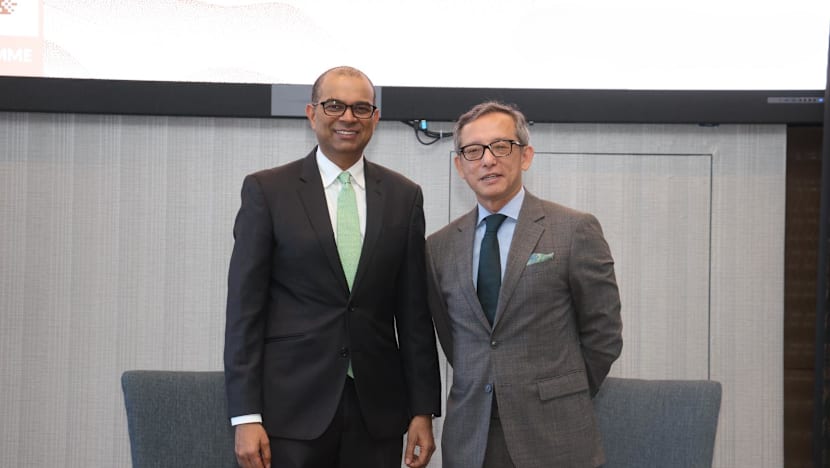
Senior Minister of State for Sustainability and the Environment Janil Puthucheary (left) spoke at the second Singapore Green Dialogue on Feb 11, 2026, at a session moderated by Singapore Institute Of International Affairs chairman Simon Tay. (Photo: Singapore Institute Of International Affairs)

This audio is generated by an AI tool.


SINGAPORE: In a turbulent world, Singapore is approaching climate change using a strategy that has guided its response to other challenges such as water security and military defence, Senior Minister of State for Sustainability and the Environment Janil Puthucheary said on Wednesday (Feb 11).
He anchored Singapore’s climate strategy in frameworks that previously guided its approach to both matters. The approach: secure survival first, build expertise, and where possible, convert capability into economic value.
"We start on the basis of our priorities, our own survival ... whether it was how we dealt with water, build up of our military capability, 50, 60 years ago, how we put in place economic tools and manage our reserves," Dr Puthucheary said.
Doing this well would give Singapore “table stakes” at developing international partnerships, where it can then argue its case for the right way to move things forward at international platforms, Dr Puthucheary said.
Another priority would be to derive economic value. He pointed to Singapore’s water story as an example of the "playbook" that Singapore has employed.
"We started off as one of the most water-stressed nations, and today, very different situation. We are still reliant on imported water, and so that sense of water insecurity is still there," he added.
"But that has not stopped us then extracting significant economic value, the whole ecosystem of water companies, and neither has it stopped us having internal confidence in our water supply."
Underpinning this was recognition that no single strategy, technology, or investment would be sufficient, said Dr Puthucheary.
Capability development in this sector also necessitated building relationships between the private sector and agencies that supervised related policy, and investments into human capital to build up experts who could "extract maximum value".
Singapore intends to take the same approach towards climate adaptation, Dr Puthucheary said.
The senior minister of state was speaking at the second Singapore Green Dialogue, organised by the Singapore Institute of International Affairs.
More than 100 policymakers, corporate leaders, investors and experts attended the event at Republic Plaza.
The dialogue, themed “sustainability in a fragmented world”, examined Singapore’s position amid geopolitical flux, with Dr Puthucheary invited to discuss how the country could sustain its climate commitments in a turbulent global environment.

ADAPTATION FINANCING
Dr Puthucheary said that nature would “force our hand” and that countries would have to turn to adaptation if they did not get mitigation right.
"Notwithstanding the more challenging geopolitical environment, Singapore remains committed to staying the course in our efforts to address climate change. But we need to be prepared, particularly if global mitigation falls short," he added.
Singapore has already started its climate adaptation efforts, particularly developing its inaugural National Adaptation Plan, which Dr Puthucheary said will chart Singapore’s long-term strategy to build resilience and adapt to the impacts of climate change.
An audience member asked how the government intended to work with the private sector to catalyse adaptation finance, given the tightening fiscal space.
Dr Puthucheary acknowledged that public financing alone would not be sufficient.
The government is exploring ways to crowd in private capital through instruments that reduce capital risk, he said. One example is the Financing Asia’s Transition Partnership (FAST-P), a Singapore-led blended-finance platform that uses public funds to draw in private capital.
He hypothesised that businesses would increasingly factor climate risks into their planning, with adaptation considerations embedded in risk assessments.
"Investments in infrastructure and capability development and risk reduction from businesses will come and match the public sector financing," he added.
Dr Puthucheary also reiterated that the government has not made a decision on deploying nuclear energy, but is building up safety and monitoring expertise.
Emerging technologies such as small modular reactors are being studied, but they remain commercially unproven, he said. Safety exclusion zones also pose additional challenges in land-scarce Singapore.

A FRAGMENTED WORLD
Globally, the climate action landscape has become more complex. The US’ withdrawal from the Paris Agreement and renewed emphasis on fossil fuels have introduced additional uncertainty.
The Paris Agreement, which came into force in 2016, aims to tackle rising global temperatures through national commitments, but US President Donald Trump pulled out of the agreement in January this year.
Instead of despondency, however, many parties decided to double down on their commitments, Dr Puthucheary noted.
"Implementation of renewable sources of energy has increased significantly and continues to increase significantly.
"And investments in these are outstripping GDP (gross domestic product) growth or inflation. So follow the numbers and you have a slightly different story."
He added: "We should continue to believe that we have agency, we have the ability to make a difference."
But he observed that geopolitical turbulence was unlikely to be temporary.
"What is happening internationally, the turbulence, the uncertainty, it's not a small blip. It's not going to change in one electoral cycle. It's a permanent, structural shift."
After Dr Puthucheary's dialogue, two panels were convened where both private and public sector leaders discussed diverging international standards but noted growing collaboration and harmonisation across jurisdictions.
Dr Bambang Brodjonegoro, the dean and CEO of the Asian Development Bank Institute, also spoke at the keynote dialogue.
He said Southeast Asia had the opportunity to shape pragmatic pathways for sustainable development.
"The critical question for ASEAN is not whether to engage with sustainability standards, but how to do so in a way that preserves competitiveness and supports development in a fragmented global environment,” Dr Brodjonegoro said.
“One key priority is regulatory interoperability by strengthening regional alignment and common frameworks.”




